Ubud Travel Guide + Central Bali – The first thing you notice in Ubud isn’t the traffic or the art galleries—it’s the rhythm. The faint sound of gamelan music drifting from a temple courtyard, the smell of incense curling skyward from daily offerings, and the sight of terraced valleys carved in green perfection all work together to remind you: this is the beating heart of Bali.
Ubud: Bali’s Beating Heart
For decades, Ubud has been described as Bali’s cultural capital—a place where art, spirituality, and nature coexist. But to reduce Ubud to a single town is to miss its true essence. Ubud is not just a destination—it’s the gateway to the Central Bali highlands, a living cultural landscape that stretches outward in every direction.
In Ubud, culture is not performed for you. It unfolds around you.
The Cultural Core
At its center lies Ubud town, with its vibrant art markets, royal palace, and Monkey Forest. Surrounding it, villages like Mas, Celuk, and Batuan continue centuries-old traditions of woodcarving, silversmithing, and painting. Just a short ride north, the sacred waters of Tirta Empul bubble from the earth, while the cliff-cut shrines of Gunung Kawi whisper stories from the 11th century. This is where culture in Ubud is not just heritage—it’s daily life.
🌿 Immerse, don't Explore
Ubud is not a “checklist” destination—it’s an experience to be soaked slowly, like tea steeping in hot water. Rushing through temples and terraces in a single day misses the point. Stay longer, explore deeper, and you’ll discover that Central Bali is more than sights—it’s a rhythm of life.
The Highland Arc
Travel further, and the landscape shifts with the altitude. The volcanic ridges of Kintamani cradle Mount Batur and its shimmering caldera lake, a sunrise pilgrimage for adventurers. To the west, the misty ridges of Bedugul hold twin lakes and the iconic water temple of Ulun Danu Beratan. Even more hidden are the highlands of Bongkasa, Carangsari, Petang, and Pelaga, where cool air drifts over bamboo forests and rivers perfect for rafting or cycling.
And for those willing to venture deeper, the rice terraces of Jatiluwih and Pupuan reveal agricultural masterpieces that rival the more famous Tegallalang, but without the crowds.
From Ubud’s royal palace to Pupuan’s misty terraces, Central Bali is where culture and nature embrace.
The Scope
This Central Bali travel guide covers not just Ubud town but also its cultural satellites and natural highlands:
- Ubud & Tampaksiring – arts, temples, wellness, sacred springs.
- Bangli & Kintamani – Mount Batur, Lake Batur, ancient villages.
- Bongkasa–Pelaga corridor – eco-villages, agro-tourism, bamboo forests.
- Bedugul & Jatiluwih – cool lakes, water temples, rice terraces.
- Pupuan highlands – untouched rural beauty, coffee, and cocoa.
Together, these areas form the Ubud & Central Highlands cluster—a region where Bali’s most iconic experiences meet its most authentic secrets.
Why Ubud Matters
For travelers, Ubud is both anchor and springboard:
- Stay in Ubud to enjoy world-class dining, boutique shopping, yoga retreats, and nightly temple dances.
- Venture outward for rice terraces, ancient temples, highland adventures, and cultural immersion.
- Design an Ubud itinerary that balances comfort and exploration, art and nature, wellness and adventure.
It is this duality—cosmopolitan yet traditional, convenient yet surrounded by wilderness—that makes Ubud the heart of Bali.
Your Ubud Travel Companion
You’ll find plenty of blog posts about “top 10 things to do in Ubud” or “best Bali waterfalls.” But this is not just another list. This is the only Ubud travel guide you’ll need:
- A comprehensive resource that covers town, temples, villages, and highlands.
- A practical companion with recommendations, tips, and itineraries.
- A storytelling journey that brings Ubud to life through sensory detail and insider knowledge.
Think of this guide as your compass—whether you’re planning from home or wandering the rice terraces.
Insider’s Picks: What to Expect in Ubud & Central Highlands
- Adventure: rafting, cycling, hiking, sunrise treks.
- Wellness: yoga retreats, healing, slow living.
- Cuisine: from traditional warungs to fine dining with a jungle view.
- Culture in Ubud: temple ceremonies, royal heritage, artisan villages.
- Nature in Bali highlands: volcanoes, lakes, waterfalls, rice terraces.
 Related Reads:
Geography & Orientation – Mapping Bali’s Heartlands
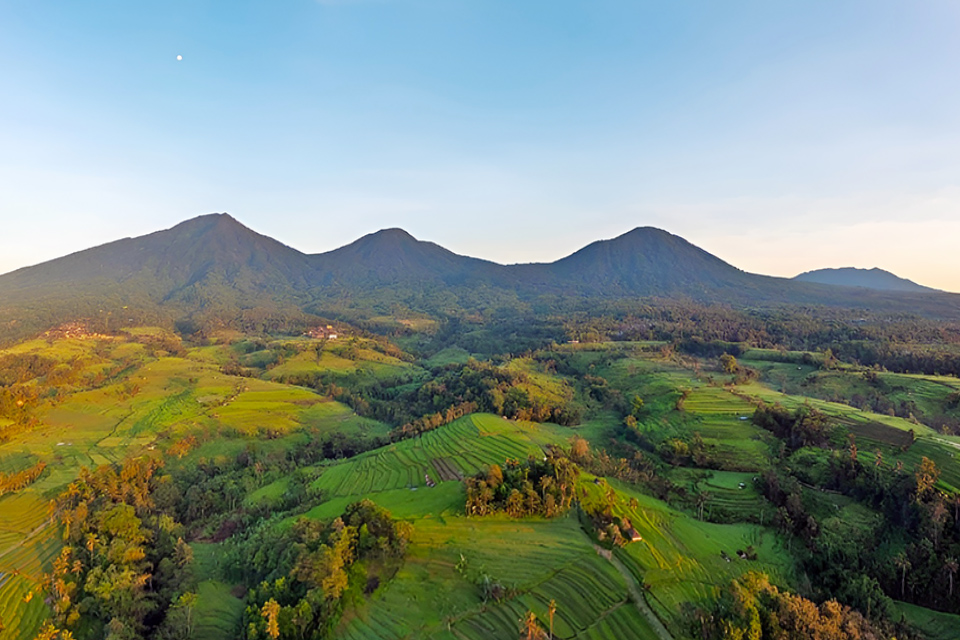
If Bali were a living body, Ubud would be its heart and the Central Highlands its vital arteries—channels of rivers, ridges, and rice terraces that sustain the island’s rhythm.
The location of Ubud is both central and strategic. Nestled about 35 km north of Denpasar (roughly 1.5 hours by car), Ubud feels worlds apart from the bustle of South Bali. To the north rise volcanic ridges, to the west roll the rice terraces of Jatiluwih and Pupuan, while the south and east gradually slope into fertile valleys. This geography is what makes Ubud more than just a cultural hub—it’s a gateway to nature.
Ubud is where Bali’s rivers carve deep valleys, and where roads lead you upward to the cool embrace of the highlands.
Reading the Land
Bali’s geography is spiritual as much as physical. In Balinese cosmology, mountains are the sacred realm of gods, rivers are life-giving arteries, and rice terraces are living temples of fertility. When you explore Ubud and Central Bali, you’re not just moving through space—you’re moving through a sacred landscape.
Orientation: Where is Ubud?
- From Denpasar Airport (Ngurah Rai): about 1.5–2 hours depending on traffic.
- From South Bali (Seminyak, Canggu, Sanur): 1–1.5 hours drive.
- From North Bali (Lovina, Singaraja): 2.5–3 hours drive over winding mountain passes.
- From East Bali (Sidemen, Tirta Gangga): about 1.5 hours.
Ubud sits at the meeting point of valleys and ridges, fed by the Ayung River to the west and the Petanu River to the east. These waterways not only shape the dramatic topography but also supply the irrigation for Bali’s UNESCO-listed subak rice terrace system.
Insider’s Tips – Orientation Made Easy
- Base in Ubud town if you want easy access to both culture and day trips.
- Stay in the highlands (Kintamani, Bedugul, Jatiluwih) if you prefer cool air and nature immersion.
- Plan driving times generously—Bali’s winding roads and ceremonial processions can add hours.
Best map strategy:
think in corridors as follow.
- South to Ubud (cultural heartland).
- Ubud to Kintamani (volcano corridor).
- Ubud to Bedugul–Jatiluwih (lake and terrace corridor).
Highlands & Horizons
Look north from Ubud, and the horizon is dominated by Mount Batur (1,717 m), its caldera shimmering with Lake Batur—a sacred site and a natural wonder. Beyond lies Mount Agung, Bali’s highest and most revered volcano. To the northwest, the Bedugul highlands cradle Lake Beratan, Lake Buyan, and Lake Tamblingan, surrounded by cool forests and farmland.
Central Bali’s geography is an ever-shifting canvas—volcanoes at sunrise, rice terraces at noon, misty lakes at dusk.
Meanwhile, the Jatiluwih and Pupuan terraces spread like green staircases down the slopes—living proof of how the Balinese have harmonized with their dramatic geography for centuries.
Climate & Atmosphere
Ubud and the Central Highlands enjoy a climate that contrasts sharply with the tropical heat of Bali’s coasts.
- Ubud town (200–300 m above sea level): warm and humid, with daily temperatures averaging 24–30°C.
- Highlands (600–1,200 m in Bedugul, Kintamani, Pelaga): noticeably cooler, especially at night, with temperatures dropping to 15–20°C.
The result? A dual climate experience: tropical valleys perfect for rice and river adventures, and refreshing highlands ideal for trekking, cycling, and slow retreats.
Insider’s Picks – Geography Highlights
- Petanu River: quieter and mystical, tied to ancient legends.
- Mount Batur & Lake Batur: sunrise treks and lakeside hot springs.
- Jatiluwih Rice Terraces: UNESCO World Heritage, vast and tranquil.
- Ayung River: Bali’s most popular rafting route, carving jungle-clad gorges west of Ubud.
- Bedugul Lakes: temple on the water, strawberry fields, and cool forests.
Cultural Heritage & Ancient Temples
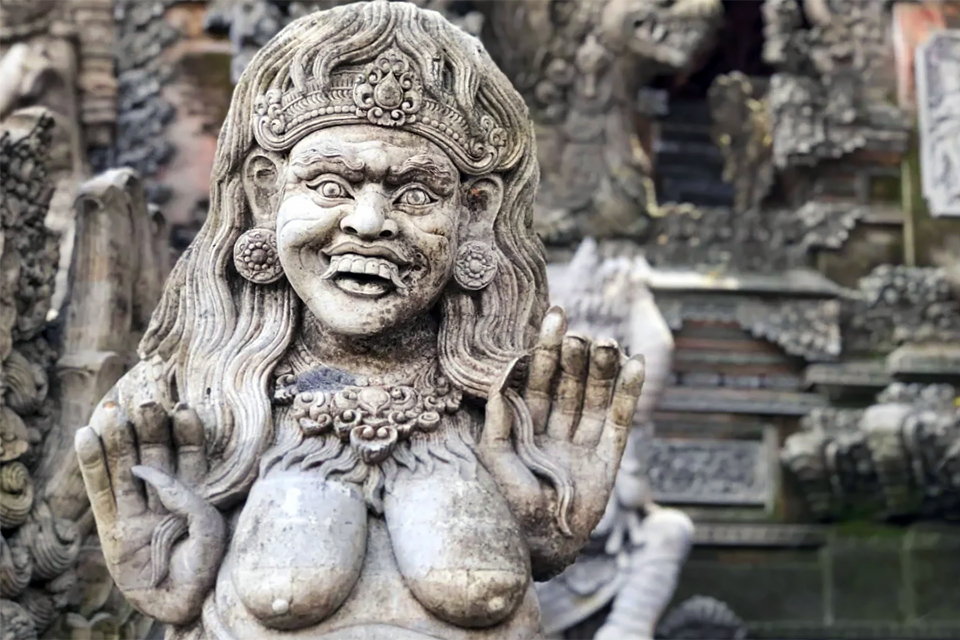
The sound of flowing water, the fragrance of frangipani blossoms, the faint echo of gamelan carried by the breeze—Ubud’s valleys are not only beautiful, they are storied landscapes where myth, archaeology, and daily ritual intertwine.
Sacred Landscapes, Eternal Stones
Nowhere is this more evident than in the sacred heartlands of Central Bali. Here, temples are not merely monuments; they are living centers of devotion, woven seamlessly into rice fields, river gorges, and forested hillsides. For travelers who seek to understand Ubud beyond yoga studios and art markets, exploring its ancient temples and remains is a journey into the roots of Balinese civilization.
In Ubud, temples are not ruins to admire from a distance—they are doorways into a timeless rhythm, where stone, water, and devotion meet.
The Petanu River Valley, running east of Ubud, holds particular significance. Archaeologists and historians trace some of Bali’s earliest kingdoms to this region, where reliefs, hermitages, and temple complexes hint at a time when Hindu-Javanese influences fused with local animist traditions. These sites are not frozen in the past; they remain vital to Balinese spiritual and social life, animated by festivals, cremations, and purification ceremonies.
Insider’s Insight – The Significance of Ubud’s Temples
- They reveal the blend of history and spirituality: from 9th-century hermitages to 14th-century stair-temples.
- They connect travelers to rituals still practiced today: water purification, banjar gatherings, and ancestral offerings.
- They are geographically layered: from riverside caves to volcanic shrines carved into cliffs.
Petanu Valley Civilization – Roots & Legends
According to Balinese mythology, the Petanu River was once cursed after a legendary battle, its waters running with blood for a century. Whether myth or allegory, the valley became home to Bali’s earliest known temples and hermitages, reflecting a civilization that aligned itself with both sacred geography and cosmic order.
Here, kings commissioned sanctuaries carved into cliffs, while priests sanctified springs believed to flow from the earth’s veins. The Petanu Valley today is an open-air archive: Goa Gajah, Yeh Pulu, Samuan Tiga, Gunung Kawi, and Tirta Empul are clustered within just a few kilometers—an unparalleled concentration of ancient spirituality.
Goa Gajah – The Elephant Cave


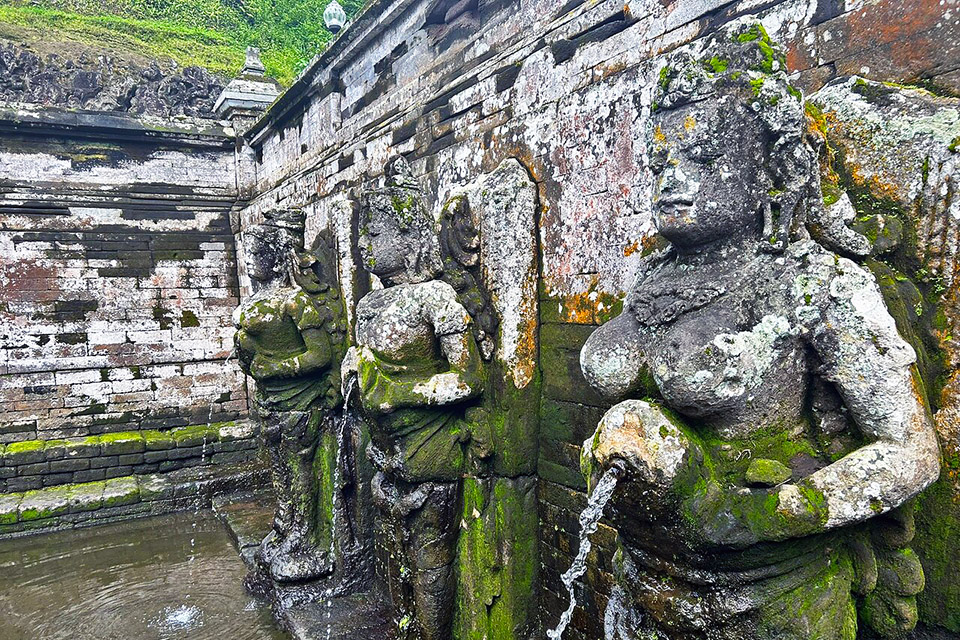
At the edge of Ubud’s southern valley, Pura Goa Gajah greets visitors with its iconic demon-faced entrance. Built as a hermitage and sanctuary in the 9th century, the cave was used for meditation by Hindu and Buddhist sages. The reliefs at the entrance—snarling monsters and divine figures—serve as guardians, symbolizing the threshold between the mundane and the sacred.
Goa Gajah is less about grandeur and more about atmosphere—its mossy stones whispering of a thousand meditations past.
Inside, the narrow stone chamber contains lingam and yoni symbols (Shiva worship) alongside Buddhist stupas, illustrating a period of religious syncretism. Outside, bathing pools with carved stone spouts invite purification.
Insider’s Tips – on Visiting Goa Gajah
- Best visited early morning to avoid crowds.
- Combine with Yeh Pulu and Samuan Tiga for a “Petanu trilogy” half-day tour.
- Modest dress is required (sarongs available at entrance).
Yeh Pulu – Carved Stories of Daily Life
A short walk from Goa Gajah lies Relief Yeh Pulu, a cliffside relief stretching 25 meters, depicting hunters, farmers, nobles, and mythological beings. Unlike many temples that focus solely on deities, Yeh Pulu offers a snapshot of 14th-century Balinese life.
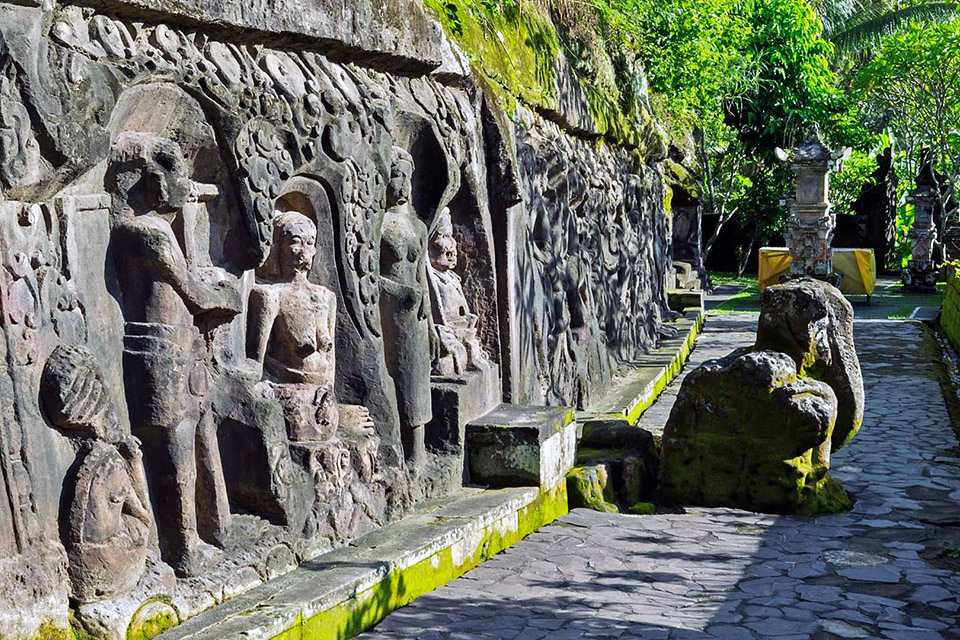
For art lovers, it’s an invaluable piece of visual storytelling; for travelers, it’s a quieter, more contemplative site often overlooked in itineraries.
Insider’s Tips – on Exploring Yeh Pulu
- Ideal for travelers interested in Balinese art and archaeology.
- Hire a local guide for stories behind each carving.
- Pair with Goa Gajah for a full cultural morning.
Insider’s Insight – on Visiting Samuan Tiga
- A living temple central to Bali’s social fabric.
- Visit during festivals (ask locally for dates).
- Less touristy than Tirta Empul or Gunung Kawi.
Samuan Tiga – The Temple of Reconciliation
In Bedulu village stands Pura Samuan Tiga, where Bali’s ancient councils are believed to have met to reconcile competing sects. Legend holds that this is where the banjar system—the cornerstone of Balinese community organization—was formalized.
Today, the temple hosts the grand Siat Sampian ritual, where devotees playfully battle with coconut-leaf offerings in a vibrant expression of renewal.
Tirta Empul – The Sacred Springs


In Bedulu village stands Pura Samuan Tiga, where Bali’s ancient councils are believed to have met to reconcile competing sects. Legend holds that this is where the banjar system—the cornerstone of Balinese community organization—was formalized.
Today, the temple hosts the grand Siat Sampian ritual, where devotees playfully battle with coconut-leaf offerings in a vibrant expression of renewal.
Step into Tirta Empul and you step into living faith—where every drop of water carries a blessing.
Insider’s Tips – to Understanding Tirta Empul
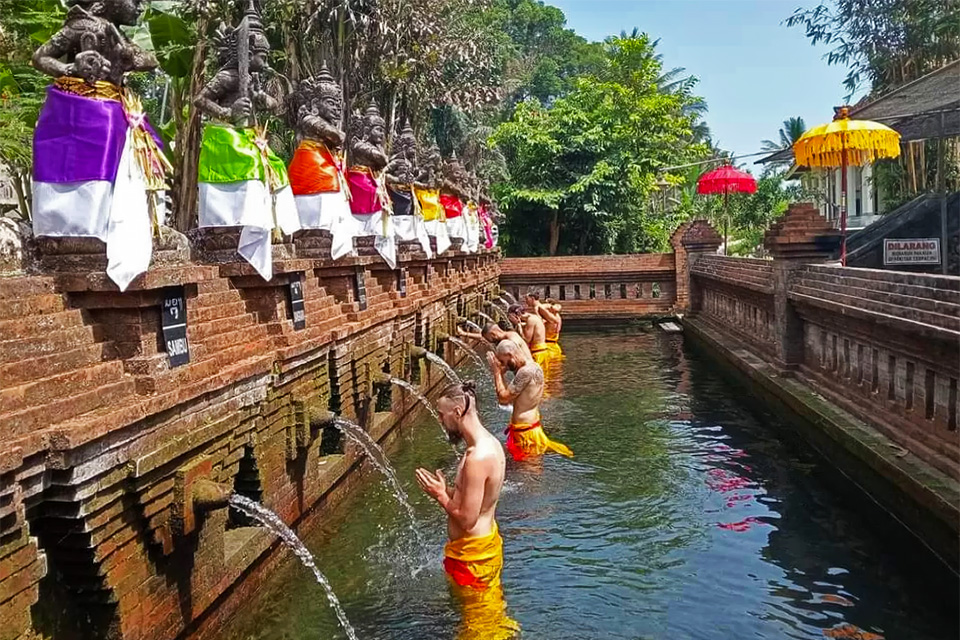
- Arrive with time to participate in purification (guides can help with ritual order).
- Bring a change of clothes if joining the bathing ritual.
- Visit early morning or late afternoon to avoid tour crowds.
Insider’s Tips – to Visiting Gunung Kawi
- Combine with Tirta Empul (5 minutes apart).
- Best light for photography: early morning.
- Allow at least 1–2 hours for exploration.
Gunung Kawi Tampaksiring – Rock-cut Shrines

Descending into the Petanu gorge, travelers encounter Gunung Kawi Temple, Bali’s most impressive rock-cut temple. Ten massive candi (shrines) are hewn directly into cliff faces, each over 7 meters tall. Dedicated to King Anak Wungsu and his queens (11th century), Gunung Kawi represents both architectural feat and devotional offering.
The walk down rice-terraced steps and across a river makes the site feel like a pilgrimage in itself. Ritual activity continues, blending ancient kingship with present-day worship.
Goa Garba – Royal Meditation Caves
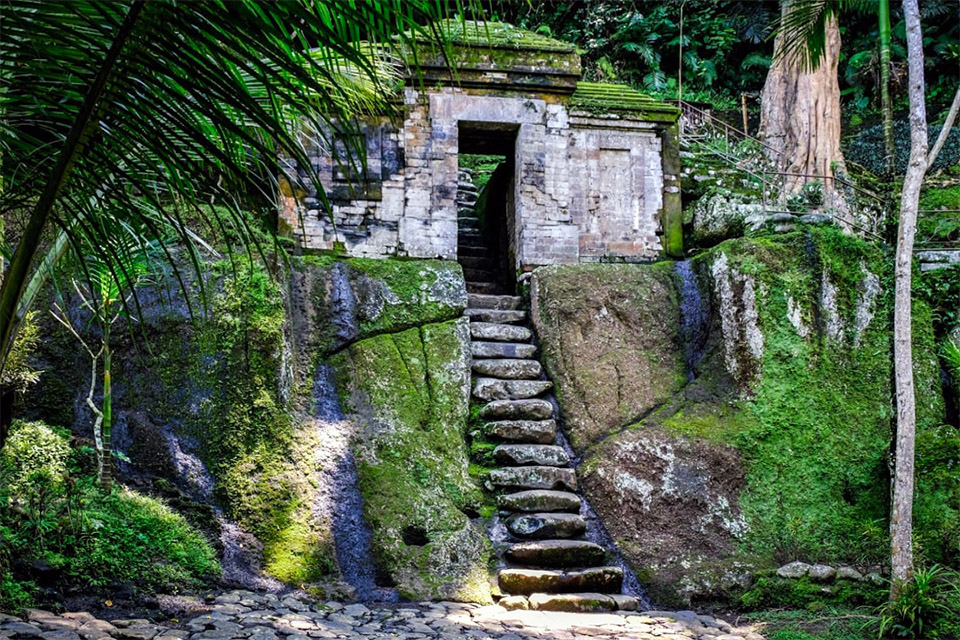
Hidden in Pejeng village, Goa Garba is a lesser-known sanctuary linked to royal meditation. Legends tie it to King Jayapangus and the scholar-priest Rsi Markandeya. Nearby lies Pengukur Ukur Temple, where rulers are said to have measured their spiritual strength.
Quiet, shaded, and mysterious, these sites are perfect for travelers seeking off-the-beaten-path sanctuaries.
Insider’s Tips – to Goa Garba
- Wear sturdy shoes; paths are steep.
- Great for photography in soft afternoon light.
- Excellent pairing with Gunung Kawi Sebatu.
Insider’s Tips – Pura Gunung Kawi Sebatu
- Ideal for meditative visits.
- Pair with Tegallalang rice terraces for a balanced itinerary.
- Photogenic in the morning when the water is still.
Gunung Kawi Sebatu – Hidden Water Temple

Unlike the monumental cliff shrines of Tampaksiring, Gunung Kawi Sebatu is a serene water temple tucked into forested hills. Pools filled with lotus and koi, shrines reflected in emerald water, and trickling springs create an atmosphere of pure tranquility.
This temple remains less frequented, yet for many, it’s one of Bali’s most enchanting.
Kehen Temple – The Stairway of Bangli
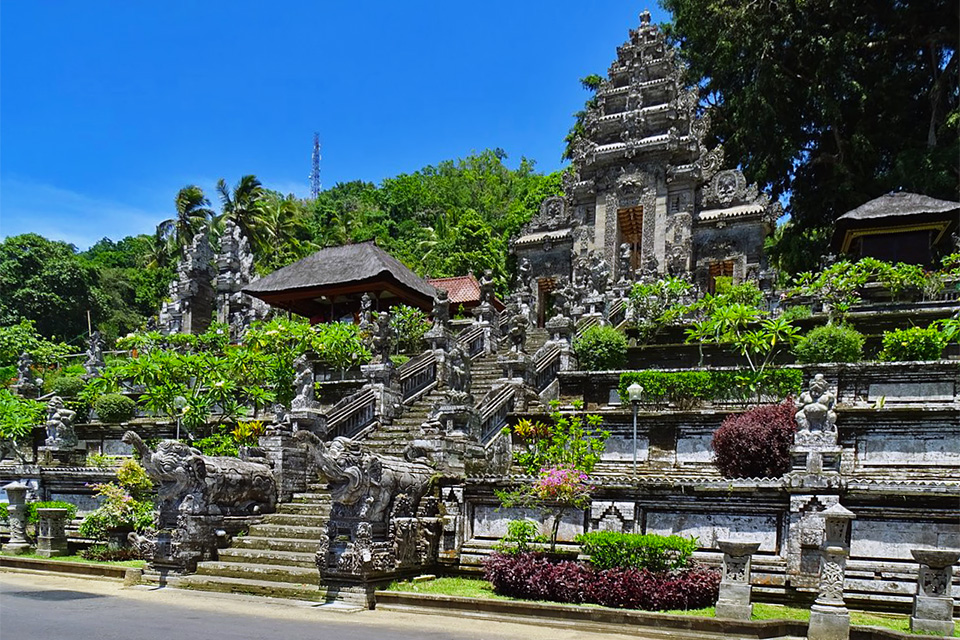
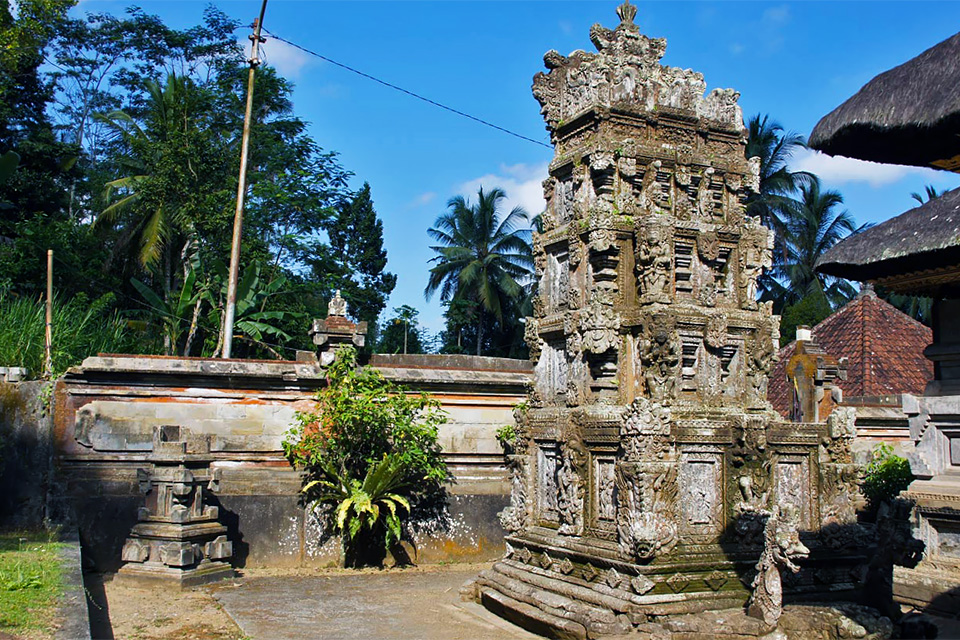
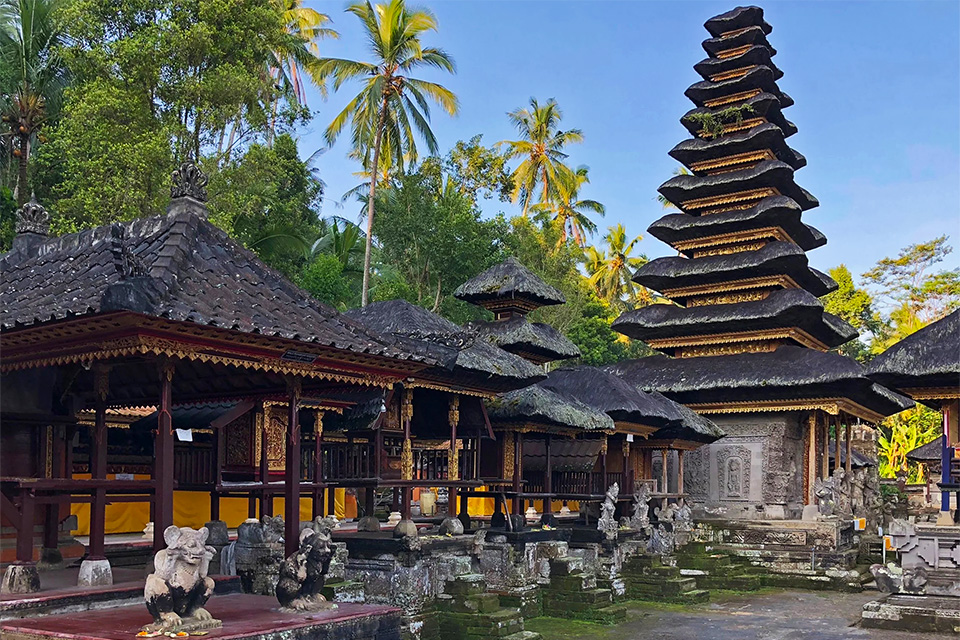
Climbing Kehen’s stairway is like ascending into a carved epic—each terrace a chapter in stone.
Rising on terraced steps at the edge of Bangli town, Kehen Temple is one of Bali’s most majestic state temples. Dedicated to the god of fire, its towering entrance staircase is lined with guardian statues, leading to a series of courtyards filled with intricate carvings and a towering banyan tree.
Dating back to the 11th century, Kehen offers insight into Balinese state religion, where temple design mirrors cosmic order. Its grandeur rivals Besakih, yet it sees a fraction of the visitors.
Insider’s Tips – On Visiting Kehen Temple
- Located in Bangli town, about 30 minutes from Ubud.
- Excellent stop en route to Kintamani or Penglipuran village.
- Best visited with a local guide for historical depth.
Context & Spiritual Continuity
To visit Ubud’s temples is to walk alongside history—yet always in the company of prayers still rising today.
Together, these temples form a mosaic of Central Bali’s spiritual landscape. They are not isolated monuments but part of a living network—water temples tied to irrigation, cliff shrines tied to kingship, reconciliation temples tied to community governance.
For the Balinese, temples are not optional heritage sites; they are daily life anchors, marking life’s cycles from birth to death. For the traveler, they offer not just cultural appreciation but an invitation to witness living faith.
Dating back to the 11th century, Kehen offers insight into Balinese state religion, where temple design mirrors cosmic order. Its grandeur rivals Besakih, yet it sees a fraction of the visitors.
Nature & Landscapes
The highlands of Central Bali are not only the cultural heart of the island but also its most breathtaking natural stage. Here, the land itself feels sculpted by both humans and gods: emerald rice terraces stepping gracefully down hillsides, volcanic peaks looming above lakes, rivers cutting through deep gorges, and waterfalls tumbling through jungle canopies.
The Living Canvas of Central Bali
The highlands of Central Bali are not only the cultural heart of the island but also its most breathtaking natural stage. Here, the land itself feels sculpted by both humans and gods: emerald rice terraces stepping gracefully down hillsides, volcanic peaks looming above lakes, rivers cutting through deep gorges, and waterfalls tumbling through jungle canopies.
In Central Bali, nature is not scenery—it is the stage on which culture and spirituality endlessly perform.
This section will guide you through the most iconic and the most hidden of Central Bali’s natural wonders: from Tegallalang’s iconic terraces to Jatiluwih’s endless UNESCO fields, from Tegenungan’s crowded cascades to the mystical shafts of light at Tukad Cepung, from rafting the Ayung to sipping coffee in Pupuan’s cool plantations.
Rice Terraces – Where Culture and Nature Dance
Tegallalang – Iconic but Crowded
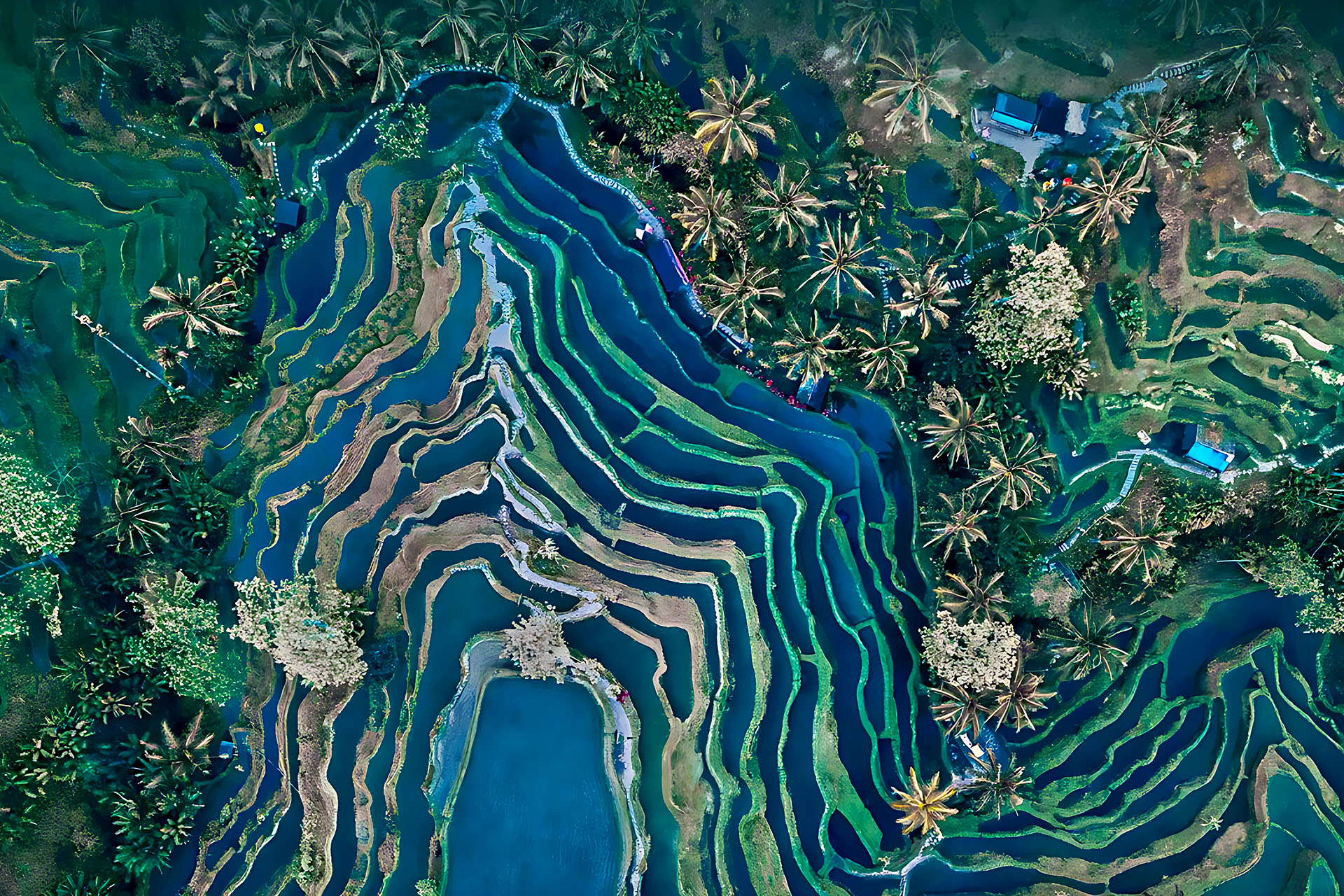
No image says “Ubud” quite like Tegallalang Rice Terraces. Just north of town, the valley is carved into a living amphitheater of green, with photogenic swings and Instagram-ready platforms dotting the ridges. Tegallalang is undeniably beautiful, but it’s also busy; its popularity has turned it into more of a photo stop than a meditative experience.
That said, if you come early—just after sunrise—you may catch a quieter moment, with morning mist lingering above the paddies and farmers heading to the fields.
Insider’s Tips – Exploring Tegallalang
- Best time: early morning or late afternoon, softer sun and better lighting for photography.
- Many cafes perch above the terraces—perfect for a drink with a view.
- Pair with Gunung Kawi Sebatu or Tirta Empul for a half-day trip.
- Trek along the labyrinth of pathways amidst the rice terraces allows you to immerse into local living.

Tegallalang
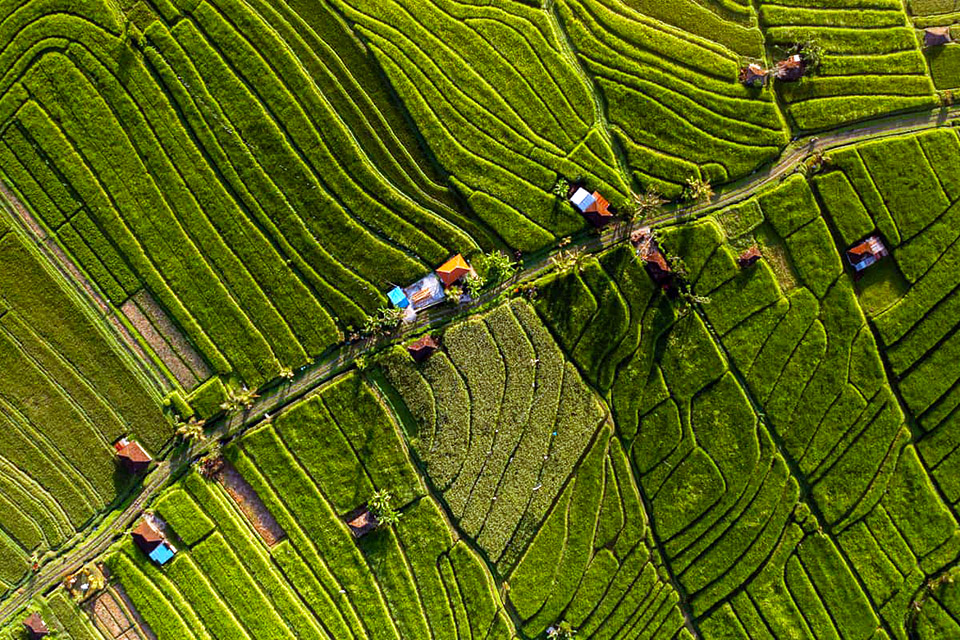
Jatiluwih
Jatiluwih – UNESCO’s Endless Terraces
Jatiluwih is not a postcard—it’s a world of green where every step feels like entering a painting.
If Tegallalang is iconic, Jatiluwih is epic. Spread across the slopes of Mount Batukaru, Jatiluwih is a UNESCO Cultural Landscape that showcases Bali’s subak irrigation system at its most majestic. Here, terraces stretch as far as the eye can see, cascading down hillsides in patterns that shift with the season—from emerald to gold to freshly flooded silver.
Unlike Tegallalang, Jatiluwih invites you to stay, to walk or cycle its trails, to listen to water flowing through centuries-old canals, and to feel the rhythm of a landscape designed not just for farming but for harmony with the gods.
Insider’s Tips – Exploring Tegallalang
- Entry fee includes well-marked walking and cycling routes.
- Best experienced in the late afternoon when the light softens.
Combine with Batukaru Temple for a full spiritual + natural journey.
- Restaurants, coffee shops, and lodgings are available for extended stay.
Volcanoes & Lakes – The Highlands’ Crown
Mount Batur & Lake Batur
The Kintamani region offers one of Bali’s most dramatic vistas: Mount Batur, an active volcano, rising above the shimmering crescent of Lake Batur. Standing on the rim at Penelokan village, you can see the black lava fields that trace past eruptions, contrasting with the fertile greenery around them.
For adventurers, the classic experience is the Mount Batur sunrise trek, climbing in darkness to witness dawn break over the island, with Mount Agung and sometimes even Lombok’s Rinjani visible on clear mornings. For those seeking less exertion, the view from lakeside villages like Toya Bungkah, with its hot springs overlooking the water, is equally memorable.
Insider’s Tips – On Exploring Kintamani & Batur
- Treks start around 3 AM; book with licensed guides for safety.
- Try jeep tour for less challenging way to enjoy the same experience.
- Hot springs are best enjoyed post-hike. Try lake watersport for more fun.
- Photographers: arrive at Penelokan by 6 AM for misty light over the lake.
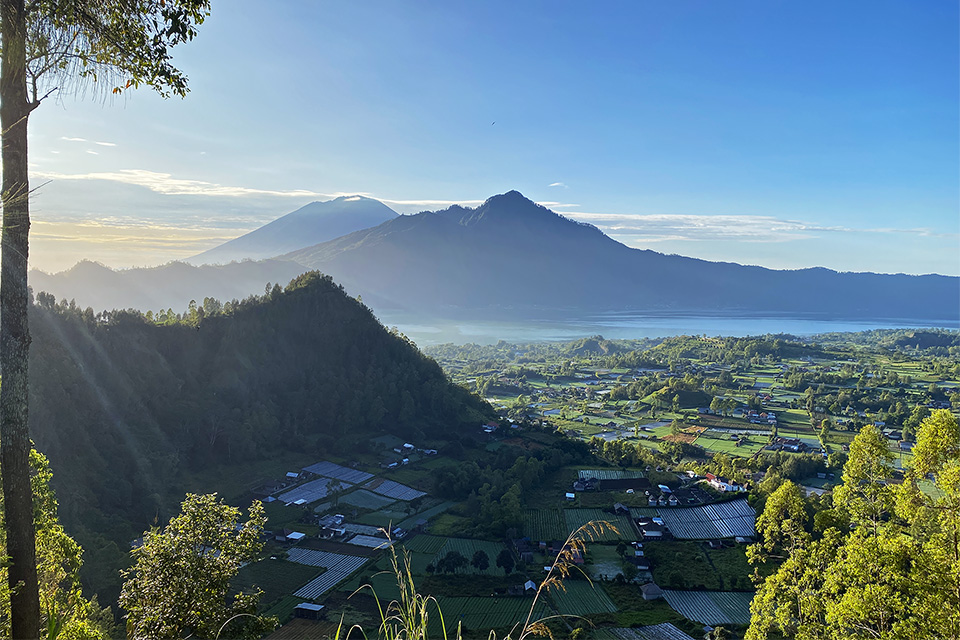
Mount & Lake Batur

Mount Batukaru
Mount Batukaru
To the west, Mount Batukaru rises cloaked in forest, Bali’s second-highest peak and a sacred mountain. Unlike Batur, Batukaru is quieter, wrapped in jungle rather than lava. Its flanks host Jatiluwih’s terraces and the revered Pura Luhur Batukaru.
The mountain embodies the wild, spiritual side of Central Bali, less visited but deeply important in Balinese cosmology as a guardian of the west.
Lake Beratan, Buyan & Tamblingan
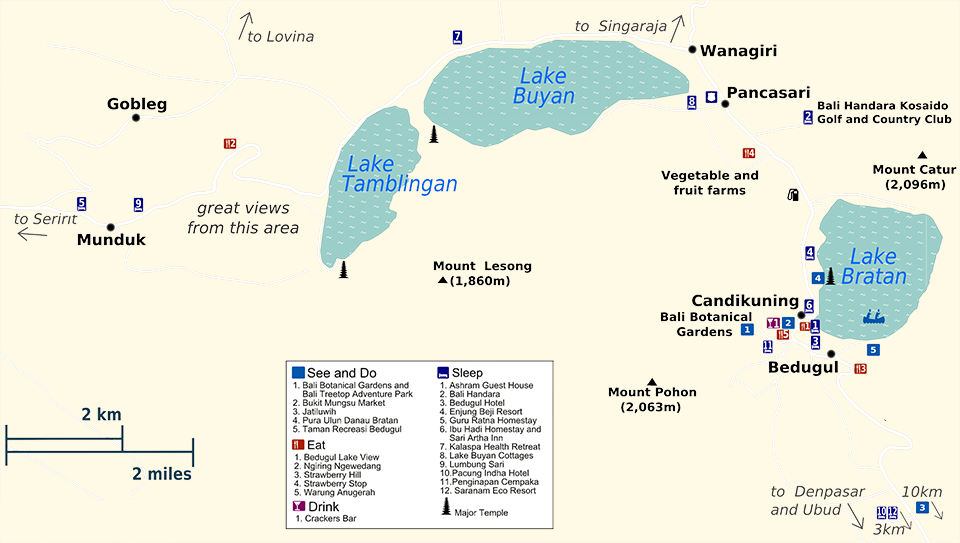
Further north in Bedugul, the trio of lakes—Beratan, Buyan, and Tamblingan—form another jewel of the Central Highlands. Lake Beratan is famous for Ulun Danu Beratan Temple, its iconic shrines appearing to float on the water. Buyan and Tamblingan, tucked deeper into forested hills, feel far more secluded and wild, perfect for hiking, canoeing, or simply escaping the crowds.
Insider’s Insight – On Exploring Bedugul
- Ulun Danu Beratan is most atmospheric at sunrise when mist rises from the lake.
- Lake Buyan has a camping ground surrounded by tropical forest.
- Try canoeing on Tamblingan for a peaceful, off-grid experience.
- Pair with a visit to Bedugul’s botanical gardens and strawberry farms.
Waterfalls – Liquid Drama in the Jungle
Tegenungan – Popular and Accessible
Close to Ubud, Tegenungan Waterfall is a perennial favorite. Easy to access and powerful in flow, it’s also heavily visited, with cafes and platforms lining the approach.
Good for first-timers, but if you crave solitude, you may prefer Central Bali’s other cascades.

Tegenungan Waterfall
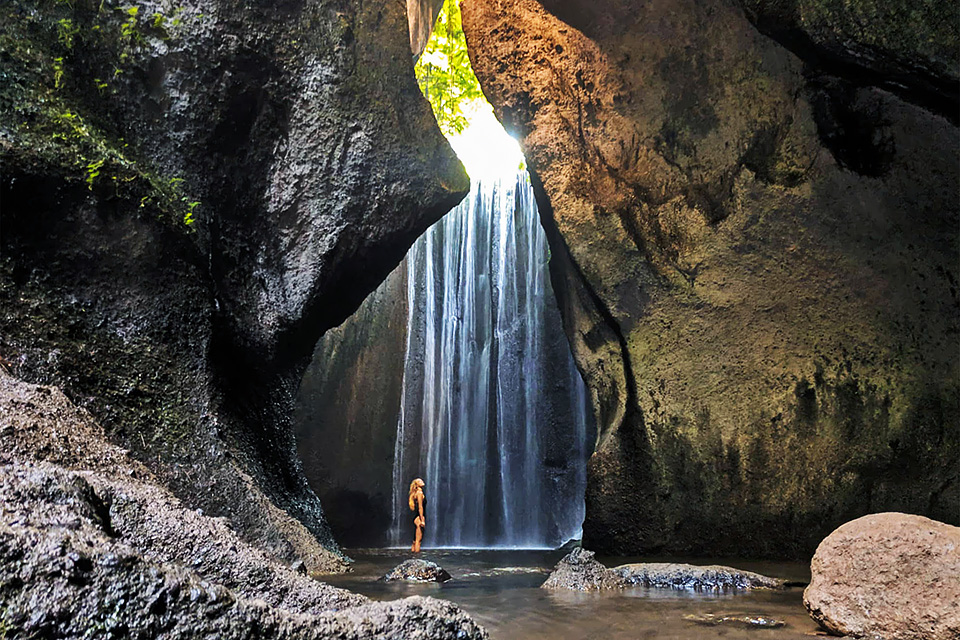
Tukad Cepung Waterfall
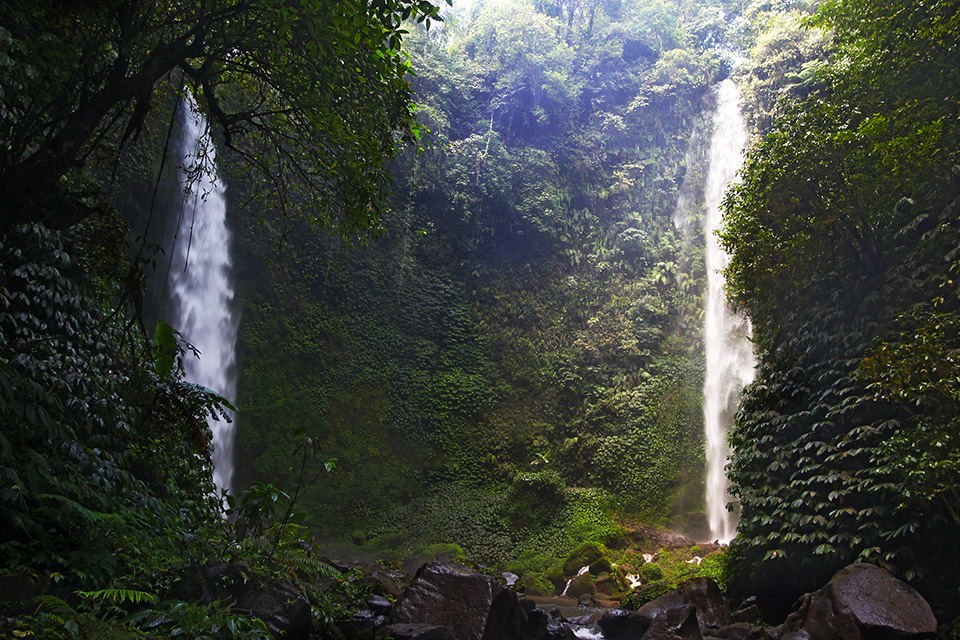
Nungnung Waterfall
Tibumana – A Hidden Curtain
In Bangli, Tibumana Waterfall drops in a clean curtain into a tranquil pool surrounded by jungle. Simpler, quieter, and more serene than Tegenungan, it’s perfect for a refreshing dip.
Tukad Cepung – A Cave of Light
One of Bali’s most photogenic waterfalls, Tukad Cepung tumbles through a cave, with shafts of sunlight turning the mist into glowing beams. The walk down involves streams and boulders, but the reward is a mystical setting unlike any other.
Nungnung – The Thunderous Giant
In the cool highlands north of Ubud, Nungnung Waterfall roars down 50 meters into a lush gorge. The descent is steep—500 steps—but the sheer power of the falls, the spray cooling your skin, and the jungle all around make it a highlight for those willing to exert themselves.
If Tegenungan is for casual visitors, Nungnung is for those who want to feel nature’s raw force in their bones.
Pelaga Cascades
Near Petang, a series of smaller, tranquil cascades feed irrigation systems and local farms. They’re less dramatic but make for a charming stop when exploring the Bongkasa–Pelaga corridor.
Forests & Rivers – The Flowing Lifelines
Ayung River – For Rafting & Scenery
The Ayung River carves deep gorges west of Ubud, its jungle walls adorned with vines, bird calls, and even carved reliefs. Today, it’s Bali’s rafting hotspot, offering accessible white-water thrills while showcasing Ubud’s wild side.
Petanu River – Sacred Heritage Stream
East of Ubud, the Petanu River carries myth and memory. Along its banks stand Goa Gajah, Yeh Pulu, Samuan Tiga, and Gunung Kawi—testament to its role in shaping Bali’s early kingdoms. Walking or cycling trails reveal its quieter stretches, where rice terraces meet jungle.
Pupuan Highlands – Plantations & Panoramas
West of Jatiluwih, the Pupuan Highlands open into rolling hills blanketed in coffee, clove, and cacao plantations. Here, you can sip freshly brewed coffee overlooking panoramic terraces, visit small family farms, or simply enjoy the cooler air. Pupuan is still off the tourist radar, making it a rewarding detour for those seeking authenticity.
Insider’s Picks – Navigating Pupuan
- Best combined with Jatiluwih for a full highland day.
- Coffee and clove harvest seasons (June–August) bring added vibrancy.
- Ideal for slow travel and photography.
The Landscape as Living Culture
Central Bali’s nature is not separate from its people—it’s a co-created landscape. Rice terraces embody centuries of community irrigation management, rivers serve both irrigation and spiritual cleansing, mountains are gods, lakes are offerings, and plantations sustain both economy and ritual.
To journey here is to witness the harmony of humans and nature, a balance that defines Bali’s uniqueness.
Ubud Town & Living Culture
The heartbeat of Central Bali lies not only in its misty highlands and ancient temples but also in Ubud itself—a town where tradition and creativity flow side by side. Walk down its narrow streets, and you’ll hear the soft clinking of gamelan rehearsals drifting from banjar halls, smell offerings of frangipani and incense placed at thresholds, and see canvases drying in the tropical sun in artist workshops.
Ubud is where Bali slows down to let you see, hear, and feel its cultural soul—layered with ritual, artistry, and a connection to nature.
The heartbeat of Central Bali lies not only in its misty highlands and ancient temples but also in Ubud itself—a town where tradition and creativity flow side by side. Walk down its narrow streets, and you’ll hear the soft clinking of gamelan rehearsals drifting from banjar halls, smell offerings of frangipani and incense placed at thresholds, and see canvases drying in the tropical sun in artist workshops.
Ubud Town is where Bali’s cultural tapestry feels most alive. Its temples, markets, museums, and artisan villages may be famous, but its essence lies in the heartbeat of community, ritual, and creativity. Here, culture isn’t preserved behind glass—it’s performed, lived, and renewed every single day.
Ubud Palace & Traditional Dance
At the heart of Ubud sits Puri Saren Agung, better known as the Ubud Palace. Once home to the royal family of Ubud, its courtyards still carry a regal calm. Ornate gates, carved stone guardians, and lush frangipani trees set the stage for one of Ubud’s most magical experiences: an evening dance performance.
Ubud's Cultural Performances
Arrive early for the palace dances to secure a front-row seat. Many travelers combine the performance with a pre-show dinner in one of Ubud’s nearby warungs or cafes.
Each night, troupes perform traditional Balinese dances here, from the entrancing Legong to the powerful Barong. The palace setting adds intimacy and authenticity—this is not just a show for visitors but a continuation of artistic heritage patronized by Ubud’s royal lineage.
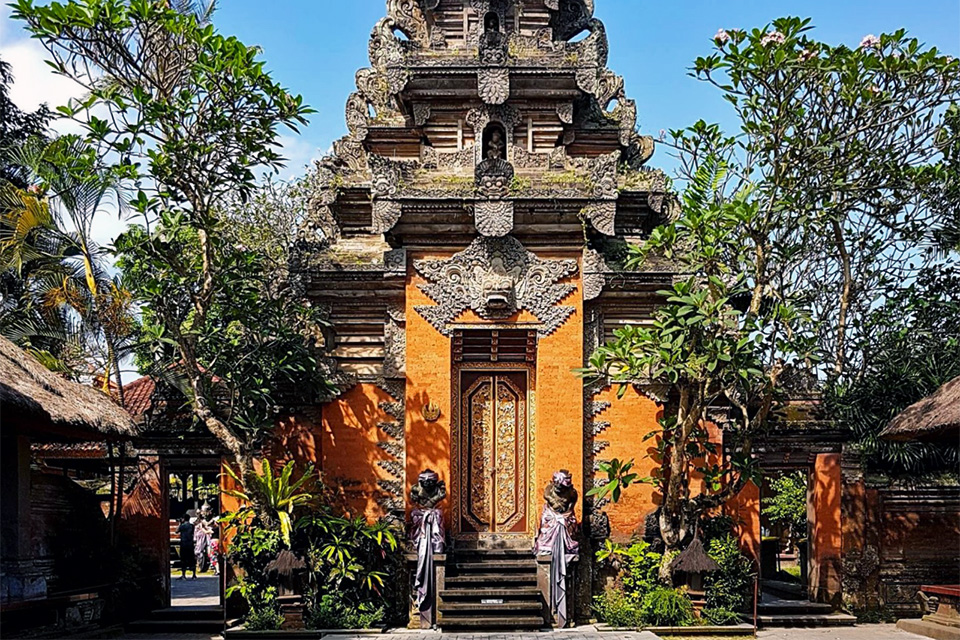
Ubud Royal Palace
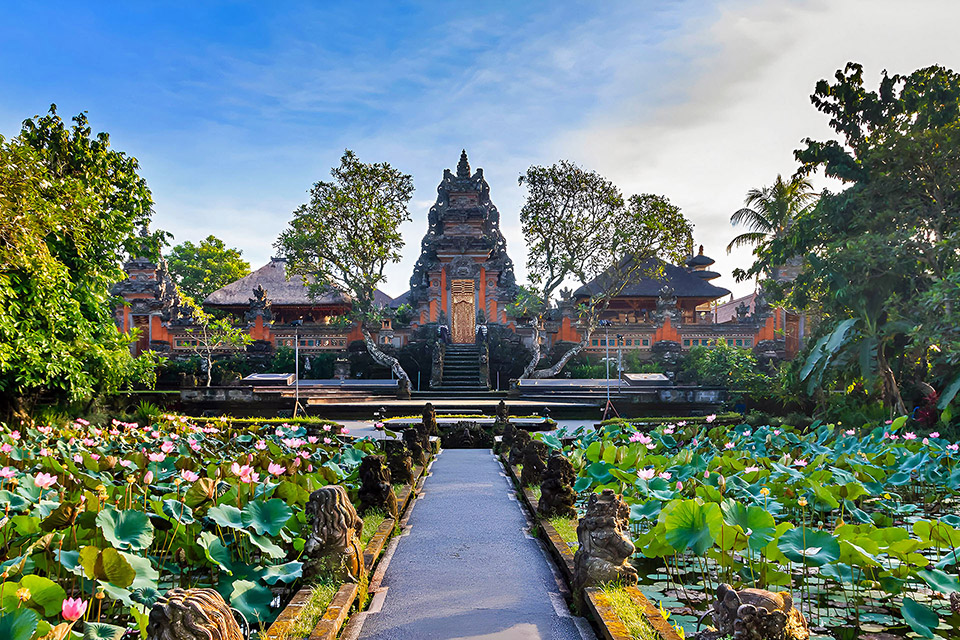
Ubud Water Palace
Ubud Water Palace a.k.a. Pura Taman Saraswati
Just steps away, another jewel awaits: the Ubud Water Palace, a temple dedicated to the goddess of wisdom and arts, Saraswati. Its lotus pond framed by stone bridges has become one of Ubud’s most photographed spots. While tourists often stop for a quick picture, the temple still functions as a place of worship. Evening kecak and Legong dances here add a poetic dimension, with shimmering reflections of dancers over the pond.
Sacred Monkey Forest Sanctuary
Few places embody Ubud’s balance of wild nature and spirituality like the Sacred Monkey Forest Sanctuary. Officially known as Mandala Wisata Wenara Wana, this forested area shelters hundreds of long-tailed macaques amid towering banyans and mossy temples.
Insider’s Tips – On Visiting Ubud Monkey Forest
While the monkeys can be cheeky (they love to grab sunglasses and snacks), they are also seen as guardians of the temples. Carry minimal belongings and don’t panic if one climbs onto you—staff are trained to help.
The sanctuary is more than a tourist draw—it is considered sacred ground, with three ancient temples within its borders. Walking along shaded paths, you feel the blend of sacredness and playfulness: monkeys leap overhead, while priests still conduct ceremonies in quiet corners.
Campuhan Ridge Walk
When you need a break from Ubud’s busy streets, the Campuhan Ridge Walk offers serenity just minutes away. This scenic trail runs along a ridge between two rivers, the Wos and the Ayung, with sweeping views of valleys and distant volcanoes.
Best visited in the early morning or late afternoon, the ridge glows golden under soft sunlight, with alang-alang grass swaying on both sides. The walk is easy, making it a favorite for casual hikers, photographers, and those simply seeking calm.
Insider’s Tips – On Exploring Campuhan Ridge Walk
Pack a light breakfast or coffee for a sunrise walk—watching Ubud awaken from the ridge is one of the most memorable ways to start a day here.
Ubud Market
A different rhythm unfolds at Pasar Ubud, the town’s central market. In the early morning, locals crowd the stalls to buy offerings, spices, and daily produce. By mid-morning, the market transforms into a hub for visitors, offering everything from batik sarongs and woodcarvings to silver jewelry and woven baskets.
Haggling is expected here, but always with a smile. Shopping at Ubud Market is less about scoring a bargain and more about connecting with Bali’s artisan traditions. Each purchase carries a story of craftsmanship passed down through generations.
Art Museums & Galleries
Ubud’s reputation as Bali’s art capital owes much to its museums and galleries:
- Neka Art Museum – housing classical Balinese paintings and modern works.
- Agung Rai Museum of Art (ARMA) – blending art exhibitions with performance spaces and lush gardens.
- Neka Art Museum – housing classical Balinese paintings and modern works.
- Agung Rai Museum of Art (ARMA) – blending art exhibitions with performance spaces and lush gardens.
Together, they illustrate Ubud’s role as a crossroads where Balinese tradition meets global creativity.
Insider’s Tip: Shopping in Ubud
If you’re planning to buy art or crafts, visit the workshops directly. Prices are fairer, and you’ll see the craftsmanship unfold before your eyes.
Artisan Villages Around Ubud
Ubud is surrounded by villages each specializing in a craft:
- Mas – woodcarving workshops.
- Celuk – fine silver and goldsmithing.
- Batuan – renowned for detailed paintings with mystical themes.
A short ride from Ubud brings travelers face-to-face with master artisans at work, offering both shopping opportunities and cultural encounters.
Daily Life: Banjar, Offerings & Markets
Beyond the temples and attractions, Ubud’s deepest cultural richness is found in daily life. The banjar (community cooperative) still organizes everything from ceremonies to music rehearsals. Offerings are placed in doorways and shrines morning and evening, a fragrant reminder of the island’s spirituality woven into routine.
Walking through Ubud at dawn reveals women carrying woven baskets of flowers, rice, and incense, heading to market or temple. By nightfall, gamelan rehearsals echo across courtyards. Visitors often feel this rhythm most vividly not in staged performances but in these fleeting glimpses of everyday devotion.
Activities & Experiences
If Ubud is Bali’s cultural heart, then its experiences are the pulse that keeps travelers coming back. Beyond sightseeing, this is where you can immerse yourself—whether by trekking through emerald fields, paddling a river, learning the secrets of Balinese cooking, or finding inner stillness in a yoga shala. Ubud and Central Bali offer a rich menu of activities that blend nature, culture, and wellness, making it one of the most versatile destinations in Southeast Asia.
In Ubud, experiences aren’t about ticking boxes—they’re about slowing down, engaging deeply, and letting Bali change the way you travel.
Trekking: From Ridges to Rice Terraces
Hire a local guide when trekking Jatiluwih. They’ll show hidden shrines, water temples, and pathways that most independent visitors miss.
Few activities capture the essence of Ubud better than walking. The Campuhan Ridge Walk is the easiest entry point—a gentle trail with views of valleys, villages, and volcanos on the horizon. For those looking for something more immersive, trekking through rice terraces is unforgettable.
- Tegallalang Rice Terraces are postcard-perfect, with sculpted fields and swings perched for photos, though often crowded. You can trek, cycle, even rent electric bicycle.
- Jatiluwih Rice Terraces, a UNESCO World Heritage site, offer more expansive trails and fewer crowds, ideal for longer walks that reveal the irrigation system known as subak.
Together, they illustrate Ubud’s role as a crossroads where Balinese tradition meets global creativity.
Cycling Tours
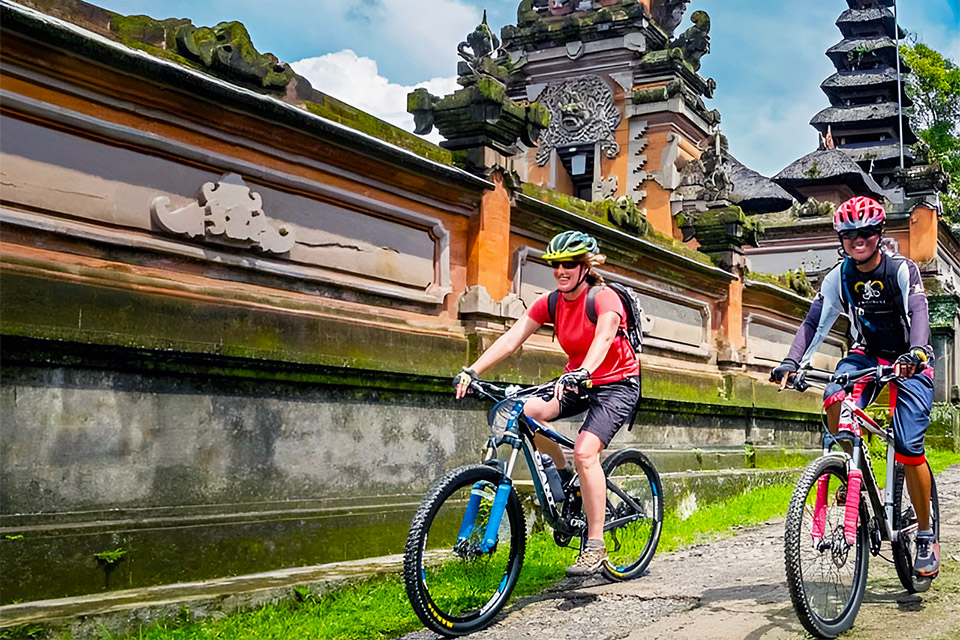
If walking brings you close, cycling takes you further. Guided cycling tours around Ubud often begin in the highlands (Batur or Kintamani) and follow downhill roads through villages, rice fields, and quiet back lanes until they reach Ubud.
- Bongkasa & Carangsari: lush countryside dotted with temples and traditional compounds.
- Jatiluwih: scenic routes through vast rice terraces, challenging but rewarding.
- Petang & Pelaga: highland plantations of coffee, cocoa, and cloves.
Cycling here isn’t just exercise—it’s a rolling introduction to Balinese rural life.
Rafting on Bali’s Rivers
Hire a local guide when trekking Jatiluwih. They’ll show hidden shrines, water temples, and pathways that most independent visitors miss.
For adventure with a splash, rafting in Ubud is among the island’s most popular outdoor activities. Two streams to choose from are:
- Ayung River (Ubud): ideal for beginners and families; calm sections mixed with Class II–III rapids, all set in a lush gorge lined with waterfalls and stone carvings.
- Telaga Waja River (East Bali): faster, longer, and more thrilling; perfect for those seeking extra adrenaline. Perfect to be combined with exploring the ravine East.
Together, they illustrate Ubud’s role as a crossroads where Balinese tradition meets global creativity, combining Bali’s nature with international-grade safety standards..

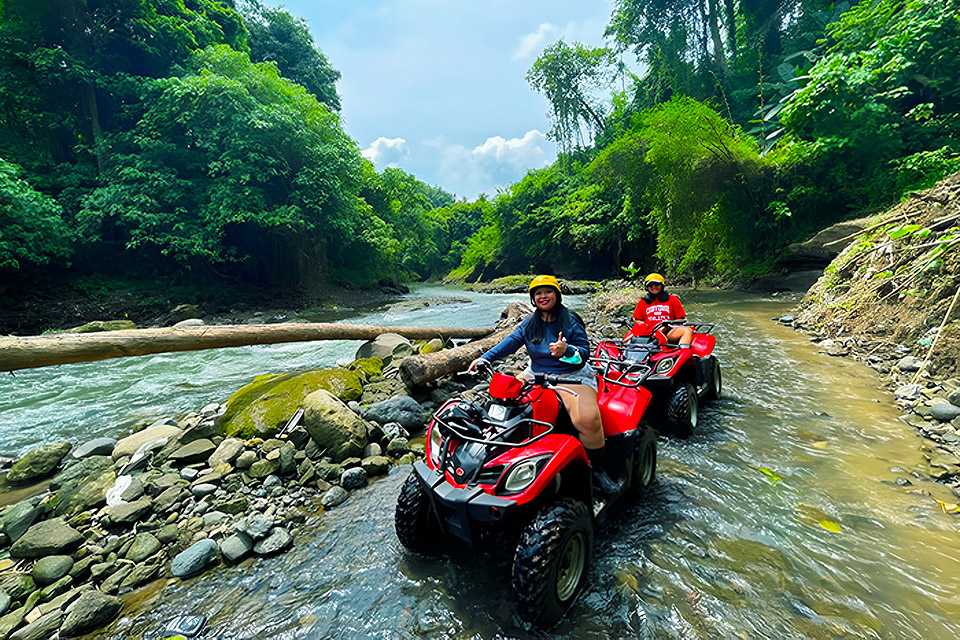
Sunrise Trek on Mt. Batur
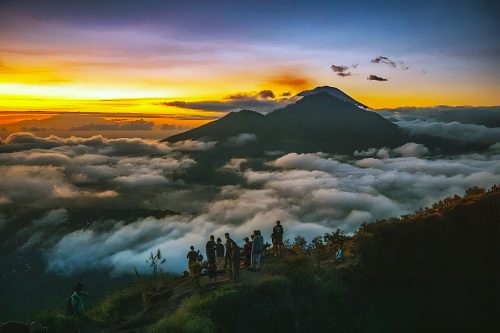
No Central Bali trip feels complete without a sunrise trek to Mt. Batur, the active volcano overlooking Lake Batur. Starting around 3 a.m., the climb (roughly 2 hours) rewards hikers with breathtaking views as the sun rises over Mount Agung, the lake, and even glimpses of Lombok’s Mount Rinjani on clear days.
Local guides lead the way, often preparing breakfast of boiled eggs cooked in volcanic steam at the summit. The atmosphere—mist lifting, birds awakening, silhouettes of temples below—makes it one of Bali’s most iconic experiences.
Cooking Classes & Market Visits
One of the most satisfying ways to engage with Balinese culture is through its food. Cooking classes in Ubud typically begin with a guided visit to a local market, where participants learn about tropical spices, herbs, and ceremonial ingredients. Back in the kitchen, you’ll grind spices into bumbu Bali, prepare satay skewers, and learn to plate offerings before enjoying a communal meal.
Hire a local guide when trekking Jatiluwih. They’ll show hidden shrines, water temples, and pathways that most independent visitors miss.
Yoga, Meditation & Healing Practices
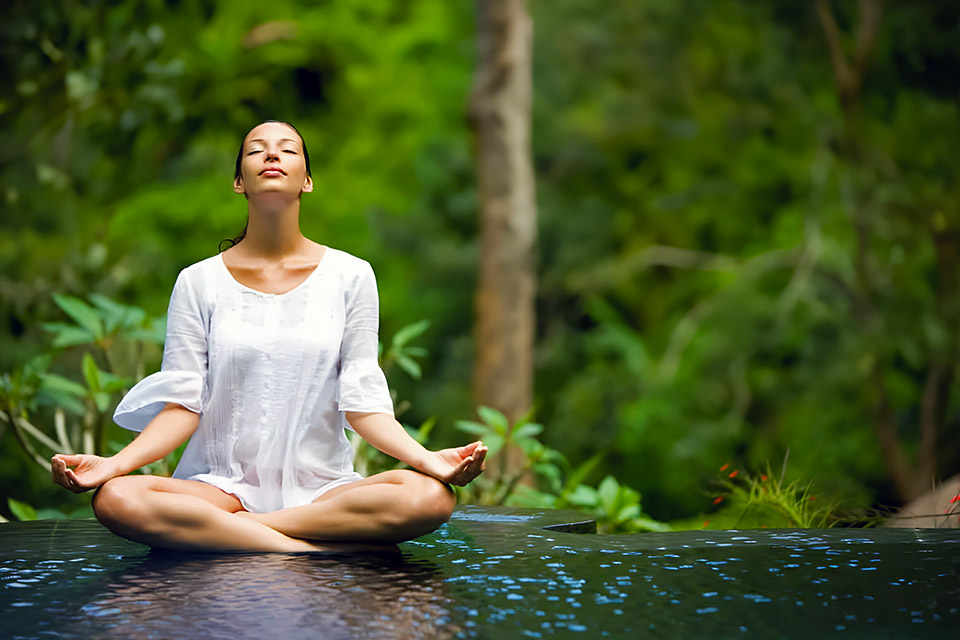
Since the 1970s, Ubud has been a hub for seekers of wellness, and today it’s considered one of the world’s yoga capitals. Dozens of studios—from rustic open-air pavilions to polished retreat centers—offer classes daily, covering everything from vinyasa and yin to aerial yoga.
But wellness in Ubud goes beyond yoga:
- Meditation sessions often combine Balinese rituals with mindfulness practices.
- Sound healing ceremonies use gongs and crystal bowls to create deep relaxation.
- Ecstatic dance gatherings turn community halls into free-spirited movement sanctuaries.
Together, they form a culture of well-being that attracts visitors from around the world.

Spa & Balinese Massage
No Ubud itinerary is complete without surrendering to a Balinese massage. Rooted in traditional techniques, this massage blends stretching, acupressure, and aromatherapy oils, offering both relaxation and energy balance.
Options range from budget-friendly spas tucked down side streets to luxurious jungle-view retreats offering flower baths, herbal scrubs, and multi-hour wellness rituals. After a long day of trekking or rafting, there’s no better way to recharge.
Hidden Corridors
Ubud to Bedugul via Bongkasa, Carangsari, Petang & Pelaga.
The journey from Ubud to Bedugul can be more than just a transfer from cultural heartland to highland lakes. If you take the scenic backroads rather than the main highways, you’ll discover an underexplored corridor of rice terraces, river valleys, waterfalls, and plantations. These hidden gems—Bongkasa, Carangsari, Petang, and Pelaga—are places where Bali feels refreshingly authentic, inviting you to slow down and experience a side of the island few visitors ever see.
The hidden corridor from Ubud to Bedugul is not about marquee attractions—it’s about immersive encounters: rice fields where time slows, heritage villages alive with history, waterfalls tucked into green valleys, and plantations where the day’s rhythm follows the harvest. For travelers who want to see beyond the obvious, this stretch of Central Bali is one of the island’s richest rewards.
The road less traveled in Central Bali isn’t about skipping the crowds—it’s about rediscovering Bali’s essence in landscapes and villages untouched by mass tourism.
Bongkasa – Rice Terraces & the Ayung Valley
Just west of Ubud lies Bongkasa, a village where rice terraces spill down into the dramatic Ayung River valley. Unlike the heavily trafficked Tegallalang, Bongkasa’s fields remain tranquil, with farmers still working in tune with the rhythms of the subak irrigation system.
Walking or cycling here reveals the quieter charm of Bali’s countryside: shrines tucked between paddies, dragonflies hovering over canals, and children waving as you pass. The terraces often open to stunning views of the river gorge, with the distant peaks of Mount Batukaru or Mount Agung framed on the horizon.
Insider’s Insight – Why Bongkasa?
If you want the look of Tegallalang without the crowds, Bongkasa is the answer. Add a stop here on a cycling tour or day trip from Ubud for a slice of authentic rural life.
Carangsari – Heritage & History
Heading further north, Carangsari holds special significance in modern Balinese history—it is the birthplace of I Gusti Ngurah Rai, Bali’s national hero, after whom the island’s airport is named. The village is proud of its heritage, blending memorial sites with community-based tourism projects.
Here you can stroll through traditional compounds, watch artisans at work, or join cultural activities like cooking, farming, or crafting. Carangsari’s rural charm is tied to its identity as both a living community and a historical landmark.
Carangsari is where heritage meets hospitality—history lessons come not from books, but from conversations over coffee with local villagers.
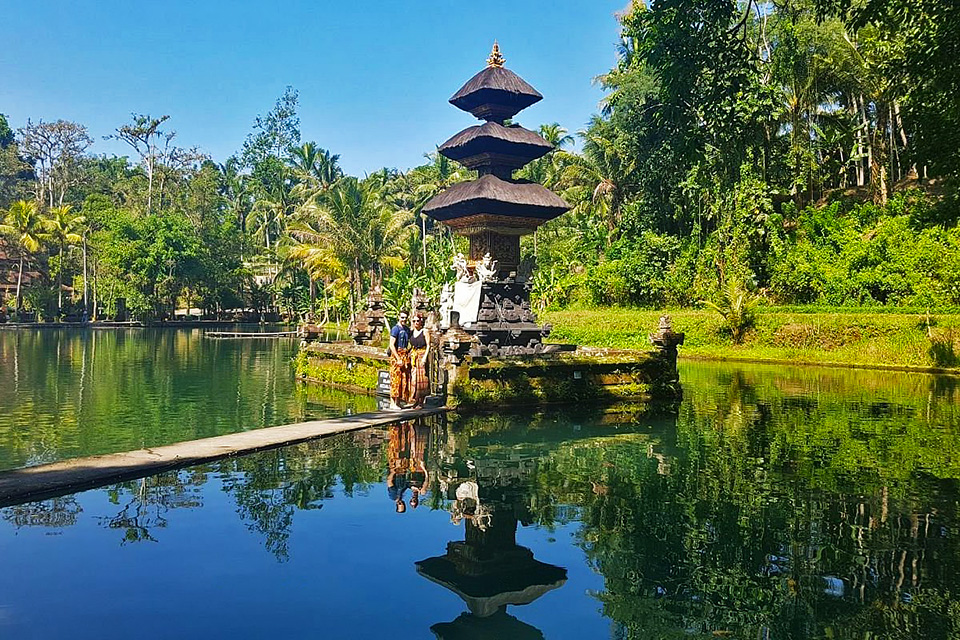
Petang – Waterfalls & Forested Valleys
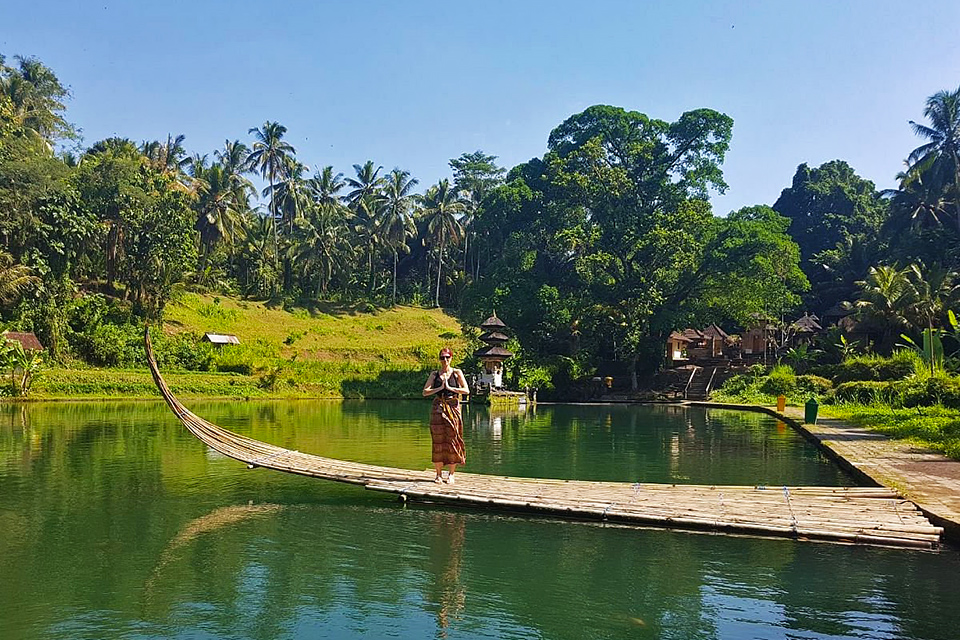
As the road climbs higher, you reach Petang, an area blessed with lush forests, cool valleys, and a cluster of lesser-known waterfalls. Trails lead to cascades hidden among bamboo groves and clove plantations, rewarding explorers with refreshing swims and photo-perfect settings.
Petang is also a hub for outdoor adventure—rafting on the Ayung starts higher upstream here, creating wilder rapids compared to the Ubud section. Cycling through Petang reveals an entirely different Bali: mist rising from valleys, narrow backroads shaded by jackfruit and cocoa trees, and the sound of water rushing unseen in the gorge below.
Insider’s Tip – Waterfall Circuit
Petang and nearby Pelaga are dotted with waterfalls such as Nungnung, one of Bali’s most powerful and photogenic cascades. Start early, wear good shoes, and prepare for steep steps.
Pelaga – Plantations & Highland Agro-Tourism
Pelaga is Bali in slow motion—a place where the rhythm of farming and the cool mountain air invite you to linger.
At around 750–1,000 meters above sea level, Pelaga feels worlds apart from the tropical lowlands. The climate is crisp, the air scented with coffee flowers, and the hillsides are covered in plantations of coffee, clove, cocoa, and vegetables.
Pelaga is at the forefront of agro-tourism in Central Bali. Visitors can tour coffee farms, sample fresh brews overlooking the fields, or stay overnight in eco-lodges where mornings begin with birdsong and mist over the valley. The village also serves as a natural gateway to the Bedugul Highlands, making it a perfect midway stop on a northward journey.
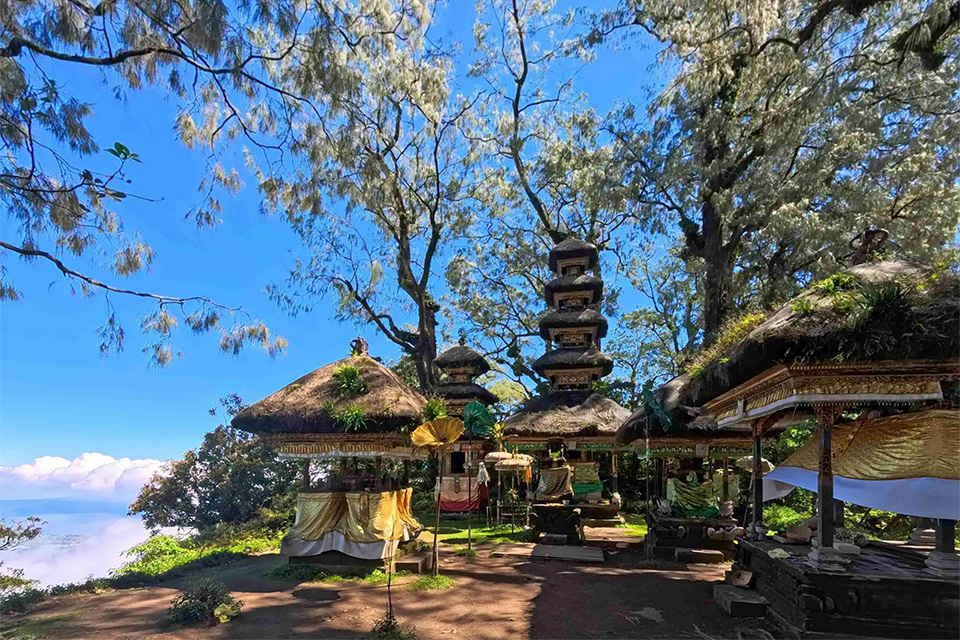
Pura Puncak Mangu at Mount Catur
Scenic Journeys: Driving & Cycling
The Ubud–Bedugul backroad corridor is one of Bali’s most rewarding drives or cycling routes. Instead of the crowded main highway through Gianyar and Tabanan, this route winds through quiet villages, fertile valleys, and cool forests.
- By car: it’s a peaceful alternative that can be done in 2–3 hours, with stops along the way for rice terraces, heritage villages, and waterfalls.
- By bike: guided tours often start Pelaga and descend through Carangsari and Bongkasa to Ubud, offering thrilling mix of scenery and culture.
Either way, this corridor is proof that the journey itself can be the destination.
🚴 Insider’s Picks – Highlights of the Corridor
- Bongkasa rice terraces: serene alternative to Tegallalang, everything but the crowd.
- Carangsari heritage tour: birthplace of Balinese independence hero, Ngurah Rai.
- Nungnung Waterfall: powerful cascade with jungle backdrop.
- Pelaga coffee farms: sip a cup where it’s grown. Authentic village atmosphere.
- Cycling Ubud–Pelaga route: lush backroads and authentic encounters.
- Pura Puncak Mangu: Classic temple with breathtaking view.
Kintamani & Bangli Highlands
The air thins, the temperature cools, and suddenly Bali feels like a different island. The Kintamani and Bangli Highlands stretch across Central Bali’s volcanic spine, where sacred mountains rise above shimmering lakes, and ancient villages keep timeless traditions alive. This region combines raw natural drama—Mount Batur’s black lava fields, steaming hot springs, and crater rim views—with some of Bali’s most cherished cultural treasures, from bamboo-built Penglipuran to hidden waterfalls in Bangli’s forested valleys.
The highlands of Bangli and Kintamani reveal Bali in contrasts—fire and water, tradition and wilderness, serenity and awe.
The Kintamani & Bangli Highlands are not just a detour from Ubud—they’re a world of their own. Here, you can stand on the rim of an active volcano, soak in hot springs overlooking Bali’s largest lake, walk through a bamboo village where tradition thrives, and step beneath waterfalls hidden in emerald gorges. For travelers who seek both awe and authenticity, this region delivers both in abundance.
🌿 Insider’s Insight – Why Bangli?
Bangli is the only regency in Bali without a coastline, but what it lacks in beaches it makes up for in spiritual landscapes. Its highland villages and forested valleys feel closer to the island’s soul, offering a balance of cultural depth and natural beauty.
Mount Batur – Sunrise Above the Clouds
The crown jewel of Kintamani is undoubtedly Mount Batur, an active volcano that rises 1,717 meters above sea level. For centuries it has drawn pilgrims and, more recently, adventure travelers who make the sunrise trek to its summit.
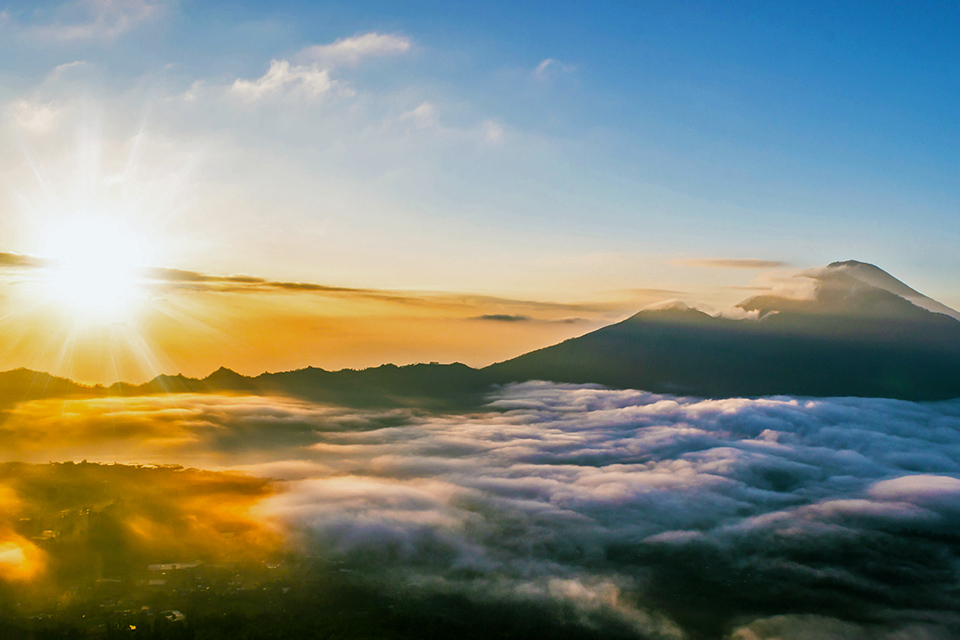
The journey begins in the stillness of night, guided by locals who know the paths winding up the slopes. After a two-hour climb, dawn breaks in breathtaking fashion—shadows dissolve, Lake Batur glows golden, and Mount Agung emerges in silhouette to the east. On clear days, even Lombok’s Mount Rinjani appears in the distance.
At the top, guides often boil eggs in volcanic steam vents, a quirky reminder of the mountain’s fiery core. Whether you come for the trek or just to admire the view from the caldera rim, Batur’s sunrise is a memory that lingers long after you descend.
Insider’s Tips – Mt. Batur Trek
- Start early: pickup in Ubud is usually around 2–2:30 a.m. Stay in Kintamani or Batur gives a better headstart.
- Fitness level: moderate; the trek is steep but manageable for most travelers.
- Wear layers: it can be chilly at the summit (10–15°C in normal days). If you hike in rainy season, have a raincoat too.
- Fitness level: moderate; the trek is steep but manageable for most travelers.
Lake Batur & Its Villages
Nestled inside the caldera, Lake Batur is Bali’s largest lake and a sacred body of water believed to be the source of irrigation for much of the island. Its mirror-like surface reflects both volcano and sky, creating a mystical setting.
The lakeside villages of Toya Bungkah, Kedisan, and Trunyan each add unique character:
- Toya Bungkah: base for hot springs and trek departures.
- Kedisan: a quiet agricultural hub with lakeside views.
- Trunyan: famous for its unique burial tradition, where bodies are laid beneath a sacred taru menyan tree instead of being cremated.
Insider’s Pick – Hot Springs at Toya Bungkah
After a trek or a long day of exploring, the hot springs around Toya Bungkah offer blissful relief. Pools overlook the lake, blending warm volcanic waters with fresh mountain air—a perfect combination of relaxation and scenery.
Penglipuran – The Bamboo Village
South of Kintamani, in the Bangli regency, lies Penglipuran Village, often called Bali’s most picturesque traditional settlement. Known for its bamboo architecture and immaculate lanes, Penglipuran has been recognized for its sustainable tourism model and preservation of Balinese cultural values.
The village is organized in perfect symmetry, with a central road lined by traditional gates leading up to the community temple. Homes are still built using bamboo and wood, and the community maintains strict cultural codes, including environmental stewardship that keeps the village remarkably clean.
Penglipuran is less a tourist attraction than a living classroom—here, culture is not preserved, but lived every day.
Tukad Cepung & Bangli’s Hidden Gems
South of Kintamani, in the Bangli regency, lies Penglipuran Village, often called Bali’s most picturesque traditional settlement. Known for its bamboo architecture and immaculate lanes, Penglipuran has been recognized for its sustainable tourism model and preservation of Balinese cultural values.
The village is organized in perfect symmetry, with a central road lined by traditional gates leading up to the community temple. Homes are still built using bamboo and wood, and the community maintains strict cultural codes, including environmental stewardship that keeps the village remarkably clean.
Beyond Penglipuran, Bangli hides several of Bali’s most atmospheric waterfalls. Among them, Tukad Cepung stands out for its magical setting: a cascade of sunlight and water flowing through a cave-like canyon. Arrive in the late morning when shafts of light pierce the mist, creating an otherworldly glow.
Other waterfalls in the region—such as Tibumana and Kuning—offer quieter alternatives, framed by tropical forests and rice terraces. Together, they show a softer, more contemplative side of the highlands, far from the bustle of Ubud.
Extended Highlands: Bedugul, Jatiluwih & Pupuan
If Ubud is Bali’s cultural heart and Kintamani its volcanic soul, then the extended highlands of Bedugul, Jatiluwih, and Pupuan form the island’s green lungs. Misty lakes, stair-stepped rice terraces, and spice-scented plantations stretch across this central spine of Bali, where altitude softens the tropical heat and the pace of life slows into a gentler rhythm. These uplands are not only beautiful; they are where the island’s relationship with water, land, and community finds its fullest expression.
In Bali’s highlands, water is more than a resource—it is the soul of the landscape, flowing through lakes, terraces, and temples alike.
The extended highlands of Bedugul, Jatiluwih, and Pupuan reveal Bali at its most elemental—where water, earth, and tradition converge in landscapes both beautiful and sacred. From the lake temples of Bedugul to the UNESCO terraces of Jatiluwih and the plantation-draped hills of Pupuan, these regions remind travelers that Bali’s identity is deeply rooted in its highlands.
For those willing to wander beyond Ubud, the journey here is both a visual feast and a cultural awakening—a chance to touch the island’s timeless essence, shaped by mountains, water, and the devotion of its people.
Bedugul – Lakeside Serenity & Sacred Waters
Perched at 1,200 meters above sea level, Bedugul is the gateway to Bali’s northern highlands. Nestled beside Lake Beratan, it is best known for one of Bali’s most photographed icons: the Ulun Danu Beratan Temple. This 17th-century water temple seems to float on the lake’s surface, its tiered meru shrines mirrored in the still water, with the misty slopes of Mount Catur rising behind. Dedicated to Dewi Danu, goddess of water and fertility, the temple embodies the Balinese philosophy that water is sacred and must be shared fairly.
🌿 Insider’s Pick – Bedugul Highlights
- Ulun Danu Beratan Temple: best seen at dawn when the lake is still and crowds are few.
- Bali Botanic Garden: Indonesia’s largest; a calm retreat from Bali’s beaches.
Strawberry farms: family-friendly and deliciously hands-on.
- The Three Lakes: Bedugul has three lakes, each has its own unique characters and lakeside temple
Just up the hill, the Bali Botanic Garden offers a refreshing contrast—390 acres of cool-climate forest, orchid collections, and towering ferns. Families flock here for picnics, while plant lovers linger among medicinal gardens and rainforest trails. The garden also doubles as a conservation hub, showcasing the biodiversity that underpins Bali’s agrarian life.
Adding to Bedugul’s charm are strawberry farms, where visitors can pluck their own fruit. The cool climate makes it one of the few places in Bali where strawberries thrive, and local stalls sell them fresh with cream or dipped in chocolate.
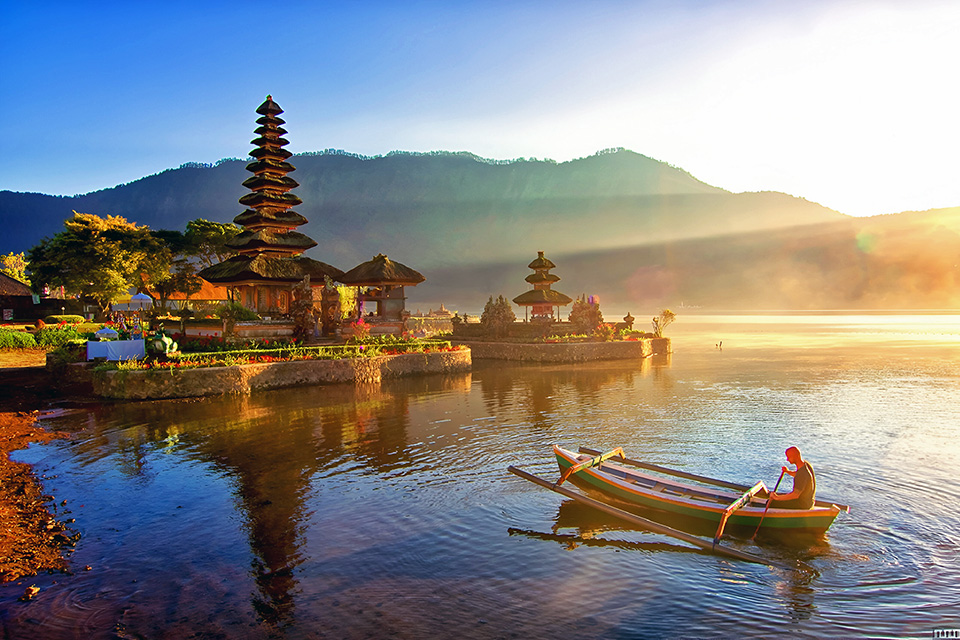
Bedugul
Jatiluwih
Jatiluwih – The Living Canvas of Subak
Jatiluwih is not just a landscape to admire—it is a living heritage where every terrace tells the story of cooperation and devotion.
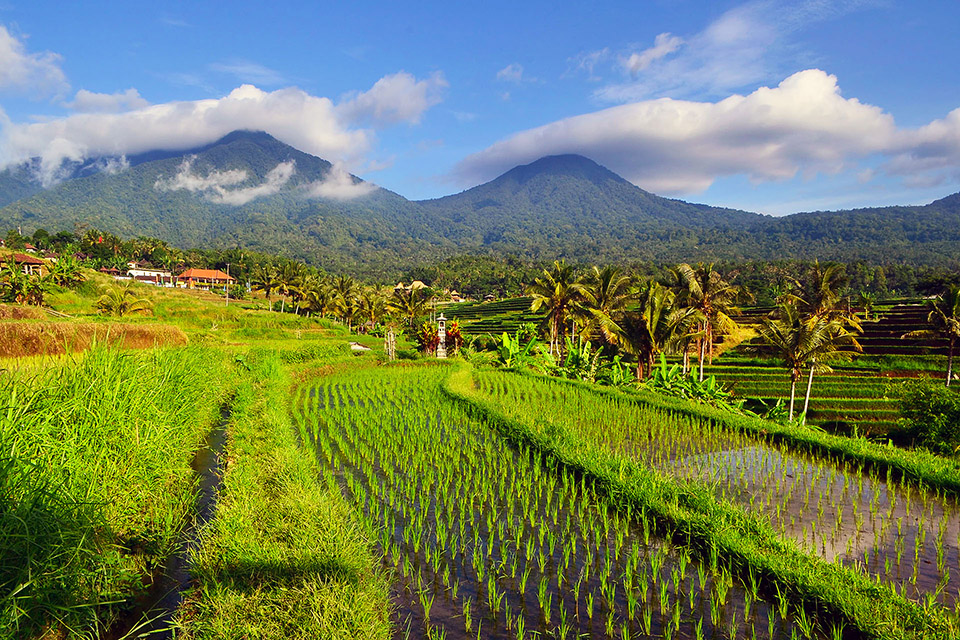
If there is one place that embodies Bali’s harmonious balance between people, nature, and the divine, it is the Jatiluwih rice terraces. Spreading across the foothills of Mount Batukaru, these UNESCO World Heritage–listed landscapes represent the Subak irrigation system, a community-based method of water management that dates back to the 9th century.
Here, emerald-green paddies cascade in endless waves, carved with breathtaking precision into the contours of the land. The name Jatiluwih itself means “truly marvelous,” and no visitor leaves doubting it. Walking trails wind through the terraces, offering different routes from short strolls to full-day treks. Along the way, you’ll encounter farmers guiding ducks, women carrying harvests, and shrines where offerings are placed to Dewi Sri, the rice goddess.
Insider’s Experience – Walking Jatiluwih
- Duration: Routes range from 1–4 hours.
- Stay Overnight: Both sunset and sunrise are spectacular, and you have a chance to see local farmer at work.
- Best time: Morning or late afternoon, when the terraces glow in soft light.
- Tip: Rent a bicycle or e-bike for a unique perspective across the wide valley.
Unlike the more touristed Tegallalang terraces near Ubud, Jatiluwih retains a sense of living authenticity. It is both an agricultural heartland and a spiritual landscape, sustained by the Subak philosophy of Tri Hita Karana—the balance between humans, nature, and the divine.
Pupuan – Plantations & Panoramas
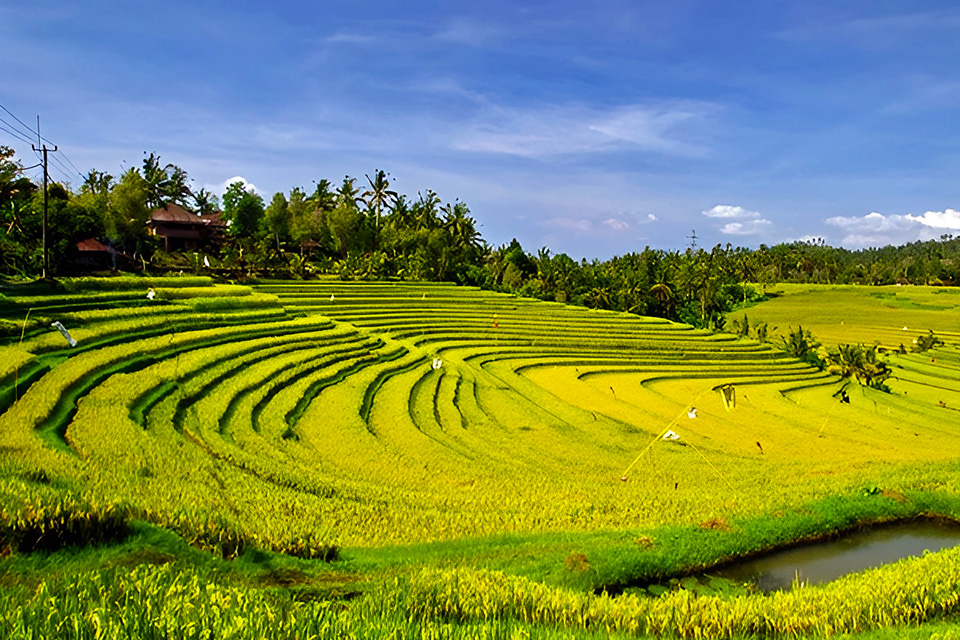
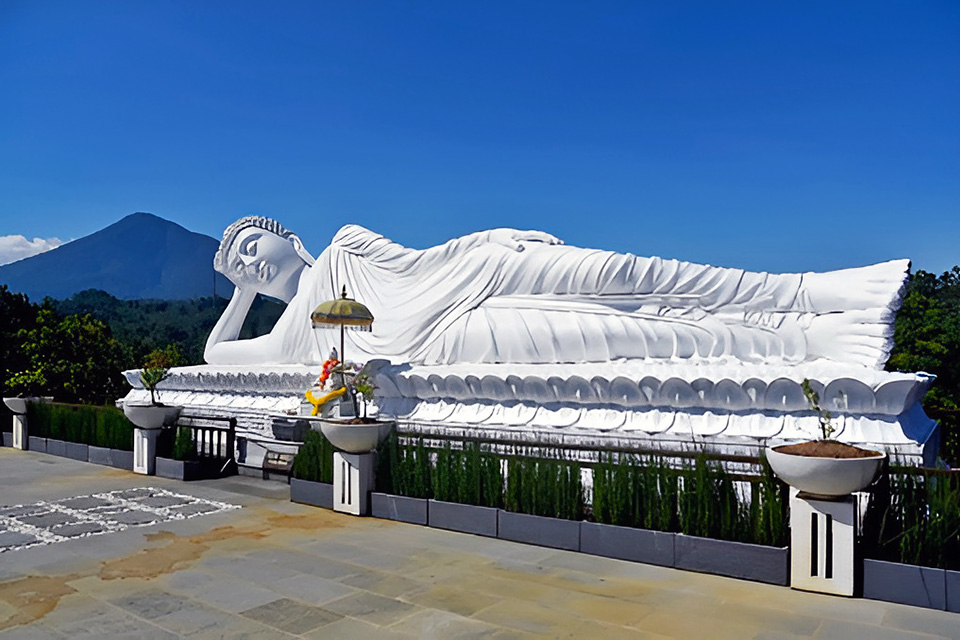
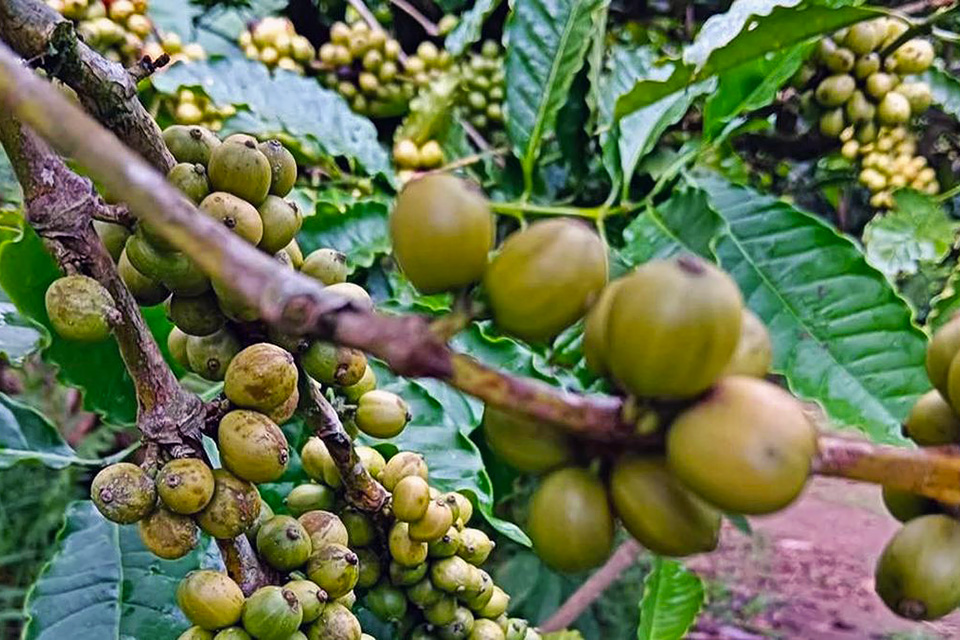
Further west lies Pupuan, a highland district often overlooked by mainstream tourism yet deeply rewarding for those who venture there. Known for its coffee, clove, and cacao plantations, Pupuan offers a glimpse of Bali as it was before mass tourism.
The landscape is a dramatic mosaic: rolling hills carpeted with rice terraces, forests threaded with waterfalls, and valleys where mist lingers over spice groves. Farmers here still cultivate Arabica coffee using traditional methods, and roadside stalls invite you to sample freshly roasted beans alongside clove-scented breezes.
Pupuan is also a photographer’s dream. Roads curve through undulating valleys with views that stretch toward the distant coast. On clear days, you can catch sight of Bali’s chain of volcanoes rising above the horizon. The area’s tranquility, combined with its fertile bounty, makes Pupuan feel like a secret garden of the island.
🌸 Insider’s Insight – Why Pupuan?
- Coffee & Cloves: Pupuan is one of Bali’s key spice-producing regions.
- Scenic drives: The road from Pupuan toward Seririt offers unforgettable vistas.
- Hidden gems: Small waterfalls and unmarked trails reward the curious.
- Authentic experience: Less touristy allows you to immerse into authentic Balinese rural living.
Culinary & Café Scene
If Bali feeds the soul with beauty and ceremony, Ubud feeds the body with flavors that mirror the island’s diversity. Here, meals are more than sustenance; they are a celebration of tradition, artistry, and innovation. From street-side warungs perfumed with spice and smoke to award-winning tasting menus that reinvent Balinese heritage, Ubud has earned its reputation as Bali’s culinary capital.
In Ubud, every plate tells a story—of heritage, of creativity, and of the island’s evolving identity.
From temple feasts to fine dining artistry, vegan cafés to third-wave coffee houses, Ubud’s culinary and café scene reflects the island’s spirit—creative, diverse, and deeply rooted in tradition. For travelers, it’s more than eating well; it’s an invitation to taste Bali’s evolving story, one plate and one cup at a time.
Traditional Balinese Flavors
A trip to Ubud would be incomplete without tasting its signature Balinese dishes, lovingly prepared in local kitchens and family-run warungs.
Bebek Betutu (Slow-Cooked Duck) – A dish steeped in patience and ritual. The duck is marinated in rich base genep spice paste, lined with banana leaves, wrapped in the sheath of a pinang palm frond, then buried in a heap of slow-burning rice husks for at least 12 hours. The result: impossibly tender meat infused with smoky sweetness and deep layers of spice. Traditionally prepared for ceremonies, today many Ubud kitchens still preserve this slow, time-honored cooking method.
Babi Guling (Suckling Pig) – Perhaps Bali’s most iconic ceremonial dish, roasted whole over an open fire. The pig is rubbed inside and out with turmeric, coriander, lemongrass, and garlic before slow-turning on the spit until its skin crisps into golden crackle. Locals flock to roadside warungs serving this feast, with Ibu Oka in Ubud often making it onto must-visit lists. Yet, smaller warungs tucked away in villages often offer versions that feel even more intimate and authentic.
Nasi Ayam Kedewatan – A dish that Ubud claims proudly as its own. Unlike nasi campur, which can be found throughout Indonesia, nasi ayam from the village of Kedewatan is distinctively Balinese. A plate comes alive with chicken cooked in multiple ways — shredded in spices, satay lilit skewers, crispy fried skin — all anchored by rice, sambal, and peanuts. It’s a microcosm of Balinese flavors on a single plate, fiery and aromatic, and a true everyday favorite for locals.
Lawar – More than just a dish, lawar is a cultural act of togetherness. Villagers often gather to prepare it for ceremonies, chopping meat, vegetables, coconut, and herbs by hand while telling stories. Each region in Bali has its own style — red with blood, green with beans, or white with coconut. When you taste lawar, you taste the communal spirit of Bali.
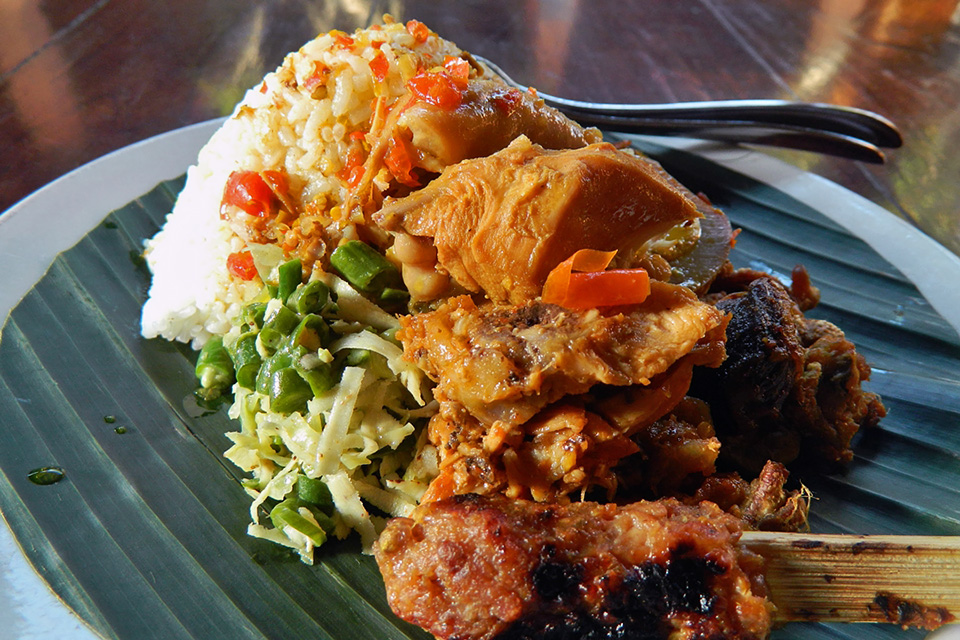
Nasi Ayam Kadewatan Ibu Mangku
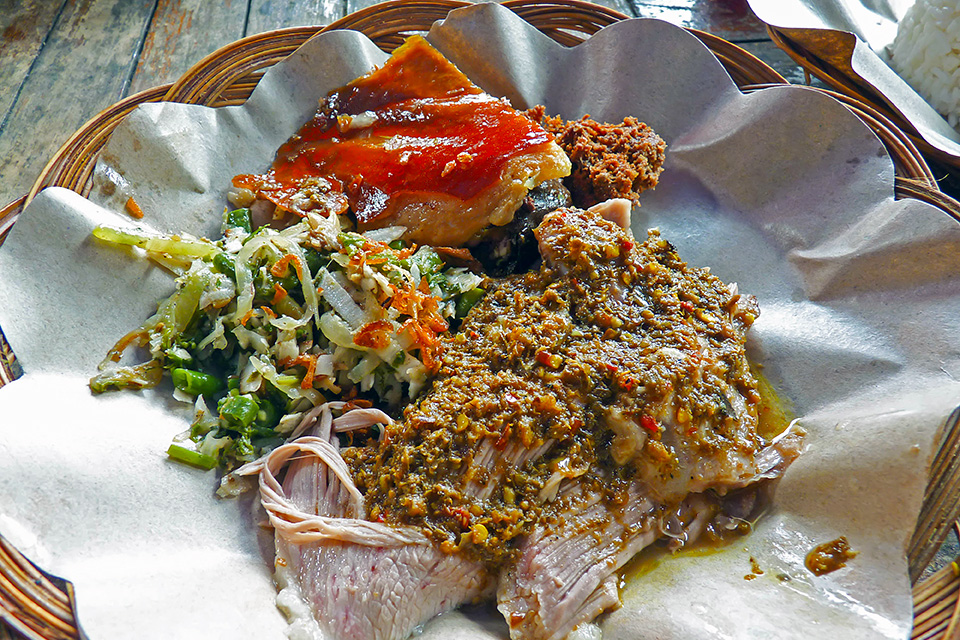
Babi Guling Ibu Oka
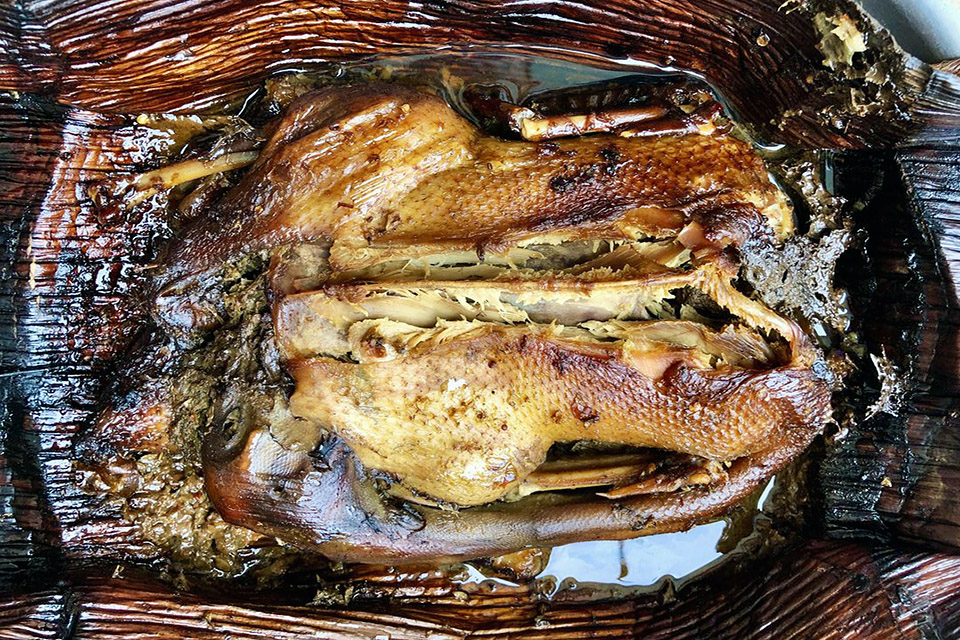
Bebek Betutu Pak Ketut Rimpin
From Warungs to White Tablecloths
Ubud’s dining scene is as diverse as its visitors. Local warungs remain the heartbeat—casual, affordable, and intimate, where grandmothers ladle soup alongside grandchildren. Dishes like nasi campur (rice with mixed sides) or mie goreng (fried noodles) are staples, perfect after a long day exploring.
At the other end of the spectrum, Ubud is home to some of Indonesia’s most celebrated fine dining restaurants:
Locavore – ranked among Asia’s best, this restaurant crafts multi-course tasting menus using only locally sourced ingredients, reimagining Balinese and Indonesian flavors with modern artistry.
Mozaic – an institution blending French techniques with Indonesian spices, offering garden-dining romance under starlit skies.
This balance—between everyday warung food and Michelin-worthy artistry—makes Ubud’s dining scene one of Southeast Asia’s most intriguing.
Insider’s Insight – Ubud Dining Spectrum
- Budget: Warung Biah-Biah, Dewa Warung.
- Mid-range: Clear Café, Casa Luna.
- Fine dining: Locavore, Mozaic.
Vegan & Health-Conscious Cafés
This balance—between everyday warung food and Michelin-worthy artistry—makes Ubud’s dining scene one of Southeast Asia’s most intriguing.
- Alchemy – Bali’s pioneering raw vegan café, famous for its salad bar and raw chocolates.
- Kismet – a stylish spot blending vegetarian and fusion cuisine with an artistic twist.
- Sayuri Healing Food – a hub for Ubud’s creative community, serving living foods, smoothies, and probiotic-rich dishes.
- Zest Ubud: Elevated vegan dining with rice field views.
This balance—between everyday warung food and Michelin-worthy artistry—makes Ubud’s dining scene one of Southeast Asia’s most intriguing.
Coffee Culture & Plantations
No culinary story of Ubud is complete without coffee. Bali has a proud tradition of Arabica and Robusta cultivation, and Ubud is both café haven and gateway to plantations in Kintamani and Pupuan. Local cafés roast beans on-site, with baristas experimenting from cold brew to siphon, while rural tours introduce travelers to the farm-to-cup journey.
For a Balinese twist, try kopi Bali tubruk—a thick, unfiltered brew—or the globally infamous kopi luwak (civet coffee), though ethical sourcing is essential.
☕ Insider’s Tip – Where to Sip in Ubud
- Seniman Coffee Studio: Pioneer of Bali’s specialty coffee movement.
- Anomali Coffee: Showcasing beans from across the Indonesian archipelago.
- Pison: Stylish blend of coffeehouse and brunch spot.
Shopping & Handicrafts
To shop in Ubud is to carry a piece of Bali’s soul home with you—hand-carved, hand-woven, and always touched by spirit.
For centuries, Ubud has been Bali’s creative heartland, where artisans shaped wood, stone, silver, and cloth into objects both sacred and everyday. Today, shopping in Ubud is as much about cultural discovery as it is about souvenirs—each item carrying the story of the island’s artistry and tradition. Whether wandering the bustling lanes of the Ubud Art Market or seeking treasures in craft villages, visitors find that Ubud shopping is not just a transaction—it’s an immersion into Bali’s living heritage.
From bargain treasures at Ubud Art Market to the timeless craftsmanship of Mas and Celuk, and the rise of eco-conscious boutiques, shopping in Ubud is not merely about acquiring objects—it is about connecting with stories, traditions, and values. Every carving, painting, or textile is a piece of Bali’s narrative, crafted by hands that still beat in rhythm with the island’s cultural heart.
Ubud Art Market – The Iconic Starting Point
For centuries, Ubud has been Bali’s creative heartland, where artisans shaped wood, stone, silver, and cloth into objects both sacred and everyday. Today, shopping in Ubud is as much about cultural discovery as it is about souvenirs—each item carrying the story of the island’s artistry and tradition. Whether wandering the bustling lanes of the Ubud Art Market or seeking treasures in craft villages, visitors find that Ubud shopping is not just a transaction—it’s an immersion into Bali’s living heritage.
Insider’s Tips – Navigating Ubud Art Market
- Arrive early: Morning is cooler, less crowded, and sellers often give a “first buyer” blessing price.
- Bring cash: Small notes help, though more stalls now accept cards or QR payments.
- Look upstairs: Fewer crowds, better chance of spotting authentic handcrafts.
Village Crafts – Living Traditions
What sets Ubud apart is that its surrounding villages remain living workshops of traditional crafts, where skills are passed through generations:
- Mas Village – synonymous with woodcarving, from intricate masks to grand statues of deities. Walking through Mas, visitors hear the steady rhythm of chisels against teak and mahogany.
- Batuan – famous for its distinctive style of painting—dense, detailed, and often depicting mythological stories or village life.
- Celuk Village – Bali’s silver capital, known for delicate filigree jewelry and bold contemporary designs. Many workshops welcome visitors to watch artisans at work and even try their hand at crafting.
- Tegalalang – besides rice terraces, also a hub for hand-carved furniture and decorative crafts.
What sets Ubud apart is that its surrounding villages remain living workshops of traditional crafts, where skills are passed through generations:
Insider’s Picks – Best for Authentic Craft
- Mas: Workshop of I Nyoman Sudarso for traditional carvings.
- Celuk: Studio Pemukuran for contemporary silver jewelry.
- Batuan: Local cooperatives for traditional paintings.
Modern Boutiques & Eco-Fashion
Ubud is not locked in the past. Along its leafy streets, modern designers are shaping Bali’s craft traditions into eco-conscious fashion, homeware, and contemporary art.
Boutiques feature handwoven ikat and endek textiles reimagined as chic dresses, bamboo and rattan furniture adapted for modern homes, and recycled materials turned into jewelry or accessories.
Eco-conscious shopping is especially strong here: organic cotton, natural dyes, and upcycled goods reflect Ubud’s progressive spirit. Stores like Threads of Life preserve endangered weaving traditions, connecting buyers directly with village cooperatives across the archipelago.
Where to Shop Sustainably
- Threads of Life: Authentic textiles supporting women’s weaving groups.
- Biasa: Contemporary Balinese fashion with a global flair.
- John Hardy Boutique & Workshop (Mambal, near Ubud): Sustainable silver jewelry rooted in Bali’s environment and culture.
Festivals & Events
If Ubud is Bali’s cultural and spiritual hub, it is also the island’s stage for festivals that celebrate creativity, spirituality, and tradition. The calendar here is alive with both internationally acclaimed gatherings and intimate temple ceremonies that offer travelers a window into the island’s rhythm.
In Ubud, festivals are not just events—they are living expressions of Bali’s soul, uniting art, faith, and community.
From the literary brilliance of UWRF to the soulful energy of BaliSpirit and the timeless cycle of temple festivals, Ubud’s events calendar bridges the global and the deeply local. For travelers, these festivals are more than spectacles—they are invitations to participate in the heartbeat of Bali itself.
Ubud Writers & Readers Festival
Every October, Ubud transforms into Southeast Asia’s literary capital. The Ubud Writers & Readers Festival (UWRF) draws acclaimed authors, poets, and thinkers from across the globe to share ideas through panel discussions, book launches, and workshops. Beyond literature, the festival embraces art, film, and performance, with venues spread across Ubud’s cafés, gardens, and museums.
For travelers, it’s a chance to engage with both international voices and Indonesian writers who rarely reach global stages, all while enjoying the creative spirit of Bali.
Insider’s Tip – Best Way to Enjoy UWRF
- Book passes early; popular sessions sell out fast.
- Explore fringe events (poetry slams, music, art exhibitions).
- Many venues are walkable—combine sessions with café-hopping.
Insider’s Insight – BaliSpirit Essentials
- Available passes range from single-day to full-week immersion.
- Bring a refillable water bottle and comfortable mat.
- Evenings are as energetic as the mornings—pace yourself!
BaliSpirit Festival
Every October, Ubud transforms into Southeast Asia’s literary capital. The Ubud Writers & Readers Festival (UWRF) draws acclaimed authors, poets, and thinkers from across the globe to share ideas through panel discussions, book launches, and workshops. Beyond literature, the festival embraces art, film, and performance, with venues spread across Ubud’s cafés, gardens, and museums.
For travelers, it’s a chance to engage with both international voices and Indonesian writers who rarely reach global stages, all while enjoying the creative spirit of Bali.
Temple Festivals & Balinese Ceremonies
While international festivals attract global crowds, the soul of Ubud’s festival calendar is rooted in Balinese Hindu tradition. Almost every temple hosts an odalan (anniversary) once a year, complete with offerings, gamelan music, and dance performances. Travelers are welcome to observe respectfully, dressed in sarong and sash.
Major island-wide festivals include:
- Galungan and Kuningan – when the spirits of ancestors return, marked by towering penjor bamboo poles lining the streets.
- Nyepi (Balinese New Year) – a day of silence, fasting, and reflection across the island, preceded by spectacular ogoh-ogoh parades of giant demon effigies.
Witnessing such events offers a rare glimpse into Balinese spirituality in its purest form.
Insider’s Tips – Joining Temple Festivals
- Always wear a sarong and sash (many temples provide rentals).
- Ask before photographing ceremonies.
- Donations are appreciated—your contribution supports the community.
Day Trips & Suggested Routes
One of Ubud’s great advantages is its location. Set at the island’s heart, Ubud is the perfect base for exploring Central Bali’s valleys, highlands, lakes, and temples. From here, you can set off on day trips that reveal Bali’s most iconic landscapes as well as its hidden countryside gems. Whether you prefer a scenic loop by car, a full-day trek, or a waterfall-hopping adventure, the options are endless.
From Ubud, every road is a story—toward volcanoes, lakes, rice terraces, and villages where Bali’s traditions still thrive.
Ubud → Kintamani Loop
The classic highland journey, this route takes you north from Ubud through Tampaksiring before climbing toward Kintamani and the rim of Mount Batur’s caldera. Along the way, you pass sacred stops like Goa Gajah, Tirta Empul, and Gunung Kawi before reaching the panoramic views of Lake Batur and Mount Agung in the distance.
On the return loop, consider stopping at Penglipuran Village to wander its neat bamboo-lined streets. The circuit blends history, spirituality, and epic natural beauty in a single day.
Insider’s Tips – Kintamani Day Trip
- Start early for clearer mountain views before clouds gather.
- Combine with a hot spring soak at Toya Bungkah on the lake’s edge.
- If you’re adventurous, book a sunrise trek on Mt. Batur and return via Ubud’s temples.
🌾 Insider’s Picks – Rice Terrace Routes
- Jatiluwih: Choose the 1.5-hour walking trail for the best views and memorable photos.
- Pupuan: Visit in the late afternoon when the light sets rice paddies aglow.
- Combine the route with Batukaru Temple for a spiritual finale.
Ubud → Jatiluwih & Pupuan
Head west through rolling countryside toward Jatiluwih, Bali’s UNESCO-listed rice terraces. Here, the Subak irrigation system—an ingenious water-sharing practice dating back centuries—creates some of the most breathtaking rural panoramas in Asia. Walking trails wind through the paddies, offering both short strolls and long treks.
Continue further into Pupuan highlands, where cloves, cocoa, and coffee thrive. The roads here are quieter and scenic, perfect for slow travel, with misty hills and traditional villages barely touched by mass tourism.
Ubud → Bedugul Highlands
For a day of lakes and cool breezes, head northwest from Ubud to the Bedugul highlands. The highlight is Ulun Danu Beratan Temple, floating gracefully on Lake Beratan. Nearby, the Bali Botanic Garden offers walking trails, canopy walks, and a huge collection of tropical plants.
The route can also include Lake Buyan and Lake Tamblingan, twin volcanic lakes ringed by rainforest. Short treks or canoe rides are possible here, adding a touch of adventure to a scenic outing.
🌿 Insider’s Insight – Bedugul Day Trip
- Stop at roadside stalls for fresh strawberries, a Bedugul specialty.
- Weather can be cooler—bring a light jacket.
- Best combined with Jatiluwih rice terraces for a full-day loop.
💦 Insider’s Tips – Waterfall Hopping
- Bring water shoes; paths can be slippery.
- Tukad Cepung is hidden but popular, visit outside peak hours to avoid crowds.
- Keep dry clothes handy if planning multiple swims. Drybag is reommended.
Waterfall-Hopping Routes
For those seeking adventure and cool swims, Ubud offers easy access to some of Bali’s most spectacular waterfalls.
- Tegenungan – the closest to Ubud, dramatic and popular.
- Nungnung – a thundering 50-meter drop north of Petang, worth the steep stair descent.
- Tibumana – smaller, peaceful, and framed by jungle.
- Tukad Cepung – a magical cascade inside a cave-like canyon, best visited late morning when sunbeams strike.
For those seeking adventure and cool swims, Ubud offers easy access to some of Bali’s most spectacular waterfalls.
Accommodation Guide
When it comes to where to stay in Ubud, few destinations in Bali rival the sheer diversity of choices. From world-renowned luxury resorts perched over jungle valleys to boutique eco-lodges, private pool villas, and charming family-run homestays, Ubud accommodation reflects the town’s role as both a cultural hub and a retreat for the soul. The surrounding highlands, from Jatiluwih to Kintamani, offer even more remote sanctuaries for those seeking cool air and mountain views.
From world-class resorts to family-run guesthouses, Ubud’s accommodation scene mirrors its identity—luxurious, artistic, soulful, and welcoming. Whether you’re planning a honeymoon retreat in a jungle villa, a yoga week in an eco-resort, or a budget journey through homestays and highland villages, Ubud and its surroundings offer stays that align with every style of travel.
Luxury Resorts in Ubud
For travelers seeking the ultimate indulgence, Ubud is home to some of Bali’s most celebrated hotels.
- Four Seasons Resort at Sayan: Nestled in a lush valley by the Ayung River, this resort is consistently ranked among the world’s best. Its striking architecture—guests enter via a suspended lotus pond before descending into the jungle—makes it an experience in itself.
- Mandapa, a Ritz-Carlton Reserve: Framed by rice paddies and river views, Mandapa combines understated Balinese elegance with impeccable service. Each suite or villa feels like a private sanctuary.
- Amandari: A pioneer in Ubud luxury, Amandari is set on the edge of the Ayung Gorge, with thatched-roof suites inspired by a traditional village. Its tranquil design reflects timeless harmony with the landscape.
These Ubud resorts redefine luxury not just with facilities, but with the immersive serenity of their settings.
Boutique & Eco-Resorts
For a more intimate stay, Ubud boutique hotels and eco-resorts combine creative design with a focus on sustainability.
- Bambu Indah: A visionary bamboo and reclaimed teak retreat designed by jewelry designer John Hardy, offering dramatic eco-luxury experiences such as jungle plunge pools and riverside dining.
- Bisma Eight: A stylish boutique stay blending modern design with Balinese touches, known for its rooftop infinity pool and curated dining.
- Chapung Sebali: A hillside hideaway with a chic jungle club atmosphere, balancing luxury suites with bohemian vibes.
These properties appeal to travelers who want comfort with character—stays that are as much about storytelling as about sleeping.
Villas & Rice Field Retreats
For those who dream of privacy and space, Ubud villas are plentiful. Many come with private pools, open-air living spaces, and rice field views.
- Couples often choose one-bedroom villas with infinity pools overlooking valleys.
- Families and groups can rent spacious multi-room villas with full staff, creating a private-hotel feel.
- Locations range from central Ubud—within walking distance to cafés and markets—to outskirts like Penestanan or Pejeng, where the vibe is more tranquil.
Staying in a villa often means enjoying sunrise yoga on your terrace, lazy afternoons by the pool, and candlelit dinners prepared by private chefs.
Budget Stays & Homestays
Travelers on a budget will find Ubud homestays and guesthouses that are warm, authentic, and surprisingly stylish. Many are family-run, offering not just a room but a window into daily Balinese life. Expect:
- Simple yet comfortable rooms with fans or AC.
- Breakfast served on balconies overlooking rice paddies.
- Hosts who are eager to share stories, tips, or even involve guests in temple ceremonies.
These homestays remain one of the best ways to experience the generosity and hospitality of Ubud’s community.
Highland Retreats – Beyond Ubud
For travelers seeking cool mountain air and dramatic scenery, Central Bali hotels and retreats beyond Ubud are an inspiring choice:
- Jatiluwih: Eco-lodges with direct access to the UNESCO rice terraces, perfect for hikers and slow travelers.
- Kintamani: Lake-view resorts and mountain lodges offering easy access to the Mt. Batur sunrise trek and hot springs. The atmosphere here is rustic, but the trade-off is waking up to volcano silhouettes at dawn.
These highland escapes allow guests to experience Bali at a slower pace, surrounded by nature rather than nightlife.
Practical Travel Tips
Even the most detailed Ubud travel guide would feel incomplete without addressing the practicalities that make or break your experience. Beyond temples and rice fields, knowing the best time to visit Ubud, how to get around, and essential etiquette will help you travel not only more smoothly, but also more respectfully.
Best Time to Visit Ubud
Bali’s tropical climate means Ubud is lush and green year-round, but the seasons matter.
- Dry Season (April–October): The most popular time to visit, with sunny days and cooler evenings in the highlands. Perfect for trekking, cycling, and outdoor exploration.
- Wet Season (November–March): Expect heavy but often short-lived rain showers, which keep the landscapes emerald. It’s quieter and can be magical for photography, but some trekking paths get muddy.
If you want festivals, July and August bring cultural vibrancy, while May and September offer the best balance of good weather and fewer crowds.
Getting to Ubud
Most travelers arrive in Bali via Ngurah Rai International Airport in Denpasar. Ubud is about 40 km (1.5–2 hours) away depending on traffic.
- Private transfer: The most convenient, especially if booked in advance through hotels or travel platforms.
- Taxis & ride-hailing apps: Widely available, though costs vary.
- Shuttles & buses: Budget options connecting Ubud with South Bali, Canggu, and the airport.
Getting Around Ubud
Ubud itself is walkable in its central area, but much of its beauty lies in the surrounding countryside.
- Scooter rental: The most flexible way to explore, but only recommended if you are confident in Bali’s traffic.
- Private driver: Best for day trips to waterfalls, rice terraces, or temples outside town.
- Cycling: Many guided tours explore rural backroads and rice fields.
Insider’s Tips – Exploring on Foot
If you’re staying in central Ubud, walking is often faster than driving short distances. The narrow streets can be congested, but on foot you can slip easily between temples, cafés, and markets.
How Many Days to Stay
- 3 days: Enough for highlights—temples, rice terraces, Monkey Forest, and a cultural show.
- 5–7 days: Allows time for day trips to Kintamani, Jatiluwih, or waterfalls.
- 10+ days: Ideal for slow travel—cooking classes, yoga, art workshops, or simply relaxing in a villa.
Ubud rewards longer stays. Its rhythm is less about rushing from sight to sight, and more about lingering in the details.
Etiquette at Temples
Ubud’s temples are living spiritual spaces. Observing proper behavior ensures respect.
- Wear a sarong and sash (often provided at entrances).
- Do not enter inner sanctums unless invited.
- Avoid pointing feet at shrines.
- Women should refrain from entering temples during menstruation.
Insider’s Insight – Watch Your Steps
Local offerings—small woven baskets filled with flowers, rice, and incense—are placed everywhere, even on sidewalks. Step around them, never over them.
Money & Connectivity
- Currency: Indonesian Rupiah (IDR). Beware that transactions in foreign currency within Indonesian territory are prohibited by law.
- ATMs: Widely available, but withdrawal limits are often small; larger withdrawals may require multiple transactions.
- Cash vs. Cards: Many cafés and boutiques take cards, but small shops and rural areas prefer cash.
- Cashless Payments: For modern, safe and reliable digital transaction, use BaliCASH.
- Internet: Wi-Fi is reliable in Ubud cafés and hotels. For seamless coverage, get a local SIM card or eSIM.
Safety in Ubud
Ubud is generally safe, but common-sense precautions apply.
- Traffic: The biggest hazard—be cautious when renting scooters.
- Petty theft: Rare, but keep bags close in crowded areas.
- Health: Tap water is not drinkable; use bottled or filtered water.
- Nature: Monkeys in the Sacred Forest can be mischievous—don’t carry food openly.
Ubud’s charm lies in its combination of adventure and tranquility. Being mindful of safety and respect allows you to immerse in it fully.
Final Note
These Ubud travel tips aim to help you navigate the essentials—weather, transport, etiquette, and safety—so that you can focus on the real treasures: art, temples, landscapes, and encounters with Balinese culture. With preparation and respect, your journey to Ubud becomes more than a trip; it becomes a harmonious immersion into Bali’s highland heart.
Suggested Itineraries
No matter how much time you have, Ubud and the Central Bali highlands offer a rhythm that adapts to every kind of traveler. This section lays out flexible Ubud itineraries—whether you have just 2 days in Ubud, 4 days to combine temples and waterfalls, or a full week exploring the highlands. We also include special routes for families, adventure-seekers, and those who prefer slow travel.
A Quick 2-Day Ubud Itinerary
Ideal for travelers on a short trip, this focuses on Ubud’s cultural heart and nearby landscapes.
Day 1 – Ubud Town & Culture
- Morning: Visit Ubud Palace, then explore Ubud Art Market.
- Afternoon: Wander through the Sacred Monkey Forest Sanctuary.
- Evening: Enjoy a Balinese dance performance at the palace or Water Palace.
Day 2 – Temples & Rice Fields
- Morning: Head to Tirta Empul and Gunung Kawi in Tampaksiring.
- Afternoon: Stop by Tegallalang rice terraces for views or a short walk.
- Evening: Return to Ubud for dinner at a local warung or a fine-dining restaurant.
In two days, you’ll glimpse Ubud’s essence: spirituality, artistry, and landscapes shaped by devotion and tradition.
4-Day Ubud + Temples + Waterfalls
Perfect for travelers who want a deeper cultural and natural immersion.
- Day 1 – Classic Ubud
Palace, Monkey Forest, Campuhan Ridge Walk, and a traditional dance. - Day 2 – Temples of the Petanu Valley
Goa Gajah, Yeh Pulu, and Samuan Tiga. Afternoon in Gunung Kawi Sebatu for a peaceful experience. - Day 3 – Waterfall Day
Visit Tibumana, Tegenungan, and Tukad Cepung. End the day with a sunset café stop overlooking rice fields. - Day 4 – Highlands Escape
Drive north through Bongkasa–Carangsari–Petang–Pelaga, stopping at waterfalls and coffee plantations before looping back.
1-Week Central Bali Circuit
This is where you experience the Ubud + Central Bali itinerary in full.
- Day 1–2 – Ubud Town & Cultural Heart
Markets, palaces, art museums, artisan villages. - Day 3 – Temples & Sacred Springs
Tirta Empul, Gunung Kawi, Goa Garba, and Samuan Tiga. - Day 4 – Kintamani Highlands
Mt. Batur sunrise trek, Toya Bungkah hot springs, and lakeside lunch with volcano views. - Day 5 – Jatiluwih & Pupuan
UNESCO rice terraces, Subak irrigation walks, Pupuan’s clove plantations and landscapes. - Day 6 – Bedugul
Ulun Danu Beratan Temple, Botanic Gardens, strawberry farms, and Lake Buyan/Tamblingan. - Day 7 – Slow Morning & Departure
Yoga, café hopping, or spa in Ubud before heading south.
Insider’s Picks – Ubud for Photographers
For photographers, a one-week trip is ideal. Sunrises in Batur, sunsets over Jatiluwih, and misty mornings in Bedugul give a stunning variety of moods and landscapes.
Thematic Itineraries
Family Trip Itinerary (5 Days)
Families often need a gentler pace with cultural touches and nature experiences.
- Day 1: Ubud Palace + Monkey Forest (kids love the monkeys).
- Day 2: Cycling through rice fields + Tegallalang swings.
- Day 3: Penglipuran bamboo village + Tukad Cepung waterfall.
- Day 4: Bedugul’s Botanic Gardens + strawberry picking.
- Day 5: Rafting on the Ayung River (mild and family-friendly) + relaxed afternoon café time.
Adventure-Focused Itinerary (6 Days)
For adrenaline seekers and explorers.
- Day 1: Rafting on the Ayung River.
- Day 2: Mt. Batur sunrise trek + hot springs.
- Day 3: Cycle Bongkasa backroads → Pelaga waterfalls.
- Day 4: Waterfall-hopping: Tukad Cepung, Nungnung, Tibumana.
- Day 5: Trekking in Jatiluwih rice terraces.
- Day 6: Explore Bedugul lakes with kayaking or forest treks.
Slow-Paces Travel Itinerary (1 Week+)
Ubud’s rhythm is perfect for those who prefer to go deeper rather than farther.
- Stay in a villa overlooking rice terraces.
- Spend mornings with yoga, meditation, or cooking classes.
- Dedicate afternoons to exploring one temple or village at a time.
- Join art workshops (painting, batik, carving).
- Take part in community tourism in Carangsari or Penglipuran.
- End days with long café sessions, reading, or journaling while gamelan drifts from a nearby temple.
In slow travel, the details bloom—incense smoke curling at dawn, farmers calling to each other across fields, the rhythm of daily offerings.
Closing Thought
Whether you have 2 days in Ubud or a week across the Central Bali highlands, the right Ubud itinerary lets you balance temples, landscapes, and living culture at your own rhythm. Think of these as blueprints to adapt—mix adventure with relaxation, or culture with cuisine—until the journey feels uniquely yours.
Why Ubud & Central Highlands Are Bali’s Soul
To understand why visit Ubud is to understand Bali itself. Nestled in a tapestry of emerald rice terraces, sacred rivers, and misty highlands, Ubud is more than a destination—it is a way of life. Here, the rhythms of daily offerings, the echo of gamelan, and the artistry carved into every temple and village home create a world where culture and nature coexist seamlessly.
In Ubud, every path, every terrace, every temple tells a story. Visiting is not just sightseeing—it is stepping into Bali’s heartbeat.
A Tapestry of Culture
Ubud’s cultural heritage is woven into every experience. From the animated energy of Ubud Palace and traditional dance performances to the intimate sanctity of riverside temples like Gunung Kawi and Tirta Empul, the town invites travelers to witness traditions that are both ancient and living. Artisan villages in Mas, Celuk, and Batuan keep centuries-old crafts alive, while museums preserve and celebrate the island’s artistic evolution.
Participating in temple ceremonies, banjar life, or local workshops is more than a tourist experience—it is a bridge to understanding Bali’s social and spiritual fabric. Ubud is where ritual, creativity, and daily life intersect, offering a profound cultural immersion that lingers long after you leave.
Nature That Inspires
The nature in Central Bali mirrors the town’s cultural richness. Terraced fields of Tegallalang and UNESCO-listed Jatiluwih reveal a landscape sculpted by human ingenuity and natural beauty. Forests along the Ayung and Petanu rivers provide sanctuary to wildlife and calm for the spirit. Waterfalls, volcanoes, and highland plantations—Batur, Pupuan, Bedugul—create an endless palette of exploration and sensory wonder.
Hiking, cycling, rafting, or simply wandering quiet lanes, travelers discover that Ubud’s natural landscapes are not just backdrops—they are living, breathing companions to the human stories unfolding in the villages below.
The Central Highlands Experience
Beyond the town center, the Central Highlands offer a slower pace, panoramic vistas, and encounters with traditions less touched by tourism. Kintamani, Bongkasa, Carangsari, Pelaga, Pupuan, and the highland corridors of Bedugul and Jatiluwih form a circuit where spirituality, agriculture, and rural life converge. Here, travelers experience Bali in its purest, most contemplative form, from misty mornings over volcanic lakes to the tranquil discipline of Subak rice terraces.
Discover the Soul of Bali
Ubud and the Central Highlands are not merely visited—they are felt. Every step along the rice terraces, every incense-scented temple courtyard, every workshop of skilled artisans evokes a deep, enduring connection with the island. It is this blend of art, spirituality, and nature that makes the region the soul of Bali.
For travelers seeking to immerse fully, to explore beyond the guidebook, and to experience Bali’s heart with all its nuance, HalloBALI tours offers curated journeys that ensure each step is meaningful, each moment unforgettable. From cultural deep dives to highland adventures, these tours turn your exploration into a lived experience of Ubud and Central Bali—a journey that resonates long after departure.
Step beyond sightseeing. Discover the soul of Bali in Ubud and the Central Highlands.