Tanggedu Waterfall Sumba is where effort meets reward. Beyond the long drive and rugged descent lies a landscape unlike anything else on the island—terraced pools, sculpted limestone, and water that glows under the sun. It’s not just about seeing a waterfall, but experiencing it from within, moving across levels and discovering new perspectives at every turn. For travelers seeking something raw, real, and deeply memorable, Tanggedu delivers a rare kind of beauty that can’t be rushed.
This is more than a destination—it’s a sensory journey through one of Indonesia’s most underrated natural masterpieces.
- Sumba Travel Guide
- East Sumba Travel Guide
- Book Sumba Tours Online
- East Sumba Tours
- Walakiri Beach Guide
- Puru Kambera Beach
- Tarimbang Beach Guide
- Wairinding Hill Guide
- Rende Village Guide
Where the Earth Splits Open into Water and Light
The road to Tanggedu does not prepare you for what comes next.
For hours, East Sumba unfolds in shades of gold and dust. Rolling savannas stretch endlessly under a wide, unforgiving sky. The land feels ancient, exposed, almost elemental—where wind replaces noise, and time slows to something quieter. You begin to understand why people describe Sumba not as a destination, but as a feeling.
And then, without warning, the earth breaks.
Not gently. Not gradually. But suddenly—like a secret split open.
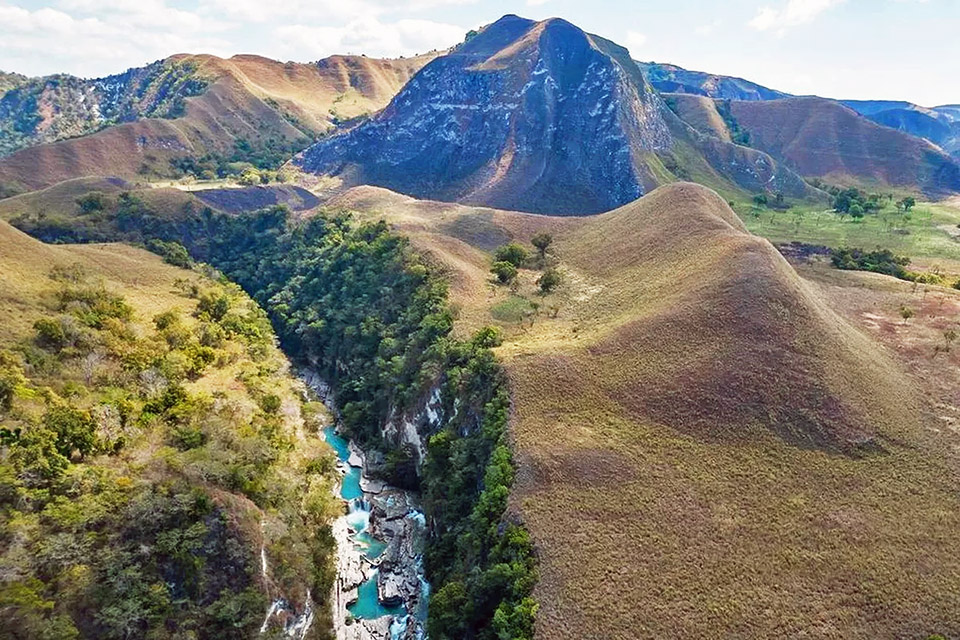
What was once dry terrain gives way to a carved canyon, its edges raw and sculpted, as if water once fought its way through stone and never truly left. You don’t see the waterfall immediately. Instead, you sense it. A subtle shift in the air. A faint echo rising from below. The promise of something hidden.
You step closer. And there it is.
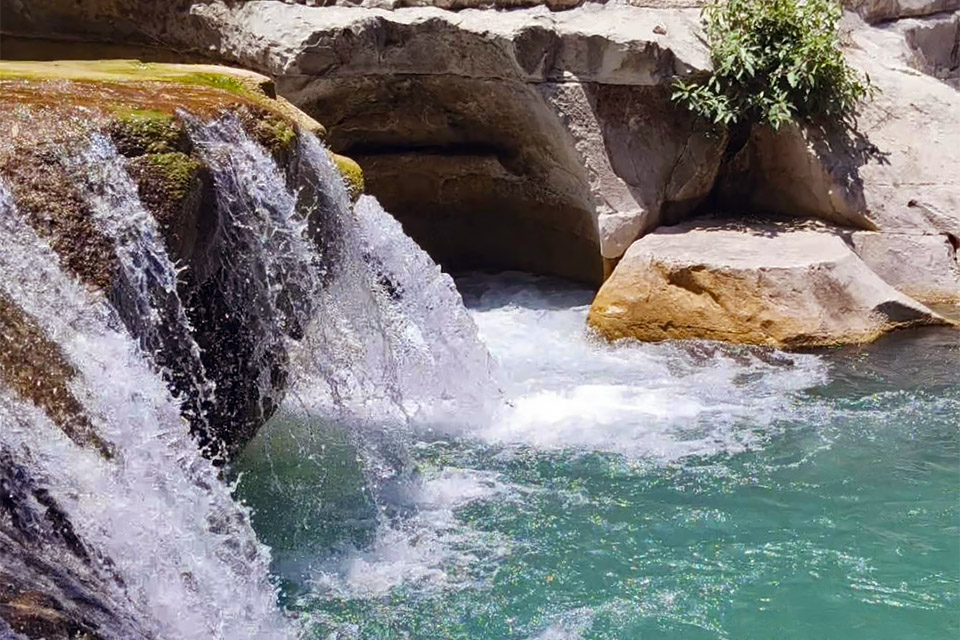
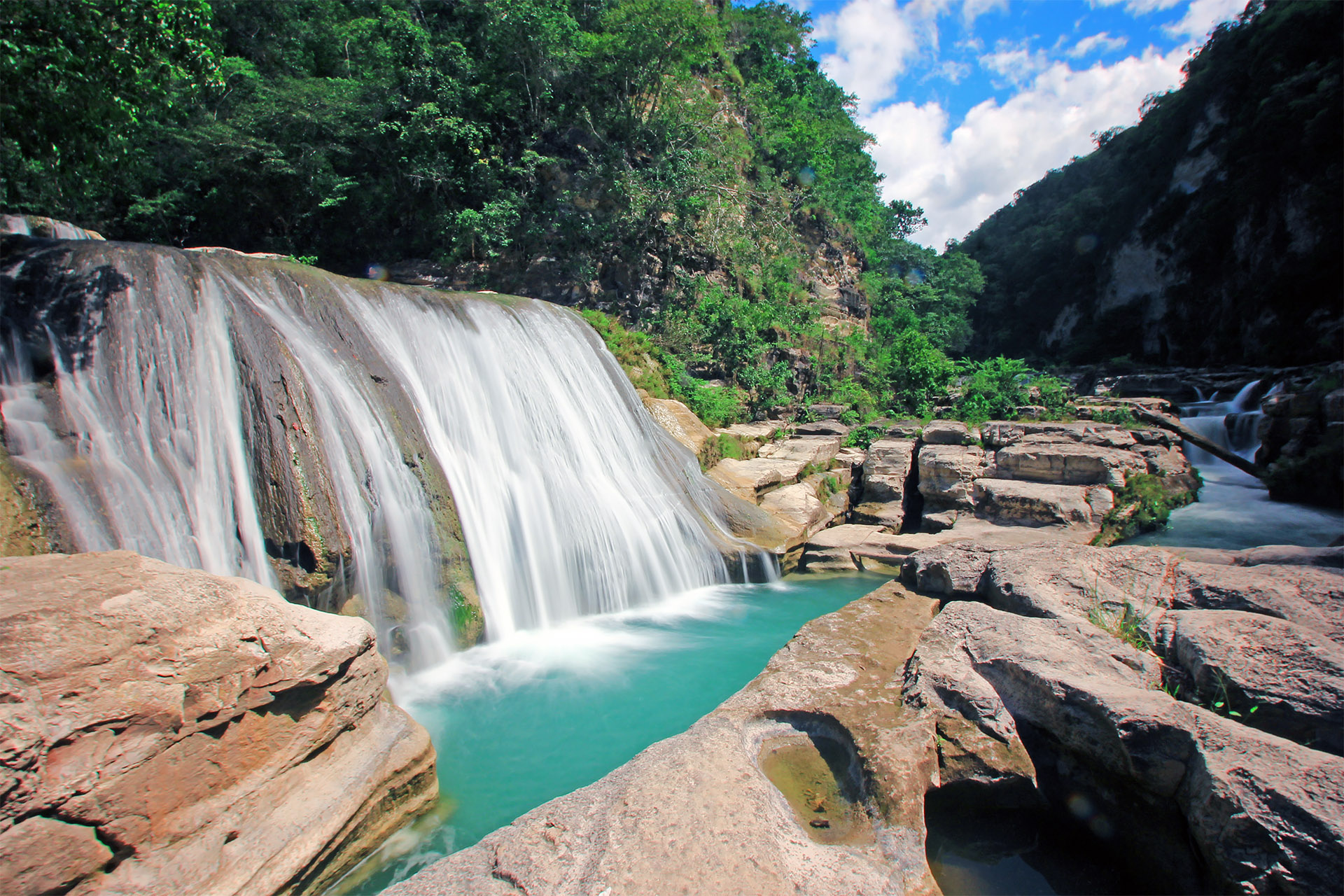
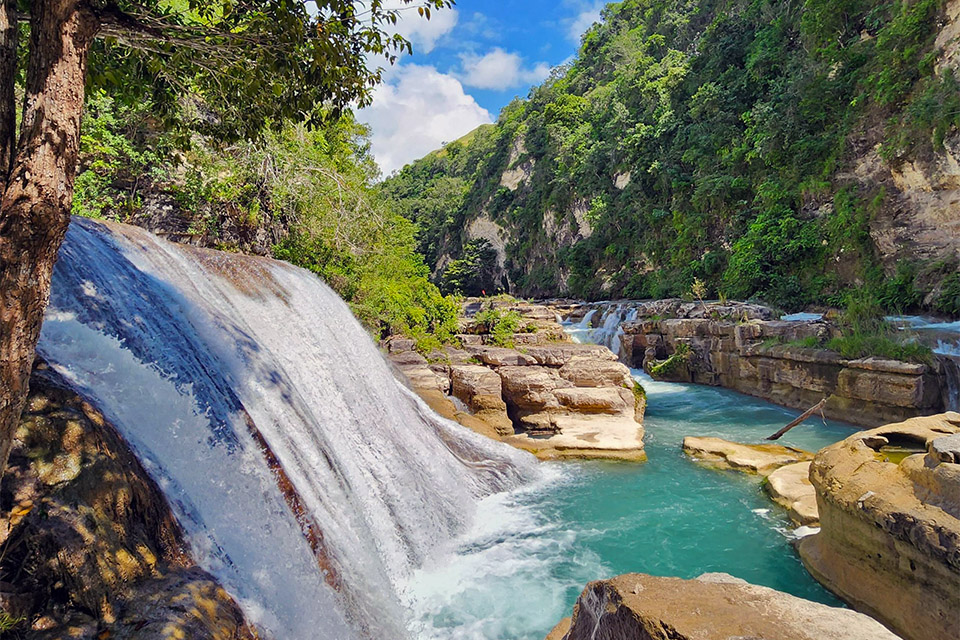
Layers of rock cascading downward in soft, irregular terraces. Water gliding, not crashing—flowing in quiet persistence from one level to the next. And at the base of each natural step, pools gather in impossible shades of turquoise, so clear and luminous they feel almost unreal against the dryness above.
For a moment, nothing makes sense.
How can something this alive exist in a landscape that feels so stark? How can water look this soft in a place this wild? This is Tanggedu Waterfall—not a single dramatic drop, but a living composition of stone, light, and movement. A place where the journey downward feels like crossing into another world entirely.
You don’t arrive at Tanggedu. You descend into it—like stepping into a secret the island tried to keep.
There is no grand entrance here. No constructed viewpoint. No immediate reward. Only a quiet invitation—to keep going, to look closer, to let the landscape reveal itself slowly. And that is exactly what makes the first encounter unforgettable.
Because Tanggedu doesn’t overwhelm you. It unfolds.
One step. One level. One breath at a time.
What Makes Tanggedu Waterfall Unique?
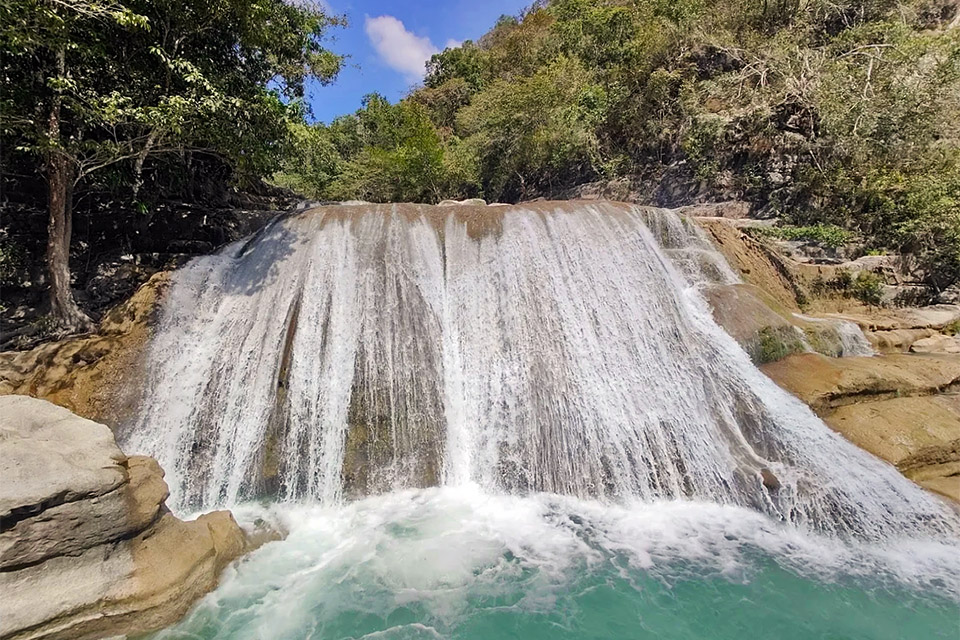
At first glance, calling Tanggedu a “waterfall” feels almost too simple. Because what you find here doesn’t behave like a waterfall at all. There is no single dramatic plunge. No towering curtain of water crashing into a misty basin. No moment where everything happens at once. Instead, Tanggedu unfolds slowly—like a landscape learning how to move.
Water doesn’t fall here. It travels.
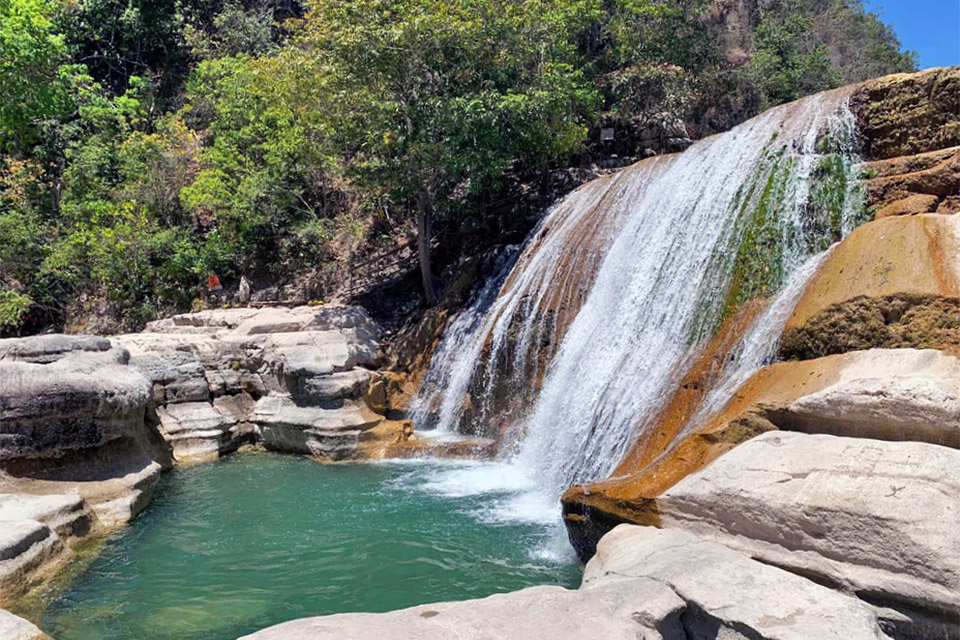
It slips, curves, and glides across layers of limestone that have been shaped over centuries into soft terraces and natural steps. Each level forms its own pool—some shallow and glass-like, others deeper and glowing in shades of turquoise that feel almost unreal against the earthy tones of the canyon walls.
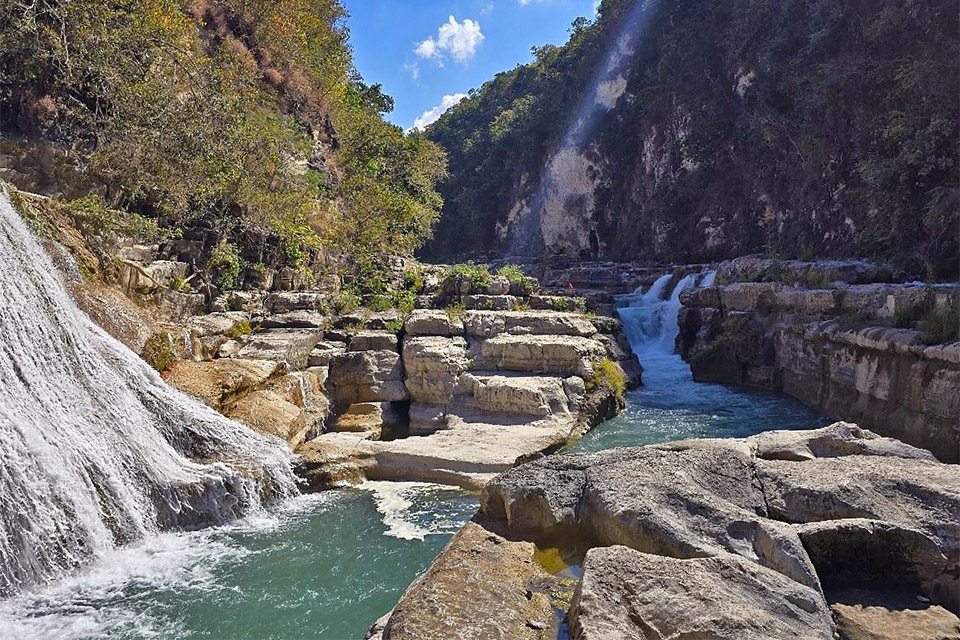
You don’t stand in front of Tanggedu and admire it from a distance. You move with it. Climbing from one level to the next. Sitting by one pool before discovering another just above it. Following the water as if it’s leading you somewhere—though it never quite reveals a final destination.
Tanggedu is not one waterfall—it’s a journey of water, unfolding level by level.
What makes it even more striking is the contrast. All around you, East Sumba stretches out in dry savannas and sunburnt hills. The island often feels raw, exposed, almost minimal in its beauty. And yet here, hidden within a carved canyon, water gathers in abundance—cool, clear, and impossibly vibrant.
It feels like an exception to the rules of the land. A quiet contradiction.
Geologically, Tanggedu is the result of time and persistence. Seasonal water flow has carved through layers of limestone, shaping smooth channels, rounded edges, and sculptural formations that look almost hand-crafted. Unlike volcanic waterfalls found elsewhere in Indonesia, this landscape feels softer—more fluid, more intimate.
There’s also a sense of scale that surprises you.
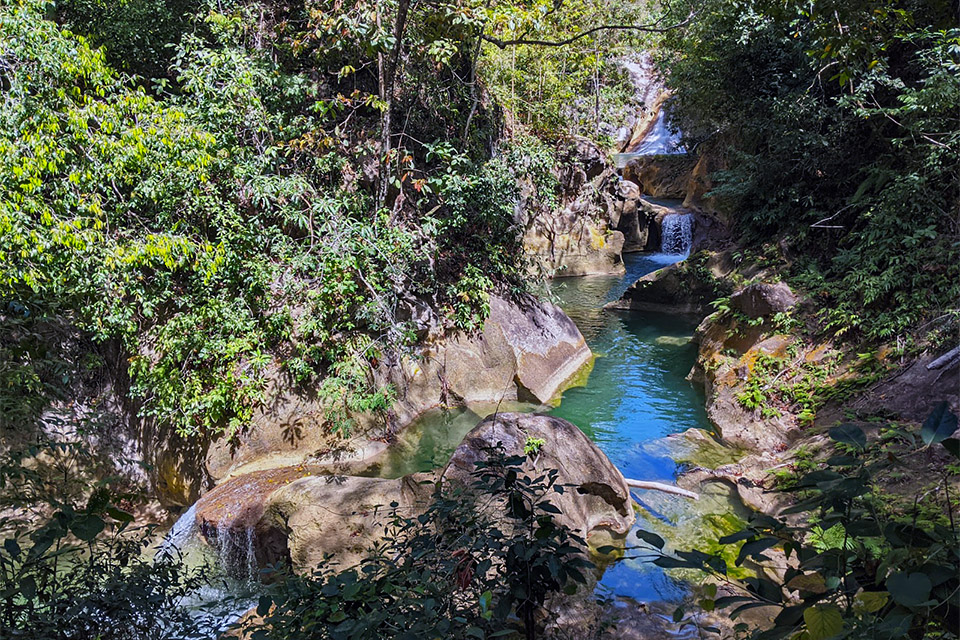
From above, Tanggedu can seem modest—just another break in the terrain. But once you descend into the canyon, everything shifts. The walls rise around you. The sound of water echoes gently between stone surfaces. The sky narrows into a ribbon of light above.
You are no longer looking at the landscape. You are inside it.
It’s only when you step down into Tanggedu that you realize—the real view was never from above.
And then there is its changing nature. Tanggedu is not static. It transforms with the seasons. In the dry months, the water clears into luminous turquoise pools, calm and inviting. In the rainy season, the flow intensifies, the color deepens, and the entire canyon feels more alive—wilder, louder, less predictable.
It never looks exactly the same twice. Which means no two visits are ever identical. Perhaps that’s what makes Tanggedu truly unique. Not just how it looks—but how it reveals itself. Slowly. Quietly. And only to those willing to follow its path all the way through.
Where Is Tanggedu Waterfall & How to Get There
Reaching Tanggedu is part of the experience—and part of the story you’ll carry long after you leave. The waterfall sits on the eastern side of the island, in East Sumba, a region known for its vast savannas, traditional villages, and landscapes that feel untouched by time. The closest gateway is Waingapu, a quiet coastal town where most journeys across the region begin.
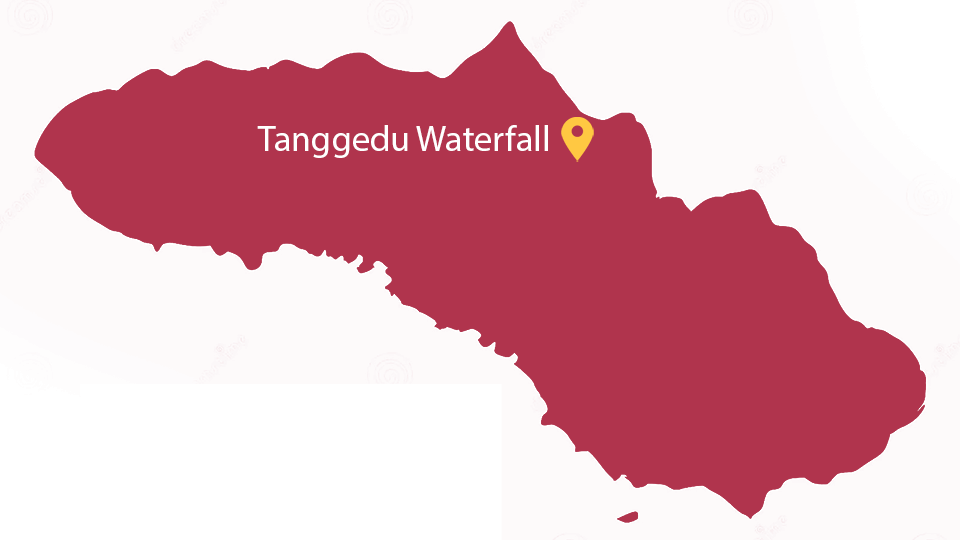
From Waingapu, the drive takes roughly 1.5 to 2 hours, depending on your pace and your willingness to stop—and you will want to stop. Because this is not a journey you rush. The first stretch eases you in with relatively smooth asphalt roads, weaving past local homes, small warungs, and glimpses of everyday Sumbanese life. Children wave as you pass. Motorbikes hum by. The landscape feels grounded, familiar.
But slowly, almost imperceptibly, the road begins to change.
The asphalt thins. The edges roughen. The rhythm of the drive shifts.
Soon, the paved road gives way to narrower paths, sometimes broken, sometimes dusty, sometimes nothing more than tracks carved into the earth. During the dry season, the surface turns into a fine layer of ochre dust that lifts behind you with every turn. In the rainy season, those same roads can become muddy, unpredictable, and occasionally impassable.
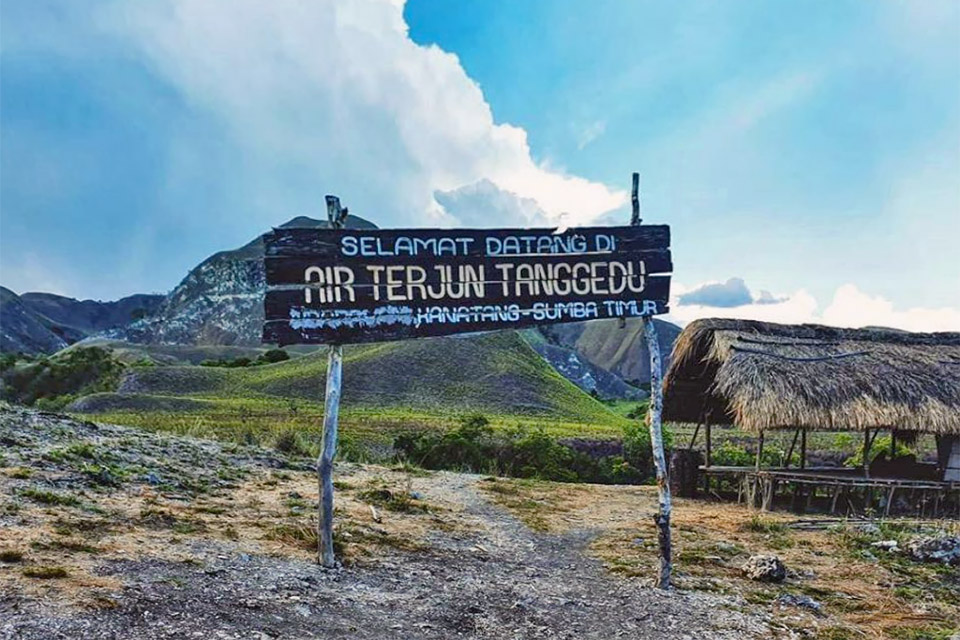
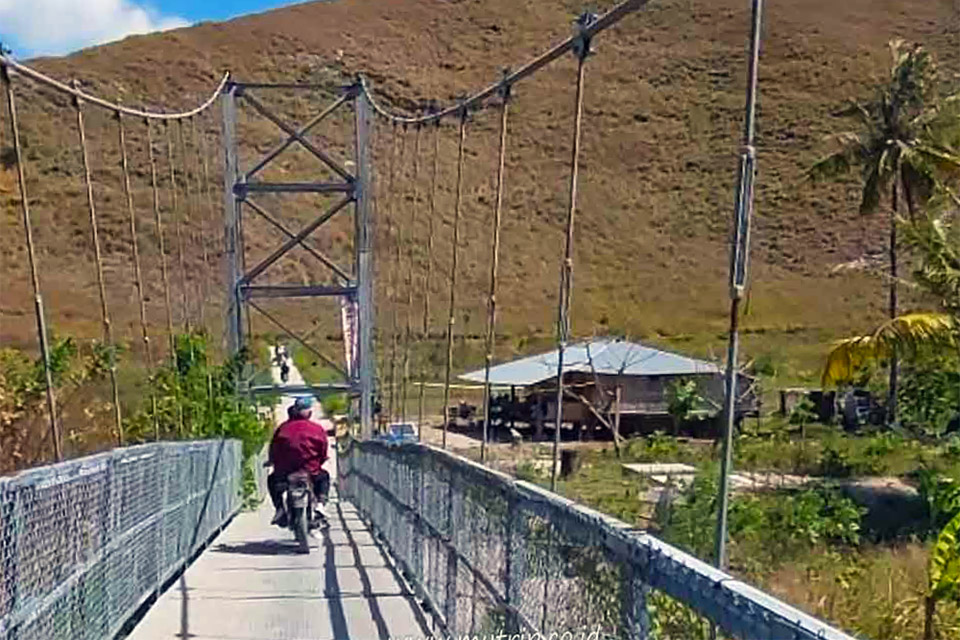
And yet, this is where the journey becomes real.
The villages grow quieter. The horizon opens wider. Hills roll in soft waves of gold and green, dotted with grazing horses and lone trees standing like silhouettes against the sky. There are long stretches where you’ll see no one at all—just land, sky, and the feeling that you’re moving deeper into something less traveled.
There are no large signboards pointing the way. No polished tourist infrastructure guiding your route. Only instinct, preparation, and sometimes the help of locals.
In Sumba, the destination is never just a place—it’s a direction you slowly learn to trust.
As you get closer, the road narrows even further. Eventually, you’ll reach a simple parking area—unmarked, modest, easy to miss if you’re not paying attention. This is where the drive ends.
From here, Tanggedu asks something more of you.
Because the final stretch is not driven. It’s earned.
 Insider’s Logistics — Getting There Without Stress
 Insider’s Logistics — Getting There Without Stress
Best starting point: Waingapu.
Recommended transport:
- Private car with experienced local driver (best option).
- Scooter (only for confident riders).
Road conditions:
- Good asphalt → broken roads → dirt tracks.
Mobile signal:
- Limited to none closer to the waterfall.
Travel time: ± 1.5–2 hours (one way).
Navigation tips:
- Download offline maps (Google Maps can be unreliable in remote areas).
- Ask locals for confirmation near the final stretch.
Fuel & supplies:
- Fill up in Waingapu—no fuel stations near the site.
The beauty of Tanggedu begins long before you see water. It begins the moment the road stops feeling predictable—and starts feeling like an invitation.
The Journey In — Trekking Into the Canyon
The car stops before the experience truly begins. There is no dramatic entrance. No sign announcing that you’ve arrived somewhere special. Just a quiet clearing, a few scattered trees, and a narrow path that seems to disappear into the earth.
At first, it feels almost underwhelming. Until you take the first step.
The trail begins gently, easing you forward across dry soil and low grass, the kind of terrain you’ve already grown familiar with in East Sumba. The sun hangs high, unfiltered, pressing warmth onto your shoulders. The air feels still. Quiet.
But within minutes, the path begins to shift. The ground tilts downward. The soil gives way to rock. The openness of the savanna starts to close in as the land subtly pulls you toward something deeper.
What was once a walk becomes a descent—uneven, sometimes steep, occasionally requiring both balance and intention.
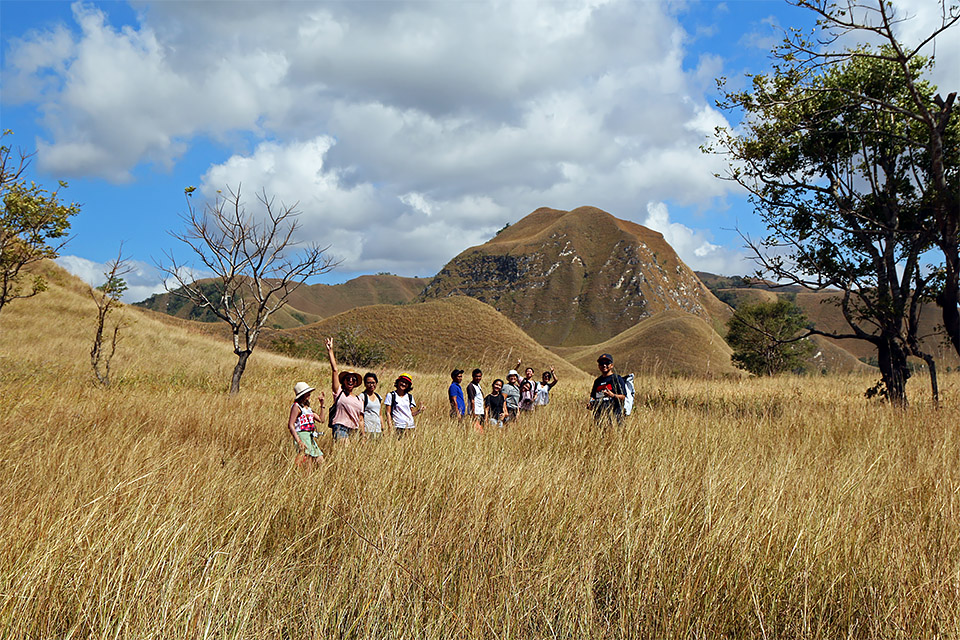
You start to notice your footing. Loose stones. Natural steps carved by time rather than design.
Sections where the path narrows just enough to demand focus. It’s not a difficult trek in the technical sense—but it asks for awareness. For presence. And slowly, almost without realizing it, the outside world begins to fall away. The horizon disappears behind you. The wind softens. The landscape becomes quieter, more enclosed. The colors shift too—from sunburnt golds to cooler shades of stone and shadow.
Then comes the first sign. Not a view—but a sound. Faint at first. Easy to miss if you’re distracted. But unmistakable once you notice it—the soft, continuous movement of water somewhere below.
It changes everything.
Your pace quickens. The heat feels less oppressive. The descent becomes less about effort, more about anticipation. Each turn of the path feels like it might reveal something—yet it never does all at once.
Tanggedu doesn’t reveal itself quickly.
It builds.
You don’t see Tanggedu immediately—you feel it approaching, one step before it appears.
The final stretch is the most telling. The rocks grow larger, smoother in places, worn by years of flowing water. The air cools slightly. And then, through a gap in the canyon walls, you catch your first glimpse—not of the full waterfall, but of a fragment. A flash of turquoise. A reflection of light moving across water.
It’s enough. Enough to stop you mid-step. Enough to reset your sense of place. By the time you reach the bottom, you realize something subtle but important: The trek was never just a way to get there. It was part of the transformation.
From observer to participant.
From traveler to explorer.
The path doesn’t welcome you—it tests you. And that’s exactly why the reward feels unreal.
Insider’s Tips — Trek Smart, Not Hard
- Footwear matters: Wear proper shoes with grip—rocks can be loose and uneven.
- Bring water: The heat is real, and there are no vendors along the way.
- Start early: Morning treks are cooler, safer, and more enjoyable.
- Take your time:
Rushing increases risk—this is not a race. - Consider a local guide:
Helpful for navigation and adds cultural context. - Pack light:
Only essentials to keep your balance and energy.
By the time you arrive at Tanggedu, you’re not just visiting a place. You’ve already entered it.
First Sight — Entering Tanggedu’s Turquoise World
The final step off the trail doesn’t feel like an arrival. It feels like crossing a threshold. One moment, you are still thinking about your footing, the heat, the descent behind you. Next, everything quiets—not in silence, but in presence. The canyon opens just enough to reveal its first secret, and suddenly your attention shifts from movement … to stillness.
Water.
Clear, luminous, impossibly calm.
It gathers at your feet in a pool so vivid it almost feels artificial—like someone has poured color into stone. Turquoise, but not just one shade. Layers of blue and green shift with the light, deepening where the rock dips, glowing where the sun touches the surface.
For a second, your mind tries to make sense of it.
It doesn’t quite succeed.
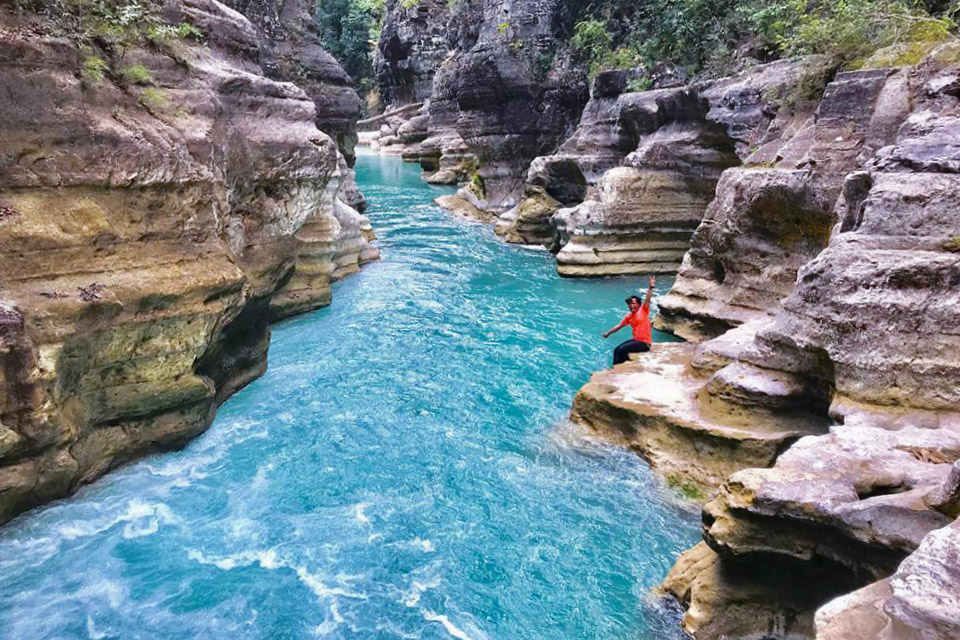
The first glimpse feels impossible—like someone painted water into a desert.
Around you, the canyon begins to define itself. Smooth limestone walls rise in soft curves, shaped not by force, but by time. Edges are rounded, textures are gentle, as if the rock has been slowly negotiated rather than broken. There’s no harshness here—only flow.
Water moves quietly from one level to another, slipping over stone in thin, continuous ribbons. No roar. No spray. Just a steady, calming rhythm that echoes lightly between the canyon walls. It’s the kind of sound that doesn’t demand attention—but holds it.
You step closer. And then you notice the details.
The way sunlight filters down in narrow beams, touching only parts of the canyon at a time. The way shadows stretch across the rock, creating contrast that shifts with every passing minute. The way the surface of the water mirrors fragments of sky, making it hard to tell where reflection ends and reality begins.
Even the air feels different here. Cooler. Softer. Carried gently along the canyon floor. You instinctively slow down—not because you have to, but because the place asks you to.
There is no single “viewpoint” at Tanggedu. No obvious spot where everything comes together at once. Instead, the beauty reveals itself in layers, just like the waterfall itself. You turn slightly, and a new angle appears. You walk a few steps, and another pool comes into view.
Nothing is announced. Everything is discovered.
Tanggedu doesn’t show itself all at once—it lets you earn each moment of wonder.
And somewhere between your first step into the water and your first pause on a sun-warmed rock, you realize something subtle has shifted. You’re no longer observing the landscape. You’re inside it—reflected in it—moving at its pace. The outside world feels distant now. The road, the heat, the descent… all of it fades into the background.
What remains is simple. Stone. Water. Light.
And the quiet realization that places like this don’t just impress you. They hold you.
Exploring the Waterfall Levels — A Natural Playground
At Tanggedu, there is no single place to stop. No defined endpoint. No “main” viewpoint that tells you you’ve seen it all. Because the moment you think you have, you notice another level just above you. Another pool catching light differently. Another curve in the rock that invites you to keep moving.
This is not a waterfall you stand in front of.
It’s one you move through.
The Lower Pools — Where Time Slows First
Most visitors arrive and instinctively settle at the lower levels—and it’s easy to understand why.
The pools here are wide, calm, and immediately inviting. The water feels cool against the skin, washing away the heat of the trek in seconds. Smooth rock ledges create natural seating areas, perfect for simply being still—feet submerged, eyes adjusting to the rhythm of the canyon.
Sunlight often reaches these pools more directly, revealing the full clarity of the water. You can see every contour beneath the surface, every ripple forming as the current gently passes through. It’s the easiest place to pause. But not the only one worth discovering.
The Middle Levels — Where Curiosity Takes Over
Climbing upward, the experience begins to change.
The pools become smaller, more varied, tucked between sculpted rock formations that feel increasingly intimate. The terrain requires a bit more attention now—hands occasionally brushing against stone for balance, feet testing each step before committing.
But this is where Tanggedu Waterfall Sumba begins to feel alive in a different way.
Water moves more visibly here, sliding across narrow channels, cascading gently between levels. The sound grows slightly stronger, echoing just enough to remind you that you are surrounded by movement, even in stillness.
You start to explore, not just observe. Turning corners. Peering over edges.
Finding small pockets of space that feel entirely your own.
The higher you climb, the quieter it becomes—
until it feels like the waterfall belongs only to you.
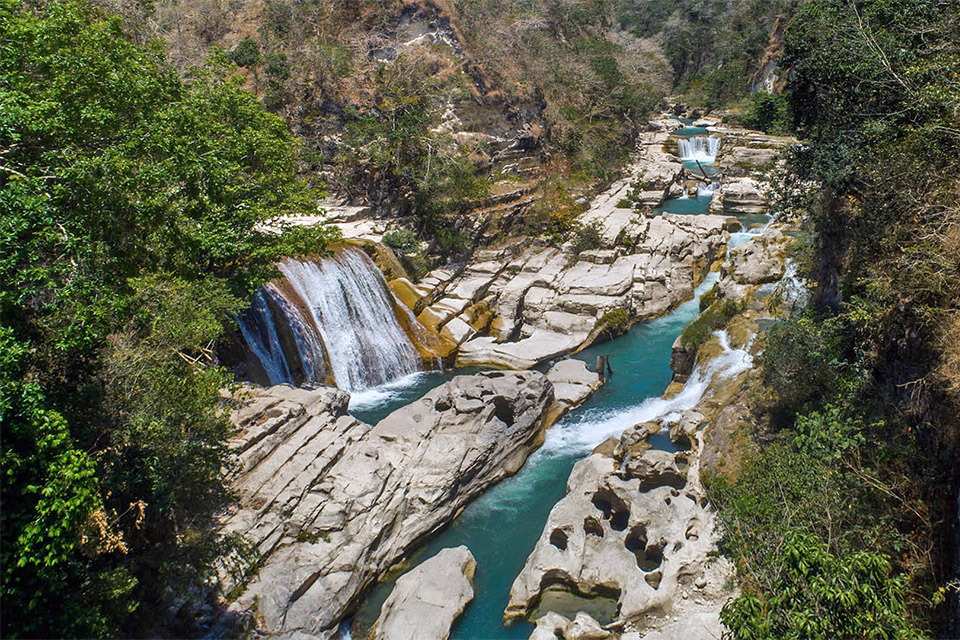
The Upper Tiers — Where the Landscape Becomes Yours
For those willing to go further, the upper levels offer something rare: Space.
Fewer people reach this far, and the reward is immediate. Pools become more secluded, the views more expansive, and the connection to the landscape more personal. Here, the canyon narrows and widens unpredictably. Some pools appear like natural infinity edges, where water spills gently into the next level below. Others feel like hidden basins, shielded by rock on all sides.
It’s also where the sense of discovery peaks. Every step feels unscripted. Every view feels earned. There are moments where you’ll stop—not because you’re tired, but because you don’t want to move too quickly past what’s in front of you.
Up here, Tanggedu stops being a place you visit—and becomes a place you inhabit.
Swimming, Climbing, and Moving with the Water
Tanggedu invites interaction—but quietly.
The pools are generally safe for swimming during the dry season, with clear visibility and manageable depth in most areas. Some sections allow for gentle cliff jumps, while others offer smooth rock slides shaped naturally over time. But this is not a playground in the conventional sense. There are no barriers. No lifeguards. No signs telling you where to go or what to avoid. Only instinct. And awareness.
The rocks, while beautifully sculpted, can be slippery. Water levels change with the seasons. What feels calm one day may feel stronger the next. So you move carefully. Intentionally. And somehow, that makes the experience even richer.
Insider’s Picks — Best Spots to Experience Tanggedu
- Best swimming pool: Lower levels for easy access and wider, calmer water.
- Best photo spot: Mid-level terraces with layered pools and canyon framing.
- Quietest hidden corner: Upper tiers—fewer visitors make the effort to reach them.
- Best light conditions: Late morning to midday for vibrant turquoise tones.
- Most relaxing spot: Flat rock ledges near gently flowing sections.
- Cliff jumping: Possible in select deeper pools—always check depth first.
Tanggedu doesn’t guide you. It invites you.
To climb a little higher.
To stay a little longer.
To notice a little more.
And somewhere between one level and the next, you stop thinking about where you are supposed to go — Because you realize there is no wrong direction here.
When to Visit Tanggedu Waterfall - Season Matters!
Tanggedu is never the same place twice. Not because it changes dramatically overnight—but because it responds quietly, consistently, to the rhythm of the seasons. The same canyon, the same stone, the same path… and yet an entirely different experience depending on when you arrive.
Understanding this is the difference between a beautiful visit—and an unforgettable one.
Dry Season (May – October) — When Tanggedu Glows
This is when Tanggedu reveals its most iconic form.
The rains have passed, the sky stretches wide and blue, and the water settles into a calm, glass-like clarity. The pools turn that unmistakable shade of turquoise—soft, luminous, almost surreal against the pale limestone.
Flow is gentler during these months, but that’s part of the magic. You can see deeper. Swim more comfortably. Move between levels with ease. The rocks are drier, the paths more stable, and the entire canyon feels open, accessible, and inviting.
This is also when East Sumba’s surrounding savanna turns golden, creating a striking contrast between the dry landscape above and the vibrant water hidden below. If you’ve seen photos of Tanggedu that feel almost too perfect to be real—this is when they were taken.
In the dry season, Tanggedu doesn’t just flow—it glows.
Rainy Season (November – April) — When Tanggedu Awakens
With the arrival of rain, the character of Tanggedu shifts.
Water flow increases, sometimes significantly. The gentle streams become more energetic, cascading with greater force from one level to the next. The canyon feels louder, more dynamic, more alive. But with that energy comes change.
The water often loses its crystal clarity, taking on deeper, earthier tones as sediment moves through the system. The turquoise fades, replaced by something more raw and untamed. The surrounding landscape, however, transforms in its own way. The dry savannas turn green, the air feels fresher, and the journey itself becomes more vibrant.
This is Tanggedu in motion—not polished, not still, but powerful.
In the rainy season, Tanggedu trades clarity for energy—and shows you a wilder side of itself.
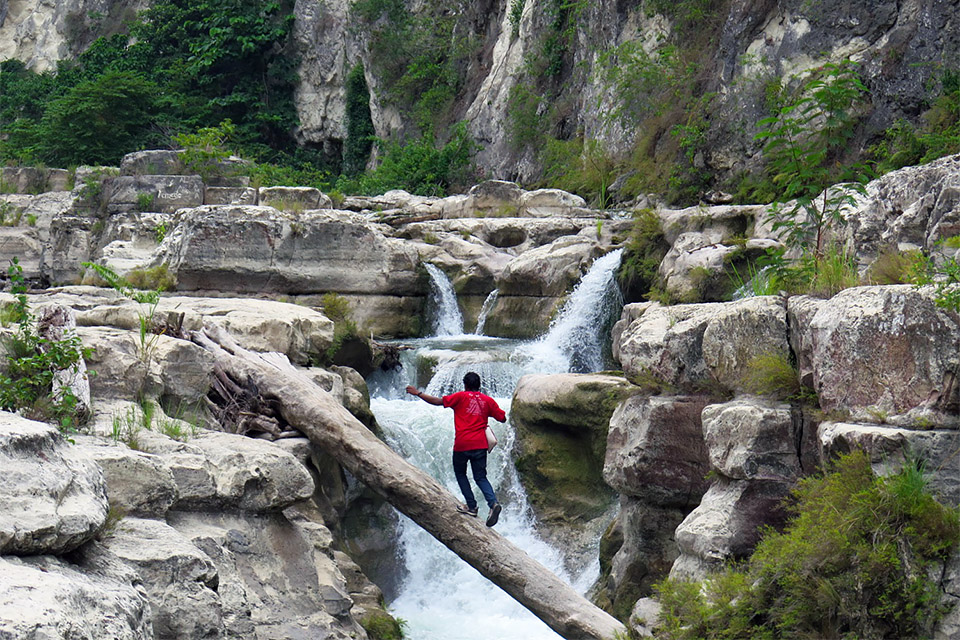
Time of Day — Light Shapes the Experience
Beyond seasons, the hour you choose matters just as much.
Early Morning (07:00 – 09:00):
Soft light, cooler temperatures, and a quiet atmosphere. Ideal for trekking and enjoying the canyon before it fully brightens.
Late Morning to Midday (10:00 – 13:00):
This is when the water shows its best color. Sunlight reaches deeper into the canyon, illuminating the pools and enhancing their turquoise tones.
Afternoon (14:00 – 17:00):
Shadows grow longer, creating more dramatic contrasts along the rock formations. Beautiful for photography, but colors may appear less vibrant.
There is no “wrong” time—but there is a time that matches what you’re looking for.
Insider’s Insights — Timing It Right
- Best overall season:
Dry season (May–October) for color, clarity, and accessibility. - Best month balance:
June–September (stable weather + strong visual conditions). - Best arrival time:
09:30–11:30 for ideal light + manageable heat.
- Avoid:
Heavy rain days—trails can become slippery and water conditions unpredictable. - Crowds:
Generally low year-round, but earlier visits feel more exclusive.
Tanggedu doesn’t demand perfect timing.
But it rewards those who understand its rhythm.
Because here, beauty is not fixed.
It shifts with light.
It deepens with water.
It reveals itself differently depending on when you choose to arrive.
Tanggedu changes with the seasons—but its magic never disappears, it simply chooses a different way to be seen.
Photography Guide — Capturing the Canyon
Photographing Tanggedu is less about chasing a single perfect shot—and more about learning how to see. Because this is not a landscape that reveals itself in one frame. There is no obvious hero angle waiting at the end of a path. No sign pointing you toward “the spot.” Instead, Tanggedu asks you to slow down, to observe, to let the details guide your lens.
Light shifts.
Water moves.
Shadows reshape the canyon every hour.
And suddenly, photography becomes less technical—and more intuitive.
Yes—you can swim at Lapopu.
Start Wide — Then Move Closer
Your instinct might be to capture everything at once—the canyon, the pools, the layers stretching into the distance. And yes, wide shots matter. They establish context, scale, and the quiet drama of being inside a carved landscape.
But Tanggedu’s real beauty lives in its transitions.
The curve of water slipping over stone.
The texture of limestone is shaped by time.
The way light touches only one part of a pool, leaving the rest in shadow.
So after your wide shots, move closer. Let your composition narrow. Let details take over.
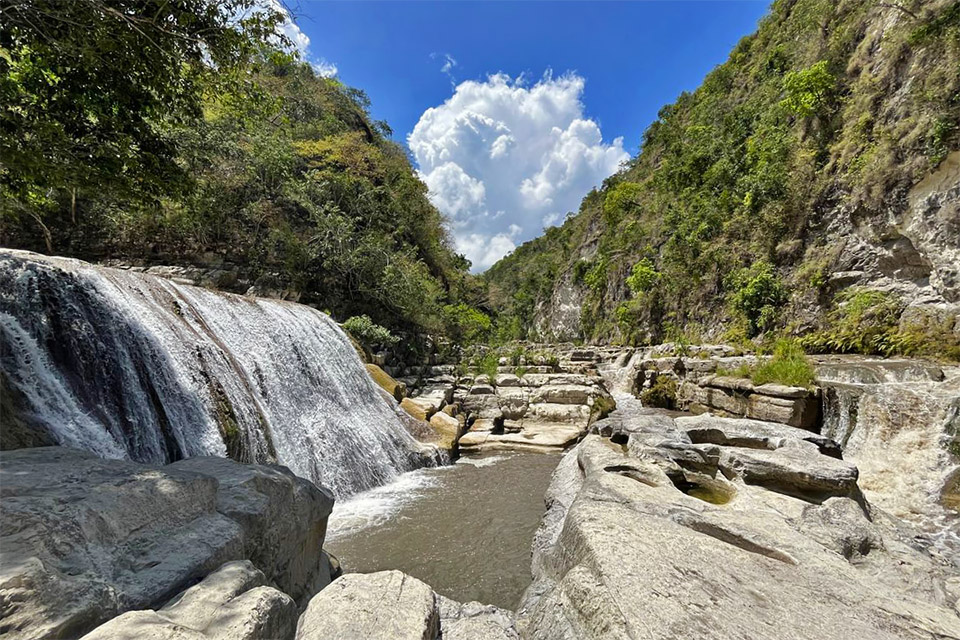
Use Layers to Tell the Story
Tanggedu’s most distinctive features is its tiered structure—and this is where your composition can come alive.
Look for ways to frame multiple levels in a single shot:
- Foreground: rock textures or shallow pools
- Midground: flowing water or a swimmer
- Background: higher tiers or canyon walls
This creates depth—and more importantly, it tells the story of movement. A single image becomes a journey, not just a moment.
Tanggedu isn’t just a place to photograph—it’s a place to notice.
Use Layers to Tell the Story
Tanggedu’s most distinctive features is its tiered structure—and this is where your composition can come alive.
Look for ways to frame multiple levels in a single shot:
- Foreground: rock textures or shallow pools.
- Midground: flowing water or a swimmer.
- Background: higher tiers or canyon walls.
This creates depth—and more importantly, it tells the story of movement. A single image becomes a journey, not just a moment.
Add a Human Element for Scale
Without context, Tanggedu can feel abstract in photos. The canyon compresses space, and the pools can appear smaller—or larger—than they actually are.
Adding a person changes everything. A figure standing on a rock. Sitting by the water. Moving between levels. It anchors the image. It gives scale. It brings emotion. Suddenly, the viewer isn’t just looking at a landscape—they’re imagining themselves inside it.
One human silhouette can transform Tanggedu from beautiful … to unforgettable.
Work With Light, Not Against It
Light defines Tanggedu more than almost anything else.
- Midday light penetrates deeper into the canyon, bringing out the iconic turquoise tones.
- Morning light is softer, creating a calmer, more atmospheric feel.
- Afternoon light introduces contrast—strong shadows, dramatic textures, and a slightly moodier tone.
Instead of forcing a shot, let the light guide your composition. If a section feels flat, move. If a pool isn’t glowing, wait. The canyon changes minute by minute.
Top-Down vs Eye-Level Perspectives
Tanggedu offers two very different visual languages:
- Top-down views:
From slightly elevated rocks or with a drone (if permitted), you can capture the geometry of the pools—the way water carves patterns into stone. - Eye-level views:
More immersive, more human. These shots place the viewer inside the canyon, surrounded by texture and light.
The best photo sets combine both.
Movement vs Stillness
Water here rarely crashes—it flows. That gives you creative freedom:
- Fast shutter: capture clarity, reflections, and texture.
- Slow shutter (if equipped): create soft, silky motion as water glides over rock.
Neither is “better.” They simply tell different stories.
💡Insider’s Insights — Photography Secrets
- Shoot slightly underexposed to preserve color depth in the water.
- Use a wide lens (16–24mm) for canyon framing and layered compositions.
- Look for reflections—still pools can mirror rock and sky beautifully.
- Avoid flat compositions—always include foreground elements.
- Be patient with people—wait for clean frames or use them intentionally.
- Protect your gear—rocks, water, and dust are all part of the environment.
There’s something unexpected about photographing Tanggedu. You arrive thinking you’ll capture it quickly. But the longer you stay, the more it reveals—and the harder it becomes to leave. Because every time you think you’ve seen the best angle … You turn around—and find another.
At Tanggedu, the best shot is rarely the first one you take—but the one you discover when you stop trying to find it.
Cultural Context — The Land Beyond the Waterfall
It’s easy to experience Tanggedu as a hidden natural wonder—an isolated canyon of water and stone, untouched and self-contained. But in Sumba, no place truly stands alone. Every landscape belongs to something older. Every path passes through a story you may not immediately see. And Tanggedu is no exception.
The land that surrounds the waterfall is part of a wider cultural world shaped by generations of Sumbanese communities—people whose lives are deeply connected to the rhythms of nature, the cycles of seasons, and a belief system known as Marapu.
A Landscape That Is Lived, Not Just Visited
As you travel toward Tanggedu, you don’t just pass through scenery—you pass through living space.
Traditional villages appear quietly along the road. Homes with tall, peaked thatched roofs rise against the horizon, built in a style that has remained unchanged for centuries. In front of them, you may notice large stone structures—megalithic tombs, still used today as resting places for ancestors.
These are not preserved artifacts.
They are part of daily life. Children play nearby. Families gather in the shade. Livestock moves freely across the land.
The past and present exist side by side, without separation.
In Sumba, history isn’t something you visit—it’s something you live among.
The Spirit of Marapu — Respecting the Unseen
At the heart of Sumbanese culture is Marapu, an ancestral belief system that shapes how people understand life, death, and the natural world. Under Marapu, landscapes are inhabited by spirits, by ancestors, by forces that deserve respect. Forests, rivers, hills, and waterfalls, are often seen as places of presence, not just beauty.
While Tanggedu may not have formal rituals taking place daily, the land it sits on is still part of this wider spiritual understanding. That’s why the way you move here matters. Not in a restrictive sense—but in a mindful one.
Lower your voice without being told.
Avoid leaving anything behind.
Notice how naturally the place invites quiet.
Some places don’t ask for silence—but feel better when you offer it.
The Role of Local Communities
The path to Tanggedu, the land you walk on, even the informal parking areas—these are maintained, directly or indirectly, by local communities.
Small entrance contributions often go toward supporting the village, maintaining access, and ensuring the site remains open and respected. There are no large-scale operators here. No formal tourism systems. What exists is simpler—and more fragile. A shared understanding that this place has value. And that visitors play a role in preserving it.
Traveling With Awareness
Experiencing Tanggedu fully seeing beyond visual beauty.
It means recognizing that the journey passes through someone else’s home. That the land carries meaning beyond what is immediately visible. That your presence, however temporary, becomes part of the environment you came to appreciate.
This doesn’t require expertise in local customs.
Just awareness.
A willingness to observe before acting.
To appreciate without imposing.
To leave the place exactly as you found it—or better.
The true depth of Tanggedu isn’t only carved in stone—but rooted in the lives that surround it.
When you leave the canyon and return to the open savanna, the landscape may look the same as it did before. But it won’t feel the same. Because now, you’ve seen what lies beneath it.
Things to Know Before You Go
Tanggedu feels wild in the best possible way. There are no gates announcing its presence, no curated pathways guiding your steps, no facilities designed to soften the experience. And while that’s exactly what makes it special, it also means one thing:
You arrive prepared—or you feel it.
This is not a place that adapts to you.
You adapt to it.
But once you understand a few simple realities, the entire experience becomes smoother, safer, and far more enjoyable.
No Facilities — Just Nature
Tanggedu remains largely untouched by tourism infrastructure.
There are no proper toilets, no changing rooms, no cafés, and no shops at the site. What you bring is what you have—and what you forget is simply not available.
That simplicity is part of the beauty. But it requires intention.
Signal Is Limited – or Non-Existent
As you move closer to Tanggedu, the mobile signal fades quickly. By the time you begin the trek, you should assume you are offline. Navigation apps may stop updating. Messages won’t be sent. Calls may not go through.
And strangely, that becomes part of the experience.
You’re fully present—whether you planned to be or not.
Cash Is Essential
At the entrance, you’ll usually be asked for a small local contribution fee. It’s informal, often managed by nearby villagers, and helps maintain access to the area.
There are no card payments. No digital systems. Just cash—and trust.
Safety Is Personal Responsibility
Tanggedu is safe—but not managed. There are no lifeguards, no marked hazard zones, no official warnings. The pools, rocks, and pathways are natural, which means conditions change depending on weather and season. So you rely on awareness.
Test the depth before jumping.
Move slowly on wet surfaces.
Know your limits.
At Tanggedu, safety isn’t enforced—it’s practiced.
Pack Light, Pack Right
Everything you carry will follow you down—and back up.
So bring what matters, and nothing more.
Insider’s Essentials — Quick Checklist
 Insider’s Essentials — Quick Checklist
- Cash:
Small bills for entrance contribution. - Water:
At least 1–2 liters per person. - Footwear:
Proper trekking shoes with grip (essential).
- Clothing:
Light, breathable, and suitable for swimming. - Sun protection:
Hat, sunscreen, sunglasses. - Dry bag:
To protect electronics and valuables.
- Towel / change of clothes:
No facilities available. - Trash bag:
Carry out everything you bring. - Offline map:
Download route in advance.
Leave No Trace — Keep It Untouched
Perhaps the most important thing to remember isn’t about logistics. It’s about responsibility. Tanggedu remains as beautiful as it is because it hasn’t been overwhelmed. Because visitors, for the most part, have treated it with care. And that’s something worth protecting.
Take your photos.
Swim in the pools.
Explore every level.
But leave nothing behind—not even the smallest trace.
The only way to preserve places like Tanggedu is to pass through them as if you were never there.
When you prepare well, something shifts. The uncertainty disappears. The effort feels lighter. And the experience becomes what it was meant to be—Simple. Raw. And deeply memorable.
Pairing Tanggedu with Nearby Attractions
Tanggedu rarely exists as a standalone experience.
Not because it isn’t enough on its own—but because East Sumba naturally invites you to keep moving. The distances are wide, the landscapes shift dramatically within hours, and each location feels like a different expression of the same wild, untamed island.
The beauty of Tanggedu is intensified when you place it within a broader journey.
Water to savanna.
Canyon to coastline.
Stillness to movement.
Waimarang Waterfall — The Emerald Counterpart
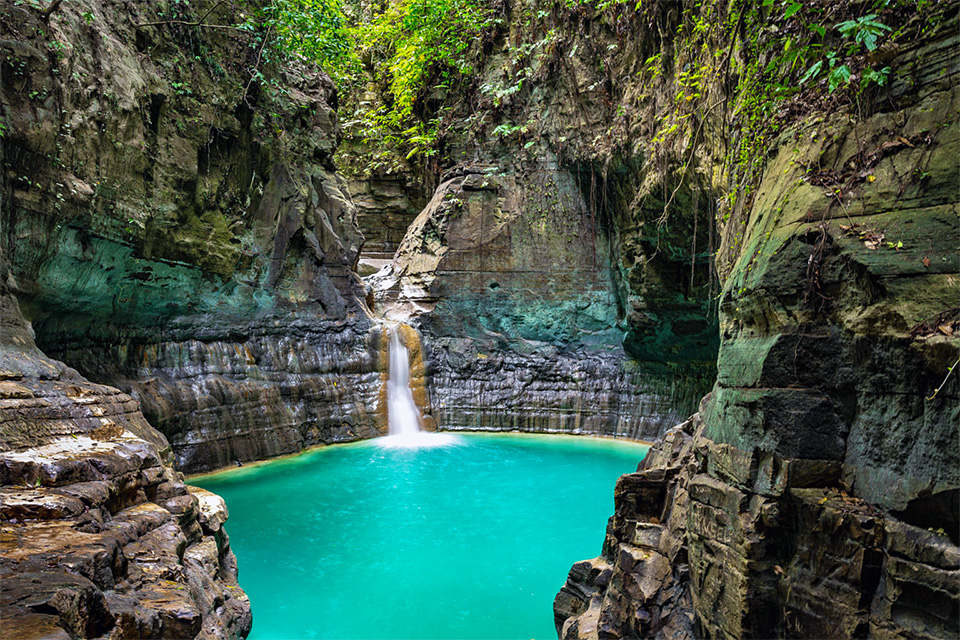
If Tanggedu feels like a canyon carved by time, Waimarang feels like a hidden sanctuary.
Surrounded by dense greenery, this waterfall opens into a deep, emerald lagoon framed by high rock walls. The atmosphere is cooler, more enclosed, almost cave-like in places. Light filters down differently here—softer, more diffused—creating a completely different mood from Tanggedu’s open, sunlit terraces.
Where Tanggedu invites exploration across levels, Waimarang invites stillness in depth. Visiting both in one day gives you contrast—not repetition.
Walakiri Beach — Where the Day Slows Down
After the descent, the climb back up, and the hours spent moving through water and stone, the coast offers something else entirely: Release.
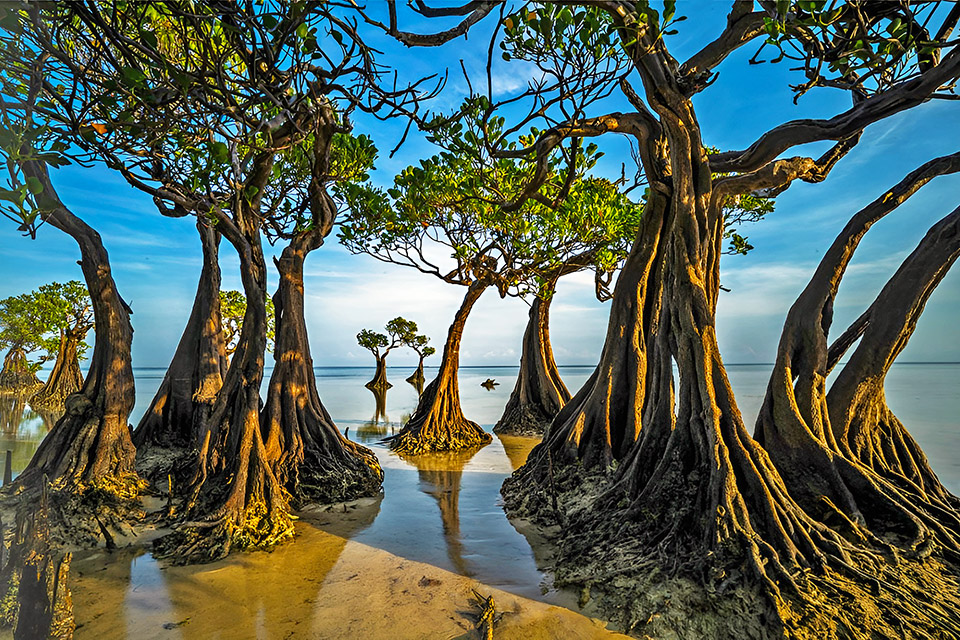
Walakiri Beach is known for its delicate mangrove trees—often called “dancing trees”—that stand gracefully against the horizon, especially during low tide. As the sun begins to set, the sky softens into warm tones, reflecting across the shallow water and silhouetting the trees in almost surreal forms.
It’s quiet. Open. Expansive. A perfect contrast to the enclosed intimacy of Tanggedu.

The Savanna — The Space In Between
Not every highlight in East Sumba has a name.
Some of the most memorable moments happen on the road itself. Rolling savanna hills stretch endlessly between destinations, shifting in color depending on the season—golden and dry, or lush and green. Horses graze freely. Occasional villages appear and disappear just as quickly.
These in-between spaces are not transitions.
They are part of the experience.
In Sumba, the journey between places often feels just as powerful as the places themselves.
Optional Coastal Stops — Where Land Meets Ocean
If time allows, consider extending your route toward the coast beyond Walakiri.
Cliffside viewpoints, quiet beaches, and empty shorelines offer a final shift in scenery. After hours spent descending into a canyon, there’s something grounding about standing at the edge of the ocean—where everything opens again.
Insider’s Itinerary — A Perfect East Sumba Day
- 07:30 – Depart from Waingapu
Start early to avoid heat and maximize daylight. - 09:30 – Arrive at Tanggedu Waterfall
Trek down, explore multiple levels, swim, and take your time. - 12:30 – Return to the top & continue journey
Light snacks or packed lunch recommended.
- 14:00 – Visit Waimarang Waterfall
A refreshing second stop with a completely different atmosphere. - 17:30 – Sunset at Walakiri Beach
Slow down, unwind, and end the day with soft light and open views
There’s a rhythm to exploring East Sumba that reveals itself only when you let the day unfold naturally. Tanggedu may be the highlight. But it’s the combination—the contrast, the movement, the transitions—that turns a visit into something far more complete.
In one day, Sumba can take you from canyon shadows to ocean light—and make both feel equally unforgettable.
Who Is Tanggedu For - and Not For
Tanggedu doesn’t try to be everything for everyone.
And that’s exactly what protects its magic. There are no polished walkways, no curated viewpoints, no effortless access designed to accommodate every type of traveler. What you find here is something more honest—raw, unfiltered, and quietly demanding.
So the real question isn’t just “Is Tanggedu worth visiting?” It’s: “Is Tanggedu right for the way you like to travel?”
Tanggedu Is Perfect For …
Those who enjoy earning the experience.
If you find satisfaction in the journey—not just the destination—Tanggedu will stay with you. The drive, the descent, the exploration across levels… every part adds depth to what you eventually see.
Adventure-leaning travelers.
You don’t need to be extreme, but you do need to be comfortable with uneven terrain, light trekking, and navigating natural environments without constant guidance.
Photographers and visual storytellers.
Tanggedu rewards patience and observation. If you enjoy working with light, texture, and layered composition, this place offers endless creative possibilities.
Nature seekers who value quiet over convenience.
There are no crowds pushing you along. No loud distractions. Just water, stone, and time that moves slower.
Tanggedu isn’t about ticking a destination off your list—it’s about letting a place change your rhythm.
Tanggedu May Not Be Ideal For …
Travelers seeking easy access.
If your ideal experience involves minimal walking, direct viewpoints, or structured facilities, Tanggedu may feel more demanding than enjoyable.
Those expecting luxury or comfort on-site.
There are no amenities here—no cafés, no rest areas, no curated spaces. Comfort comes from preparation, not infrastructure.
Visitors with limited mobility.
The trek down (and back up) involves uneven paths, loose rocks, and sections that require balance and care. It’s not suited for those who need stable, accessible terrain.
Rigid itineraries and rushed schedules.
Tanggedu doesn’t respond well to being squeezed into a tight timeline. The experience unfolds best when you allow space—for the trek, for exploration, for simply being there.
Tanggedu doesn’t try to please everyone—and that’s exactly why it feels untouched.
A Place That Chooses Its Visitors
In a way, Tanggedu filters its own audience. Not through exclusivity—but through effort. Those who arrive here have chosen to. They’ve accepted the road, the heat, the descent. And because of that, the experience feels more personal, more intentional.
It’s not about difficulty.
It’s about alignment.
If you’re looking for something easy, Tanggedu may challenge you.
If you’re looking for something real, Tanggedu may stay with you.
And often, the difference between those two expectations defines everything.
The Reward of Effort in Sumba
There’s a moment at Tanggedu that doesn’t arrive all at once. It comes quietly—somewhere between your last swim and the first step back up the trail. When the water has settled, your breathing has slowed, and the canyon no longer feels new, but familiar.
You sit, or stand, or simply pause. And you realize something has shifted. Not just around you—but within you. Because Tanggedu is not only about what you see. It’s about what it asks of you.
The drive that stretches longer than expected.
The road that becomes uncertain.
The descent that demands attention.
The climb that reminds you what effort feels like.
None of it is accidental.
In Sumba, beauty rarely arrives without context. It doesn’t present itself instantly or effortlessly. It reveals itself through layers—of distance, of time, of intention.
And that changes the way you receive it.
The beauty of Tanggedu is not just in what you see—but in what you have to become to reach it.
Effort as Part of the Experience
In many places, convenience is the goal. Paths are smoothed. Distances are shortened. Experiences are designed to be immediate, accessible, predictable. Sumba moves in the opposite direction. Here, effort is not removed—it’s preserved. Not to make things harder, but to make them matter.
Because when something takes time to reach, you don’t rush through it.
When something requires presence, you don’t experience it passively. When something feels slightly uncertain, you pay closer attention. And in that attention, something deeper forms. A kind of connection that doesn’t rely on spectacle—but on participation.
What You Carry Back
When you leave Tanggedu, you don’t just leave with images. You leave with sensations.
The warmth of the sun on the way down.
The cool shock of water against your skin.
The texture of rock beneath your hands.
The quiet echo of water moving through stone.
These details linger longer than any photograph.
Because they were not simply observed.
They lived.
Sumba’s Quiet Philosophy
There’s an unspoken philosophy woven into the island—one that Tanggedu expresses perfectly.
That not everything needs to be easy to be meaningful.
That not everything needs to be explained to be understood.
That some places are more powerful when they are discovered slowly.
You don’t conquer a place like this.
You meet it—on its own terms.
In Sumba, the journey doesn’t lead you to the experience—the journey is the experience.
Leaving, But Not Quite
The climb back up is different. The same path. The same rocks. The same sun overhead. And yet, it feels lighter. Because now you know what waits below. Because now the unknown has become a memory. Because now Tanggedu is no longer just a place on a map—but something you’ve moved through, step by step.
And as the canyon disappears behind you, returning once again to the wide openness of Sumba’s savanna, there’s a quiet awareness that stays with you: That places like this are becoming rare. Not because they are disappearing.
But because fewer places remain this untouched, this unstructured, this willing to ask something of you in return.
The reward of Tanggedu is not just the waterfall—it’s the reminder that the most meaningful places are never the easiest to reach.
And perhaps that’s the real reason people come to Sumba. Not just to see something beautiful. But to feel something real.
- Sumba Travel Guide
- East Sumba Travel Guide
- Book Sumba Tours Online
- East Sumba Tours
- Walakiri Beach Guide
- Puru Kambera Beach
- Tarimbang Beach Guide
- Wairinding Hill Guide
- Rende Village Guide
FAQ - Tanggedu Waterfall
1. Where is Tanggedu Waterfall located?
Tanggedu Waterfall is located in East Sumba, part of the island of Sumba. The closest town and main gateway is Waingapu, from which most travelers begin their journey.
The waterfall sits in a remote canyon area, surrounded by savanna landscapes and small local villages. It’s not directly visible from the road—you’ll need to drive close, then trek down to reach it.
2. How do you get to Tanggedu Waterfall from Waingapu?
From Waingapu, the journey typically takes 1.5 to 2 hours by car.
- First stretch: paved roads (relatively smooth).
- Second stretch: broken roads and rural paths.
- Final stretch: dirt tracks leading to a simple parking area.
From the parking point, you’ll need to trek 20–40 minutes downhill to reach the canyon. Most travelers choose:
- Private car with driver (recommended).
- Scooter (only for experienced riders).
Offline maps and local directions are essential.
3. How difficult is the trek to Tanggedu Waterfall?
The trek is moderate, not extreme—but it requires attention.
- Duration: 20–40 minutes.
- Terrain: rocky, uneven, sometimes steep.
- Conditions: dry and dusty (dry season), slippery (rainy season).
You don’t need hiking experience, but you should be:
- Comfortable walking downhill on uneven terrain.
- Wearing proper footwear.
- Physically able to handle the return climb (which is more demanding).
4. Is Tanggedu Waterfall safe to visit?
Yes—if approached with awareness. There are no formal safety systems, so responsibility is personal.
Key safety considerations:
- Rocks can be slippery.
- Water depth varies.
- No lifeguards or marked zones.
- Weather can affect conditions.
Best practices:
- Test water depth before jumping.
- Move carefully between levels.
- Avoid visiting during heavy rain.
Tanggedu is safe—but it expects you to be present and mindful.
5. Can you swim at Tanggedu Waterfall?
Yes—and it’s one of the highlights.
The pools are:
- Clear (especially in dry season).
- Generally calm.
- Varying in depth.
Swimming is most enjoyable in:
- Lower and mid-level pools.
Some areas allow:
- Gentle cliff jumping (check depth first).
- Relaxed floating in calm sections.
6. When is the best time to visit Tanggedu Waterfall?
Best season:
- Dry season (May–October).
Why:
- Clear turquoise water.
- Safer trekking conditions.
- More stable weather.
Time of day:
- 09:30–12:00 → best light for water color.
- Early morning → cooler, quieter.
- Afternoon → more dramatic shadows.
7. Is Tanggedu Waterfall worth visiting in the rainy season?
It depends on your expectations.
Pros:
- Stronger water flow.
- Lush green surroundings.
- More dramatic atmosphere.
Cons:
- Water may appear brown or less clear.
- Trek can be slippery.
- Conditions are less predictable.
If you’re chasing turquoise pools, visit in the dry season.
If you enjoy raw, powerful landscapes, the rainy season can still be rewarding.
8. Do you need a guide to visit Tanggedu Waterfall?
Not mandatory—but helpful.
Reasons to consider a guide:
- Navigation (especially final route).
- Safety during trek.
- Local insights and cultural context.
Many visitors go independently, but hiring a local guide:
- Supports the community.
- Enhances the experience.
9. Are there entrance fees at Tanggedu Waterfall?
Yes, but they are informal and community-based.
- Usually a small cash contribution.
- Managed by local villagers.
- Helps maintain access and support the area.
Always bring small bills.
10. Are there facilities at Tanggedu Waterfall?
No.
There are:
- No toilets.
- No changing rooms.
- No shops or cafés.
- No formal infrastructure.
You should:
- Bring everything you need.
- Pack out all the trash.
11. What should you pack for Tanggedu Waterfall?
Essentials include:
- Water (1–2 liters per person).
- Proper trekking shoes.
- Swimwear.
- Towel & change of clothes.
- Sunscreen & hat.
- Dry bag for electronics.
- Snacks.
- Cash (small bills).
- Offline map.
Pack light—but smart.
12. Can beginners visit Tanggedu Waterfall?
Yes—with realistic expectations.
You don’t need advanced hiking skills, but you should:
- Be reasonably fit.
- Be comfortable with uneven terrain.
- Take your time during the trek.
It’s beginner-friendly for active travelers, not for those seeking effortless access.
13. How does Tanggedu compare to Waimarang Waterfall?
They are often compared—but offer very different experiences:
Tanggedu Waterfall:
- Canyon-style.
- Multi-level pools.
- Open, sunlit environment.
- More exploration-based.
Waimarang Waterfall:
- Enclosed lagoon.
- Single dramatic pool.
- Shaded, jungle-like setting.
- More static, relaxing.
Ideally, visit both—they complement each other perfectly.
14. Can you visit Tanggedu in one day with other attractions?
Yes—and it’s highly recommended.
A typical route:
- Morning: Tanggedu Waterfall.
- Midday: savanna drive.
- Afternoon: Waimarang Waterfall.
- Sunset: Walakiri Beach.
This creates a full-day East Sumba experience with varied landscapes.
15. Is Tanggedu crowded?
15. Is Tanggedu crowded?
No—especially compared to Bali destinations.
Reasons:
- Remote location.
- Effort required to reach.
- Limited tourism infrastructure.
Even at peak times, it often feels quiet and spacious.
16. Is Tanggedu suitable for families or older travelers?
It depends on mobility and fitness.
Suitable for:
- Active families with older children.
- Travelers comfortable with trekking.
Not ideal for:
- Elderly visitors with mobility limitations.
- Very young children without supervision.
17. Why is Tanggedu often called the “Grand Canyon of Sumba”?
Because of its:
- Canyon-like rock formations.
- Layered landscape.
- Sense of depth and enclosure.
However, the comparison is only partial.
Tanggedu Waterfall Sumba is:
- More intimate.
- Water-focused.
- Interactive.
It’s less about scale—and more about experience.
18. What makes Tanggedu different from other waterfalls in Indonesia?
Most waterfalls in Indonesia are:
- Vertical drops.
- Surrounded by jungle.
Tanggedu Waterfall in Sumba is different because it is:
- A cascading canyon system.
- Made of limestone terraces.
- Designed for exploration, not just viewing.
It feels less like a “sight” … and more like a place you move through.
19. Is Tanggedu Waterfall environmentally protected?
Not formally in a strict conservation sense—but it is community-preserved.
Its condition depends heavily on:
- Visitor behavior.
- Local stewardship.
- Low-impact tourism.
Visitors play a key role in keeping it pristine.
20. Final Question — Why do people fall in love with Tanggedu?
Because it doesn’t give everything away at once.
Because it asks for effort—and rewards it quietly.
Because it feels discovered, not delivered.
Tanggedu stays with you not because it was easy to reach—but because it wasn’t.