There are moments in travel when the landscape doesn’t just appear — it reveals itself slowly, almost deliberately. Mbawana is one of those moments.
You don’t see it immediately — you arrive, and then it unfolds.
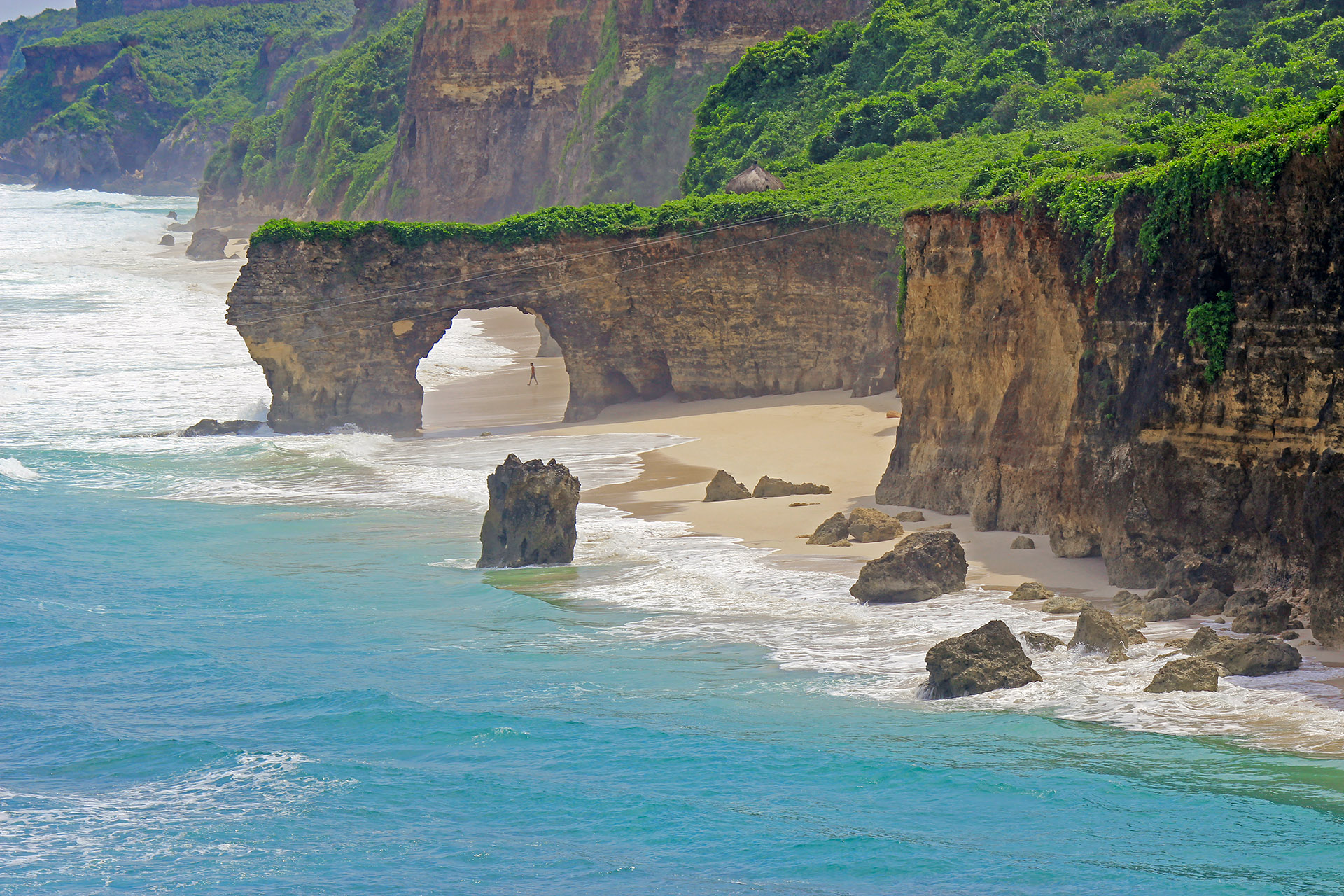
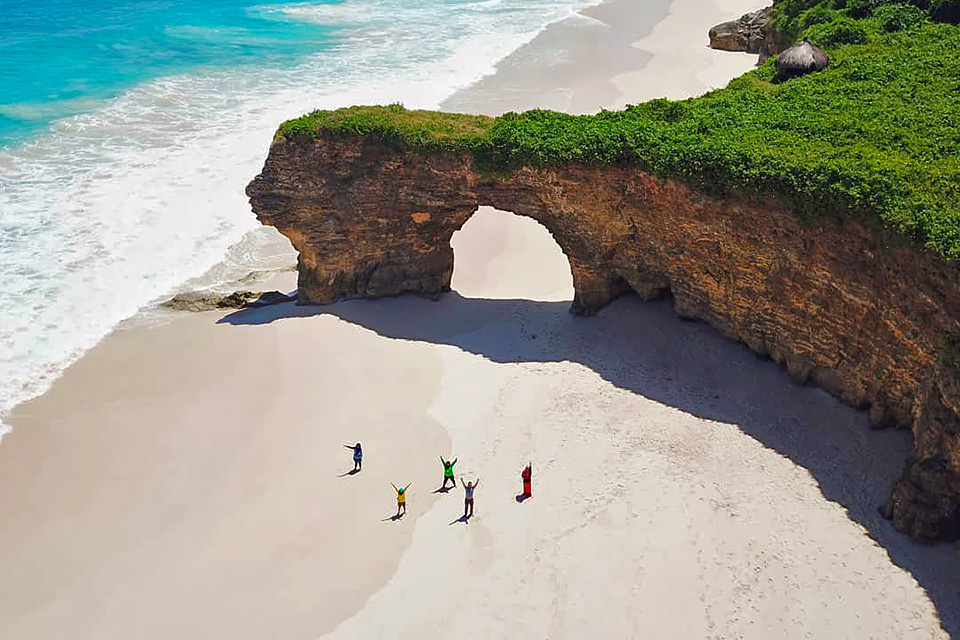
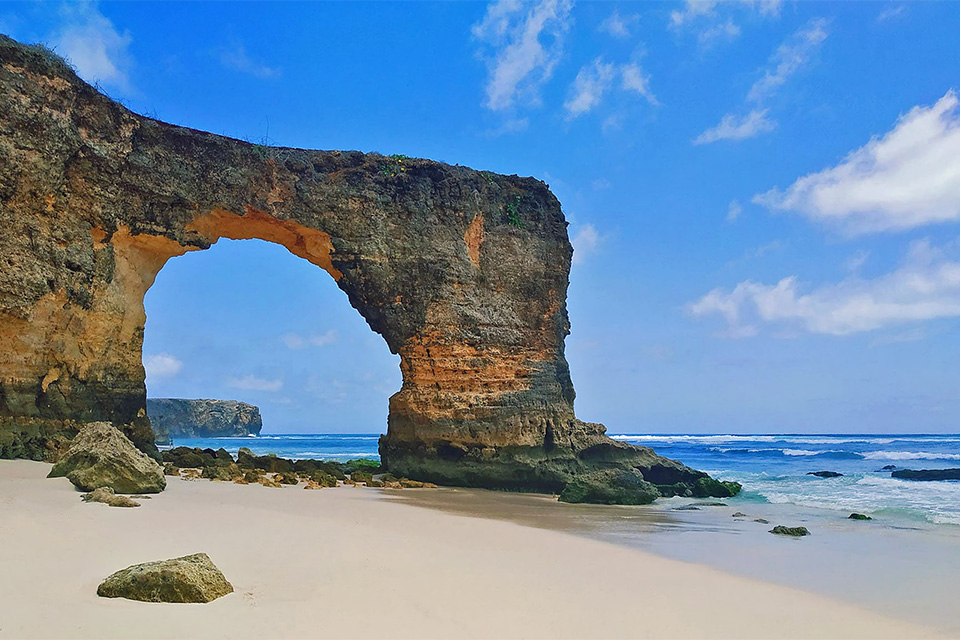
Hidden along the rugged coastline of West Sumba, Mbawana Beach is not defined by its shoreline alone — but by a single, striking formation carved by time and tide. A massive rock arch rises from the edge of the sea. Framing the horizon. Shaping the light. Turning the landscape into something that feels almost unreal. Unlike the open, expansive energy of Nihiwatu Beach, Mbawana feels more composed.
- A defined viewpoint.
- A natural focal point.
- A scene that draws your attention inward.
At Mbawana, the ocean doesn’t stretch endlessly —
it’s framed, focused, and held in a single view.
What Makes Mbawana Beach Different
- Iconic rock arch (“gigantic hole rock”) shaping the entire landscape whilst the beach itself is scenic.
- Elevated viewpoints offer natural framing of the ocean.
- A more visual, composition-driven experience.
- Feels like a place you arrive into, not just pass by.
Some places are wide and open — Mbawana is precise, almost intentional in how it reveals itself.
 Insider's Insight: The Main Attraction of Mbawana Beach
 Insider's Insight: The Main Attraction of Mbawana Beach
- Mbawana is best experienced from the clifftop viewpoint, not just the beach below.
- Expect a short trek down and back up — wear proper footwear.
- Best visited during late afternoon or sunset time for dramatic light through the arch.
- Combine with nearby coastal stops, but allow time to pause and take it in.
👉 Step into the story of Mbawana — where the landscape frames the ocean, and the moment stays longer than expected.
Mbawana Beach - Where the Land Opens to the Ocean
There is a moment on the journey to Mbawana Beach when the road feels like it is dissolving into the horizon. The villages grow quieter, the hills roll wider, and the air begins to carry that unmistakable salt-laced promise of the sea. You don’t arrive at Mbawana all at once—you ease into it, as if the island is gently preparing you for something it has kept hidden.
And then, quite suddenly, the land opens.
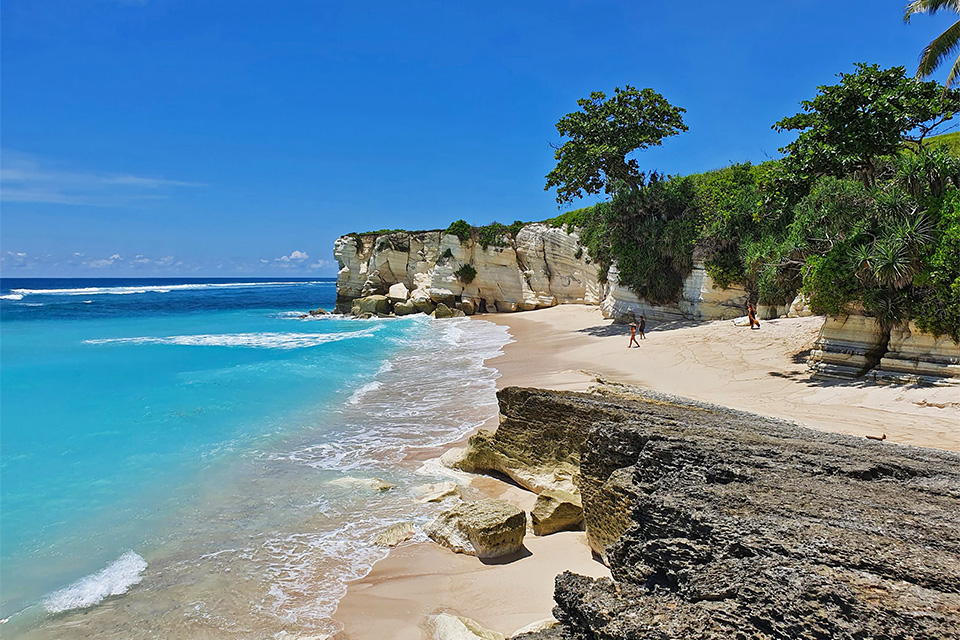
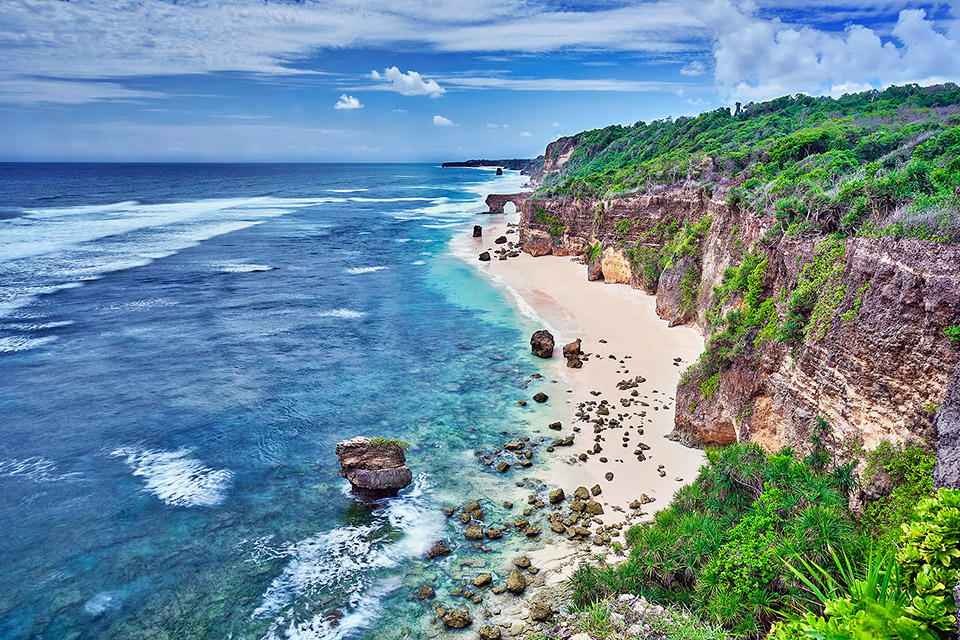
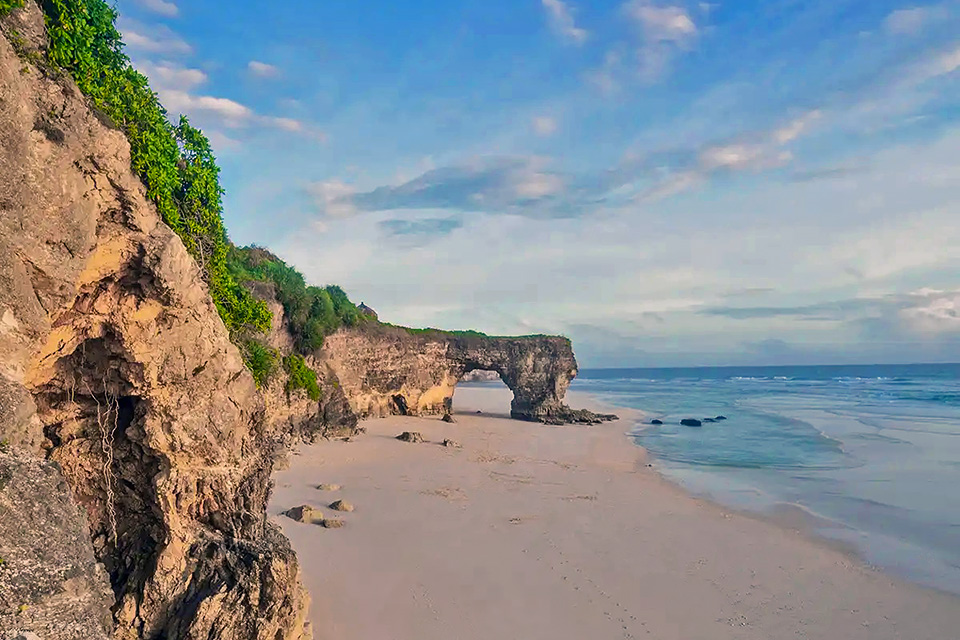
A vast sweep of sand stretches below, framed by towering limestone cliffs that seem sculpted not just by wind and water, but by time itself. The ocean arrives in long, deliberate waves, unhurried and powerful, as if it knows it has nowhere else to be.
But what truly defines Mbawana is not just its scale—it’s the arch.
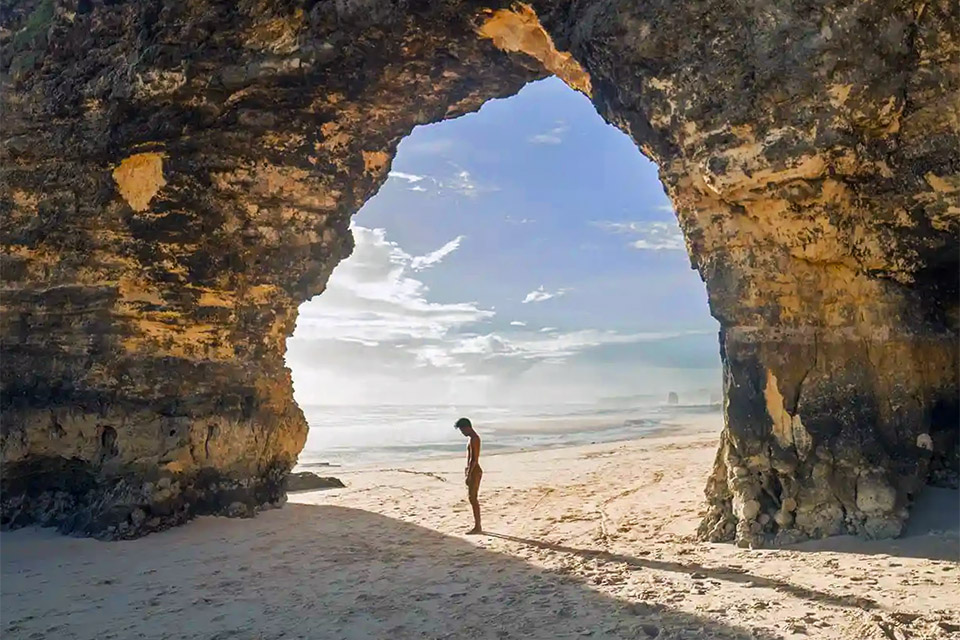
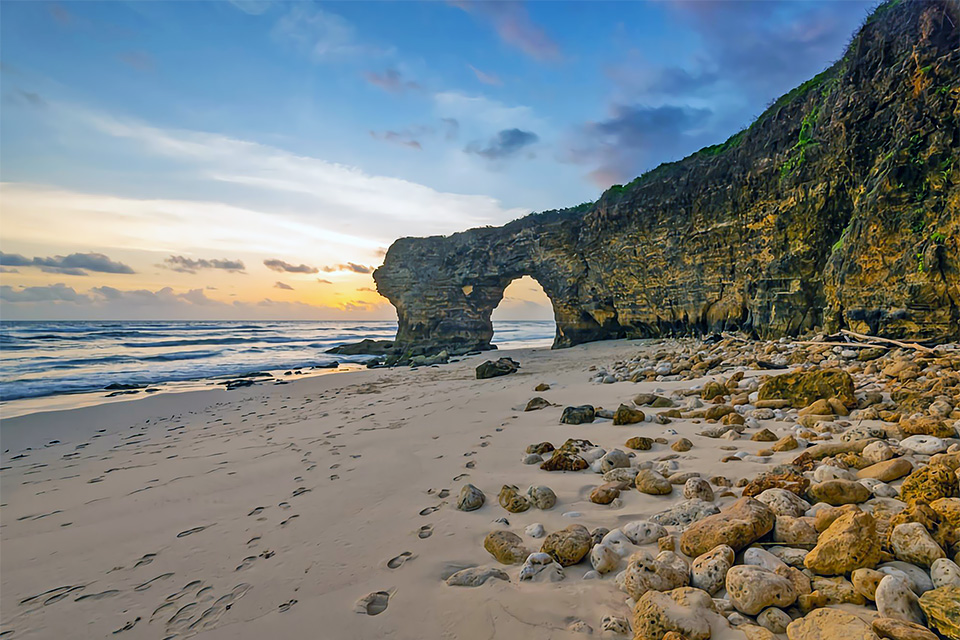
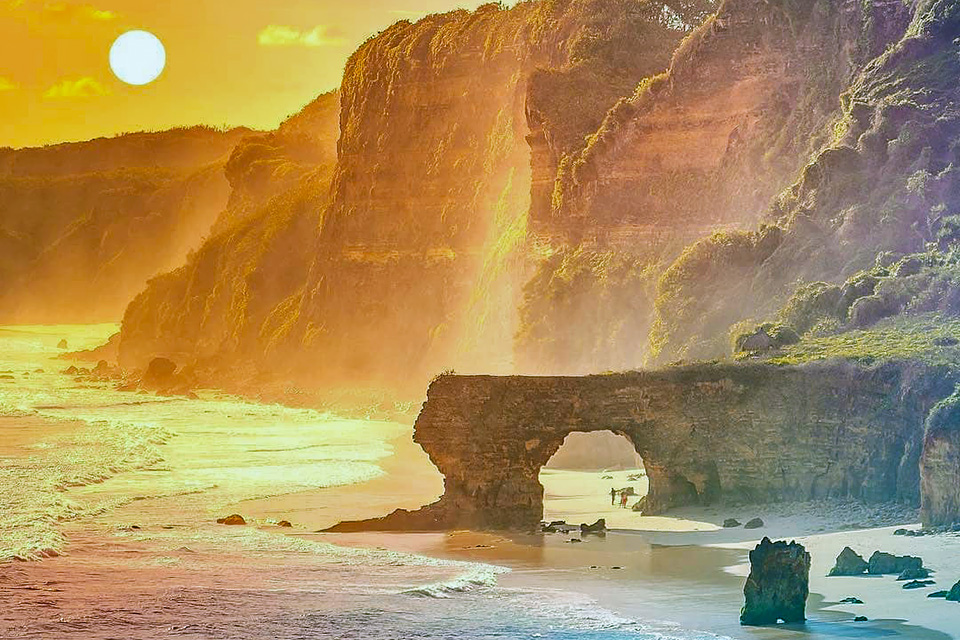
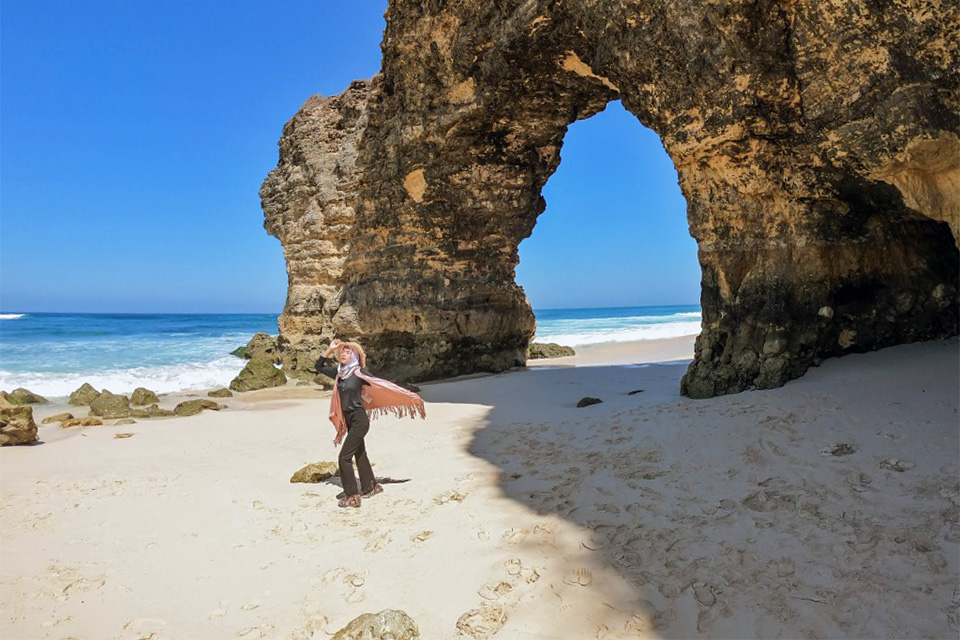
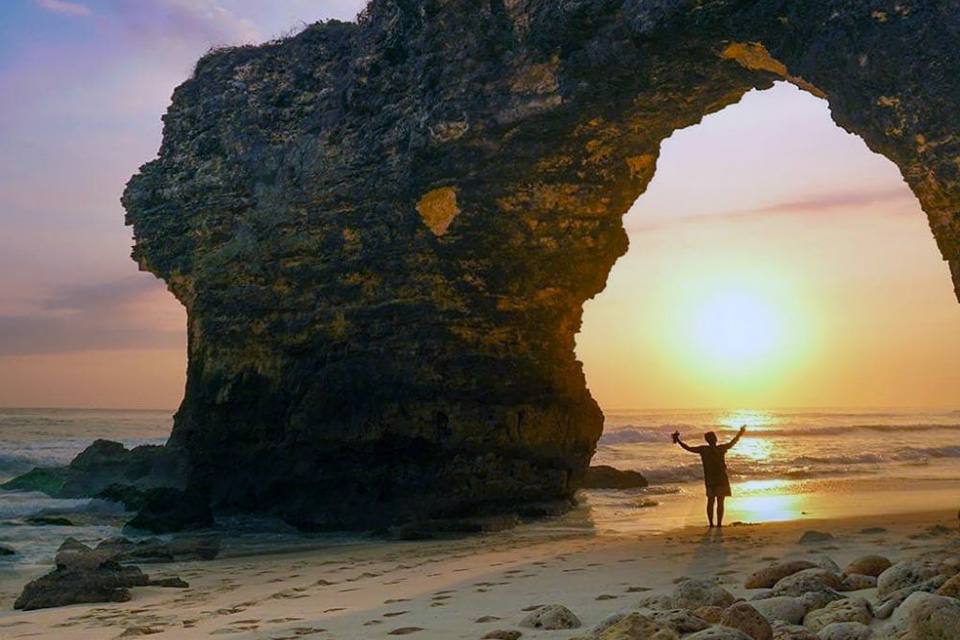
Carved into the cliff face, the iconic “hole rock” stands like a silent gateway between two worlds. At certain hours, the sun aligns perfectly within it, pouring golden light through the opening and casting long shadows across the beach. It is a simple phenomenon, yet it feels ceremonial—like witnessing a quiet dialogue between earth and sky.
Mbawana is not crowded. It is not curated. There are no rows of beach clubs or curated viewpoints competing for attention. What you find instead is space—space to walk, to sit, to watch, and to feel small in the most grounding way. It is the kind of place where time loosens its grip, where the rhythm of the waves replaces the urgency of schedules.
And perhaps that is its real magic.
Mbawana does not try to impress you. It simply exists—raw, open, and quietly unforgettable.
Insider's Insight: The Power Behind Its Stillness
Location
- West Sumba, around 1.5–2 hours drive from Tambolaka Airport.
- Remote coastal area with limited signage—local guidance helps.
Best Time to Visit
- Late afternoon or sunset time for golden light through the rock arch.
- Dry season (May–October) for easier roads and clear sky.
Access & Terrain
- Final stretch involves rough sandy roads.
- Motorbike or high-clearance vehicle recommended.
Entrance Fee
- Small local contribution (cash only).
Swimming Conditions
- Strong currents—swimming is not recommended.
- Best for walking, photography, and views.
Photography Tip
- Position yourself facing the arch during sunset.
- Silhouettes work beautifully with the glowing frame of light.
What to Bring
- Water, sun protection, sturdy footwear.
- No facilities on-site (no cafés, no toilets).
Where Mbawana Beach Lies — At the Edge of West Sumba
To understand where Mbawana Beach is, you have to let go of the idea of neat coordinates and easy directions. This is not a place you stumble upon between café stops or detour to on a whim. Mbawana sits in the far reaches of West Sumba, in a region where the island begins to feel wider, quieter, and more elemental.
Most journeys begin from Tambolaka, the main gateway to this side of the island. From there, the road leads you south and west, slipping gradually away from the small hum of town life into something far more expansive. Houses thin out. The terrain shifts. The lush greens give way to rolling savannahs that stretch under an endless sky, especially during the dry season when the land turns shades of gold and ochre.
As you move deeper into the Kodi region, the sense of direction becomes less about maps and more about instinct. You follow narrow roads that curve with the land, occasionally passing traditional villages where life unfolds at an unhurried pace—children playing, livestock crossing, the quiet rhythm of daily routines untouched by tourism.
And then the coastline begins to reveal itself.

Not all at once, but in fragments—first a glimpse of blue on the horizon, then the distant sound of waves carried by the wind. Mbawana Beach lies tucked beneath a line of cliffs, hidden from view until the very last stretch. It’s this concealment that makes the arrival feel almost cinematic, as if the island is holding something back just for you.
Geographically, Mbawana faces the vast openness of the Indian Ocean, with nothing between you and the horizon but water and wind. There are no neighboring resorts, no developed beachfronts—only raw coastline shaped by centuries of natural forces. Its relative isolation is not a drawback; it is the very reason Mbawana remains what it is.
You don’t just go to Mbawana Beach. You journey into it.
Insider’s Coordinates — Finding Mbawana Beach
Regional Location
- West Sumba, Indonesia.
- Located in Kodi area, southwest of Tambolaka.
Nearest Airport
- Tambolaka Airport (TMC).
- 1.5–2 hours by car depending on road conditions.
Navigation Tips
- Unreliable GPS signal—download offline maps.
- Asking locals for “Pantai Mbawana” is often the most reliable way.
- Look for small hand-painted signs near the final turn-off.
Route Character
- Mix of paved roads and rough rural tracks.
- Final section can be sandy, uneven, and narrow.
Fuel & Supplies
- Fuel up in Tambolaka—you will not find proper fuel stations near the beach.
- Do not rely on local supplies, bring essentials (water, snacks) before leaving town.
Connectivity
- Limited to no signal closer to the coast.
- Treat the journey as an offline experience.
What to Expect — When Mbawana Reveals Itself
Arrival at Mbawana is not a single moment—it unfolds in layers.
You’ll likely begin at what feels like the end of the road: a quiet clearing, a few scattered trees, perhaps a simple hut or a local presence collecting a small entrance fee. There is no grand entrance, no sign announcing what lies ahead. Just a path. And it is here that Mbawana asks something of you.
The trail descends from the clifftop toward the beach below—uneven, sometimes sandy, occasionally steep. Each step draws the ocean closer, its sound growing fuller, deeper, until it becomes the only thing you hear. The wind picks up. The horizon widens. And then, almost without warning, the landscape opens into its full scale.
The beach stretches long and empty, framed by cliffs that rise like quiet guardians. There is a sense of vastness here that is hard to articulate—not just in size, but in feeling. Mbawana does not surround you with activity; it gives you space.
You’ll notice it in the details.
The way the waves arrive—steady, powerful, and unbroken.
The way the wind moves across the sand, erasing footprints as quickly as they appear.
The way the iconic rock arch stands slightly apart, drawing your gaze without demanding it.
Walking toward the arch feels almost instinctive. Up close, it becomes even more striking—not just as a photo subject, but as a presence. When the sun begins to lower, the light shifts dramatically. Shadows stretch. Colors deepen. And if you’ve timed it right, the sun aligns with the opening, turning the arch into a glowing frame of gold.
But Mbawana is not only about that perfect moment.
It is in the quiet in-between.
There are no beach clubs, no music, no vendors calling out. You may share the space with only a handful of other visitors—or sometimes no one at all. The absence of distraction becomes the experience itself. You find yourself slowing down without trying, sitting longer than planned, watching the horizon as if it might say something back.
There is, however, a certain wildness you should respect.
The currents are strong, and the waves is unpredictable. This is not a swimming beach in the usual sense. It is a place to observe, to walk, to feel the raw meeting of land and ocean without needing to step fully into it.
When it’s time to leave, you’ll feel that gentle resistance again. As if the place is not asking you to stay, but quietly reminding you that not everything is meant to be rushed.
Insider’s Expectations — Before You Go Down
The Descent
- Short but challenging walk from the clifftop.
- Loose sand and uneven ground—wear proper footwear.
Beach Experience
- Wide, open and typically uncrowded shoreline.
- No facilities—completely natural setting.
Ocean Conditions
- Strong currents and heavy waves.
- Not suitable for casual swimming.
Must-See Moment
- Sunset through the rock arch is the highlight.
- Arrive at least 45–60 minutes before golden hour so you can see it in different light.
Weather & Elements
- Can be windy, especially in the afternoon.
- Very hot during midday with minimal shade.
Atmosphere
- Quiet, raw, and meditative.
- Ideal for slow travel, photography, and reflection.
Best Time to Visit — When Mbawana Feels Just Right
Time behaves differently at Mbawana.
It isn’t just about when you arrive, but how the island chooses to reveal itself in that moment. The same stretch of sand can feel entirely different depending on the hour, the season, the light. Mbawana does not change for you—you learn to arrive when it is most itself.
For most travelers, that moment begins in the late afternoon.
As the sun starts its slow descent toward the Indian Ocean, the entire coastline softens. The cliffs take on warmer tones, the wind eases, and the long shadows begin to stretch across the sand. This is when the iconic arch becomes more than a formation—it becomes a frame. The light filters through it, slowly, deliberately, until it reaches that fleeting alignment where everything feels suspended.
It doesn’t last long.
And perhaps that is why it matters.
Arriving about an hour before sunset allows you to settle into the rhythm of the place. You walk, you pause, you notice. By the time the light reaches its peak, you are no longer rushing to capture it—you are already part of it.
Mornings, on the other hand, carry a different kind of quiet.
The air is cooler, the light softer, and the beach often feels even more untouched. There is no dramatic alignment with the arch, no golden spectacle—but there is clarity. The kind that comes with empty horizons and the gentle repetition of waves. If sunset is Mbawana’s performance, sunrise is its meditation.
Then there is the question of season.
During the dry season, roughly from May to October, the journey itself becomes easier. Roads are more accessible, the skies are clearer, and the landscape turns into that signature Sumba palette of gold and earth.
Everything feels open, expansive, and predictable in the best way.
The wet season, from November to April, brings a different mood. The hills turn green, the air thickens, and the skies become more expressive—sometimes dramatic, sometimes unpredictable.
Access can be more challenging, but for those willing to embrace it, Mbawana reveals a softer, more atmospheric side. Fewer visitors make the journey, and the solitude deepens.
There is no single “perfect” time to visit Mbawana Beach.
Only the time that matches what you are seeking.
Insider’s Timing Guide — Choosing Your Moment
Best Time of Day
- Late afternoon (4:30–6:30 PM) is the best time for sunset and arch alignment.
- Morning (6:00–9:00 AM) is best for quiet, cooler exploration.
Golden Hour Tip
- Arrive at least 45–60 minutes before sunset.
- Scout your angle toward the arch early.
Dry Season (May–October)
- Easier road access and clearer skies.
- Ideal for first-time visitors and photography.
Wet Season (November–April)
- Greener landscapes and more dramatic skies.
- Roads can be muddy—travel requires more preparation.
Wind & Heat
- Midday can be hot with strong sun exposure.
- Afternoons often bring coastal breeze.
Crowd Levels
- Generally low year-round.
- Sunset attracts a few more visitors, but never crowded.
Essential Tips — What Mbawana Asks of You
Mbawana is generous—but only to those who arrive prepared.
This is not a place that adjusts itself to your comfort. There are no conveniences waiting quietly in the background, no infrastructure designed to anticipate your needs. What Mbawana offers instead is something far rarer: an experience that remains untouched, precisely because it asks you to meet it halfway.
And that begins long before your feet touch the sand.
Preparation here is not about overplanning—it is about respect. Respect for the terrain, for the elements, for the quiet rhythm of a place that continues to exist on its own terms.
You will feel it in the road that tests your patience.
In the heat that asks you to slow down.
In the absence of facilities that reminds you to rely on what you bring.
But once you understand this, Mbawana becomes easier—not because it changes, but because you do.
Insiders’ Insight: Preparing Yourself for Nihiwatu Beach
Pack Like There’s Nothing There
- Bring sufficient drinking water.
- Snacks or light meals—no food vendors on-site.
- Sunscreen, hat, and sunglasses are essential.
Dress for the Terrain
- Wear sturdy footwear for the descent (sand + uneven rocks).
- Light, breathable clothing for heat and wind.
- A light layer if staying until sunset (it can get breezy).
Prepare Before Leaving Town
- Fuel up in Tambolaka—no gas stations nearby.
- Bring small cash for entrance and local contributions.
Embrace Being Offline
- Signal is weak to nonexistent near the beach.
- Download offline maps and inform someone of your plan.
Plan Your Transport Wisely
- High-clearance car or experienced motorbike rider recommended.
- Avoid traveling after dark—the roads are unlit and isolated.
- Consider hiring a local driver familiar with the route.
Respect the Ocean
- Strong currents and unpredictable waves.
- Enjoy the water from the shore—avoid swimming.
Be a Thoughtful Visitor
- Take all trash back with you.
- Be mindful when passing through local villages.
- Ask before photographing people or homes.
Give It Time
- Don’t rush the visit—Mbawana reveals itself slowly.
- Stay through the changing light if you can.
Mbawana does not reward speed. It rewards presence.
And the more prepared you are, the easier it becomes to let go of everything else—to sit, to watch, and to experience the kind of quiet that stays with you long after you’ve left the shore.
How Mbawana Beach Fits Into Your Sumba Journey
Mbawana is not a stop you simply “add.”
It’s a place you place carefully within your journey—like a pause between stronger beats, a breath between chapters. In an island as expansive and textural as Sumba, where distances are longer and experiences feel deeper, where you put Mbawana shapes how you remember it.
Most travelers explore West Sumba as a cluster—moving between coastlines, villages, and quiet inland landscapes over one or two days. And within that rhythm, Mbawana fits best not as a rushed checklist item, but as a deliberate highlight—ideally paired with places that echo its sense of space and stillness.
A natural route begins from Tambolaka, the island’s western gateway. From here, you can move gradually into the Kodi region, where the land opens wide and the pace slows almost instinctively. Along this path, Mbawana becomes part of a wider story rather than a single destination.
You might start your day inland or along gentler waters—perhaps at Waikuri Lagoon, where the sea rests in stillness, enclosed by rock and calm enough to step into. Then continue to Ratenggaro Village, where traditional houses rise against the sky, and ancient stone tombs speak of a culture that feels both distant and present.
By the time you reach Mbawana in the late afternoon, something has shifted.
You’ve already experienced Sumba’s calm. Its culture. Its quiet rhythms.
And Mbawana becomes the release—the open horizon after intimacy, the vastness after detail. Alternatively, Mbawana pairs beautifully with Pero Beach, another stretch of raw coastline known for its waves and local life. Seen together, they tell two sides of the same story: one more grounded in community, the other in solitude.
But timing is everything.
Because Mbawana is, at its core, a sunset destination.
Trying to squeeze it between midday stops often diminishes what makes it special. Instead, build your day toward it. Let the journey rise gradually, so that by the time you arrive, you are ready to slow down—and stay.
For those exploring Sumba over several days, Mbawana often finds its place in a West Sumba day trip loop, or as part of a 2D1N exploration based in Tambolaka or Kodi. It can also serve as a powerful closing note before heading eastward, where the landscape begins to change again.
Because that’s what Mbawana does best.
It doesn’t compete with other places.
It completes them.
Insider’s Itinerary Tips — Making Mbawana Work
 Insider’s Itinerary Tips — Making Mbawana Work
Best Pairings
(Same Day Route)
- Waikuri Lagoon → Ratenggaro Village → Mbawana Beach (sunset).
- Pero Beach → Mbawana Beach (coastal afternoon into sunset).
Ideal Timing Strategy
- Start late morning from Tambolaka or Kodi.
- Reach Mbawana by 4:30–5:00 PM for a relaxed sunset experience.
Suggested Duration
- Half-day minimum if focused on Mbawana only.
- Full-day if combining with lagoon + village stops.
Travel Flow Tip
- Avoid backtracking—plan a loop where possible.
- Roads take time; distances are felt, not just measured.
Experience Strategy
- Keep the day light—don’t overcrowd itinerary.
- Let Mbawana be the emotional high point, not an afterthought.
Where to Base Yourself
- Tambolaka: more accommodation options, easier logistics.
- Kodi area: closer to attractions, more immersive but limited stays.
Mbawana Beach is not the loudest moment of your Sumba journey. It is the one that lingers—quietly, persistently—long after the road has taken you elsewhere.
Can You Visit Mbawana Beach Independently?
The short answer is yes—you can visit Mbawana Beach independently.
But the better answer is: it depends on how you want to experience it.
Because independence in Sumba is not the same as independence in more developed destinations. Here, it doesn’t mean convenience or complete control. It means navigating uncertainty, embracing slower rhythms, and accepting that the journey may ask more from you than expected.
And for some travelers, that is exactly the appeal.
If you choose to go independently, you’ll likely rent a motorbike or a car from Tambolaka and make your way toward the Kodi region using offline maps and instinct. The roads, while increasingly accessible, still require attention—patches of rough terrain, unclear turns, and long quiet stretches where you won’t see another vehicle for a while.
There’s a certain freedom in this.
You can stop when the landscape calls for it.
Pause in villages. Take in the shifting colors of the hills without watching the clock.
But that freedom comes with responsibility.
There are no clear signposts guiding you all the way. Mobile signal fades as you get closer to the coast. And if something goes wrong—a flat tire, a wrong turn, sudden weather—you will be relying mostly on yourself and the kindness of locals.
For confident, experienced travelers, this creates a deeper connection to the place. The journey becomes part of the story, not just a means to an end.
For others, it can feel unnecessarily stressful.
That’s where hiring a local driver or joining a curated trip changes the experience—not by taking away freedom, but by removing friction. A local driver knows the rhythm of the roads, the subtle turns that maps miss, the right timing to arrive before the light shifts. You don’t have to think about directions or fuel or whether you’ve taken the correct fork in the road.
You simply arrive. And sometimes, that is exactly what Mbawana asks of you—to arrive without distraction, fully present for what unfolds. So yes, you can go independently. But the real question is not can you—it’s how do you want to feel when you get there?
💡Insider’s Decision Guide — Independent vs Guided
Go Independent If You …
- Are confident navigating remote areas with limited signage.
- Are comfortable driving on rough roads.
- Enjoy flexibility, spontaneity and slow exploration.
Balanced Option
- Hire a driver but keep your itinerary flexible.
- Combine independence in experience with ease in logistics.
Choose a Driver or Tour If You …
- Prefer a stress-free, seamless experience.
- Are short on time and want efficient routing.
- Want local insights along the way.
Things to Consider
- Navigation can be tricky—offline maps are essential, download beforehand.
- Fuel and supplies must be prepared in advance.
- Limited to no mobile signal near the beach.
In the end, Mbawana Beach does not reward how you arrive.
It rewards that you made the journey at all.
Why Travelers Choose a Structured Tour to Visit Mbawana
At first glance, Mbawana feels like the kind of place you should discover on your own.
Remote. Quiet. Unscripted.
And yet, many travelers—especially those who have spent a few days navigating Sumba—end up choosing a structured tour for this very experience. Not because Mbawana is difficult to reach in a purely technical sense, but because the quality of the journey shapes the quality of the moment when you arrive.
A structured tour, whether arranged through a local operator or your hotel, is not about turning Mbawana into something commercial. It’s about removing the small frictions that quietly take you out of the experience.
You don’t have to think about fuel stops before leaving Tambolaka. You don’t second-guess a turn where the road splits without a sign. You don’t check the time constantly, calculating whether you’ll make it before the light shifts. Instead, the day unfolds with a certain ease.
There is a driver who knows when to slow down—not just for the road, but for the view. A guide who understands how Mbawana fits into the wider rhythm of West Sumba. A plan that is structured enough to be reliable, yet open enough to still feel personal.
And that balance is what many travelers come to value. Because Mbawana is not just about reaching a destination—it is about arriving in the right state of mind.
When logistics are taken care of, something subtle changes. You are more present. Less rushed. More receptive to the quiet details that make Mbawana Beach what it is. The wind, the scale, the slow alignment of the sun through the arch—these are not things you want to experience while mentally retracing your route back in the dark on your own.
There is also a deeper layer to this choice.
Structured travel in Sumba often connects you more meaningfully to the place itself. Local drivers and guides are not just navigators—they are part of the cultural landscape. They know the villages you pass through, the stories behind the traditional houses, the unspoken etiquette of moving respectfully across the island.
What might feel like independence can sometimes keep you at a distance.
What feels like structure can, in the right hands, bring you closer. Of course, this is not about saying one way is better than the other. It is about recognizing what you want from the experience.
If your priority is exploration on your own terms, independence will give you that.
If your priority is depth without distraction, structure often becomes the better path.
And Mbawana, in its quiet way, rewards both.
Insider’s Perspective — Why Structured Works
Less Mental Load, More Presence
- No navigation stress or time pressure.
- Fully immerse in the landscape and the moment.
Better Timing for Sunset
- Experienced drivers plan arrival around light conditions.
- No risk of missing the arch’s golden alignment.
Smarter Route Planning
- Efficient combinations with nearby highlights
- Avoid unnecessary. backtracking or wasted time.
Local Insight & Connection
- Learn about Sumba culture along the way.
- Travel more respectfully with local guidance.
Comfort & Safety
- Skilled driving on rough and unfamiliar roads.
- Less risk when traveling in remote areas.
Ideal for Short Stays
- Maximize limited time without compromising experience.
- Especially valuable on 2–4 day Sumba itineraries.
Choosing a structured tour doesn’t make the experience less authentic. If anything, it allows Mbawana to remain exactly what it is—unfiltered, expansive, and quietly powerful—while you arrive ready to receive it.
Where the Island Stays With You
There are places you visit.
And then there are places that follow you home.
Mbawana Beach belongs to the second.
It does not overwhelm you with activity or leave you with a checklist of things done. There are no loud highlights to recount, no long list of attractions to tick off. And yet, days—or even weeks—later, it returns to you. Quietly. Unexpectedly.
In the way the horizon looked when the light began to fall. In the sound of waves that seemed both distant and deeply present. In the feeling of standing somewhere that asked nothing from you, and yet gave something you didn’t quite have words for. Perhaps that is what makes Mbawana different. It strips travel back to something simpler.
Not performance, but presence.
Not consumption, but connection.
Not speed, but stillness.
And in a destination like Sumba—where distances are long, roads are imperfect, and plans often shift—this kind of experience becomes even more meaningful. Mbawana is not just another stop along the way. It is a recalibration point. A place that gently reorients how you move, how you look, how you feel the journey itself.
You may remember the arch—the way the sun passed through it, briefly, beautifully. But more than that, you will remember how it felt to be there when it happened.
Unrushed.
Uninterrupted.
Completely present.
And when you continue your journey—eastward across the island, or back toward the familiar rhythm of daily life—Mbawana doesn’t stay behind. It travels with you, reshaping the way you notice other places, other moments.
Because once you’ve experienced that kind of openness, it becomes something you begin to look for everywhere.
Experience Mbawana Your Way
- Let Mbawana be more than a stop—make it a moment you build your day around.
- Give yourself time to stay, not just to see.
- Choose the travel style that lets you arrive most present, independent or guided.
And if you’re ready to experience it without distraction—woven seamlessly into a thoughtfully paced West Sumba journey—there are ways to do that too.
The island is waiting.
Not to impress you.
But to stay with you.
FAQ - Mbawana Beach
Below are the most common questions travelers have before visiting Mbawana Beach—answered in a way that helps you plan better and understand the experience more deeply.
Where is Mbawana Beach located?
Mbawana Beach is located in the Kodi area of West Sumba, Indonesia, southwest of Tambolaka. It sits along the island’s rugged southern coastline, facing the Indian Ocean. The beach is relatively remote, which is part of its appeal—there are no major developments nearby, only natural landscape and small local communities.
How do I get to Mbawana Beach from Tambolaka?
From Tambolaka (home to the main airport), the journey takes approximately 1.5 to 2 hours by car. The route includes a mix of paved roads and rougher rural tracks, especially toward the final stretch.
You can:
- Rent a motorbike or car and drive yourself
- Hire a private driver (most recommended for comfort)
- Join a guided tour that includes multiple West Sumba highlights
Offline maps are essential, as signals can be unreliable closer to the coast.
Is Mbawana Beach difficult to access?
It’s not extremely difficult, but it does require some effort:
- The final road section can be uneven or sandy
- You’ll need to walk down a short but moderately steep path from the clifftop
It’s accessible for most travelers with reasonable mobility, but not ideal for those with significant physical limitations.
Is there an entrance fee?
Yes, there is usually a small informal entrance or community fee collected locally. It’s typically inexpensive and paid in cash. This contributes to local maintenance and community support.
What is Mbawana Beach famous for?
Mbawana Beach is best known for its iconic natural rock arch, often called the “hole rock.” During sunset, the sun can align perfectly within the arch, creating a striking visual moment that draws photographers and travelers alike.
Beyond that, it’s famous for:
- Dramatic cliffs and wide, empty shoreline.
- Raw, untouched atmosphere.
- One of the most photogenic coastal landscapes in West Sumba.
What is the best time to visit Mbawana Beach?
The best time is late afternoon, especially around sunset (approximately 4:30–6:30 PM). This is when:
- The light becomes softer and more dramatic.
- The rock arch aligns with the setting sun.
Morning visits are also beautiful if you prefer cooler temperatures and fewer people, though without the sunset effect.
Season-wise:
- Dry season (May–October): Easier access, clearer skies.
- Wet season (November–April): Greener. landscapes, but trickier roads.
Can you swim at Mbawana Beach?
Swimming is generally not recommended due to:
- Strong currents
- Large, powerful waves
- Lack of safety supervision
Mbawana is better enjoyed as a scenic and contemplative destination rather than a swimming beach.
Are there facilities at Mbawana Beach?
No—Mbawana is completely undeveloped.
There are:
- No cafés or restaurants.
- No toilets.
- No rental services.
You need to bring everything you’ll need for your visit, including water, snacks, and sun protection.
Is Mbawana Beach crowded?
No, and that’s one of its biggest draws.
Even at sunset, you’ll typically only see a small number of visitors. Outside of peak hours, it can feel almost completely empty. This makes it ideal for travelers seeking quiet, space, and a more personal connection with the landscape.
Can I visit Mbawana Beach independently?
Yes, independent travel is possible and suits confident travelers comfortable with:
- Navigating remote areas
- Driving on mixed road conditions
- Traveling without consistent mobile signal
However, many visitors choose to hire a driver or join a structured tour for ease, safety, and better timing—especially for sunset.
Why do many travelers choose guided tours?
Structured tours help remove logistical friction:
- No navigation stress
- Better timing for sunset
- Local insight into culture and routes
They’re especially useful for short stays or first-time visitors to Sumba.
How long should I spend at Mbawana Beach?
Plan for at least 1.5 to 2 hours, especially if visiting for sunset.
Ideal flow:
- Arrive 45–60 minutes before sunset.
- Explore, walk, and settle in.
- Stay through the changing light.
If combined with nearby attractions, it fits well into a full-day West Sumba itinerary.
What should I bring to Mbawana Beach?
Essentials include:
- Drinking water (at least 1–2 liters per person)
- Snacks or light food
- Sunscreen, hat, sunglasses
- Comfortable walking shoes
- Camera or phone for photos
Optional but helpful:
- Light jacket for windy evenings
- Offline maps downloaded in advance
Is Mbawana Beach suitable for families?
It can be, with some considerations:
- The descent path may be challenging for young children
- No facilities means you need to be fully prepared
- Swimming is not safe
Families who enjoy nature and don’t rely on amenities can still have a rewarding visit.
What other places can I visit near Mbawana Beach?
Mbawana pairs well with other West Sumba highlights such as:
- Waikuri Lagoon — calm, swimmable lagoon.
- Ratenggaro Village — traditional village with iconic houses.
- Pero Beach — another raw coastal spot with local life.
These can be combined into a full-day or multi-day itinerary.
Is Mbawana Beach worth visiting?
If you value:
- Raw, untouched landscapes
- Quiet, uncrowded places
- Meaningful travel moments over curated experiences
Then yes—Mbawana Beach is absolutely worth it.
It’s not about what you do there.
It’s about what you feel while you’re there.
💡Related reads:
👉 Step into the story of Mbawana — where the landscape frames the ocean, and the moment stays longer than expected.