An honest, region-by-region guide to where your family will actually thrive
— not just survive.
The Best Family-Friendly Resorts in Bali – Your eight-year-old has been asking about monkeys since the flight booked. Your four-year-old does not care about monkeys — she cares about the pool, specifically whether it has a slide. Your partner wants one dinner, just one, where nobody tips a bowl of nasi goreng into their lap. These are the real parameters of a Bali family holiday, and they have almost nothing to do with the photographs on the resort’s homepage.
Bali remains one of the most naturally family-welcoming destinations in Southeast Asia. Balinese culture places children at its centre — not as passengers in an adult world but as participants. Locals stop to talk to your children in the market, temple priests offer blessings without being asked, the rice farmer waves from the paddy with a warmth that feels nothing like performance. The island’s geography helps too: beach, jungle, highland, and temple can each be reached within ninety minutes of wherever you sleep.
The question is never whether Bali suits families. It is which corner of Bali suits your family, and which resort in that corner will make the difference between a holiday you endure and one you replay at the dinner table for years. This guide works through both questions honestly, region by region, with the caveats the property websites never include.


💡Related reads:
Before You Book: Choosing the Right Region
Bali is compact enough to cross in two hours on a clear road, yet its character shifts so dramatically from coast to highlands that you might be on different islands entirely. Getting the region right matters more than getting the resort right. A mediocre room in the perfect location still gives your family the right experiences; a flawless suite in the wrong place leaves everyone frustrated.
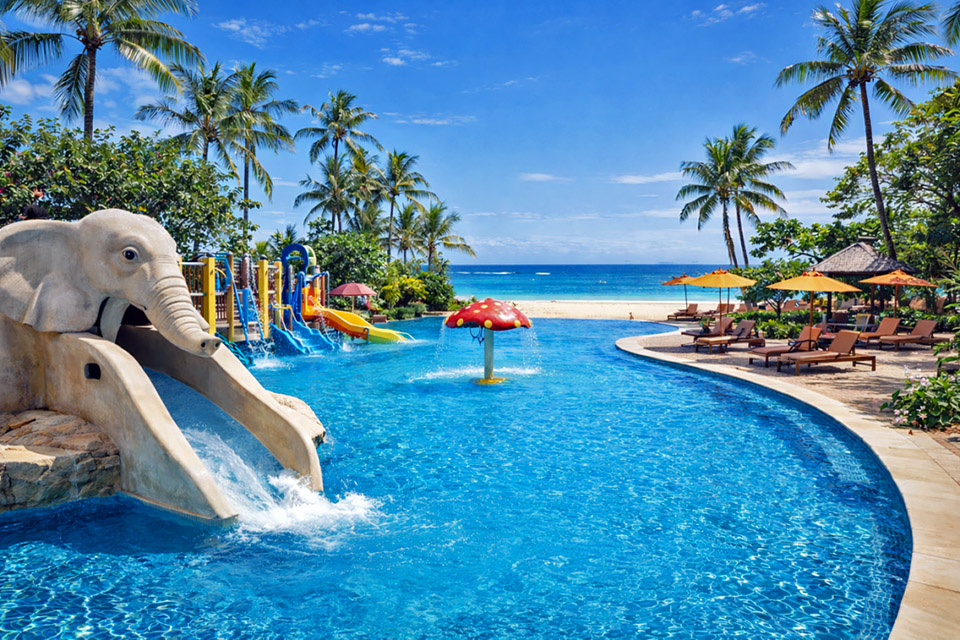
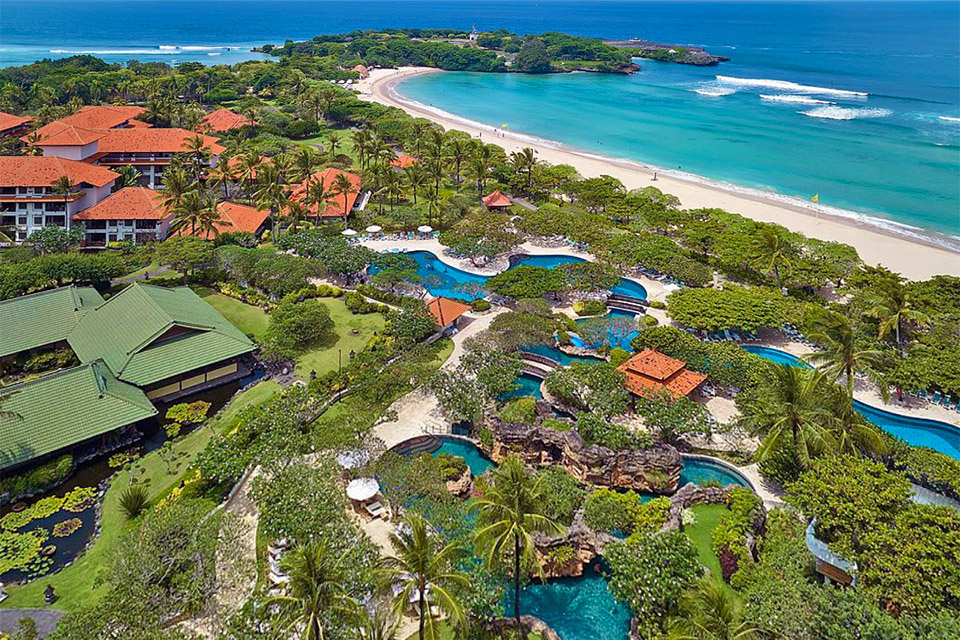
Nusa Dua and the southern peninsula is where families who want a managed, predictable holiday base themselves. The reef-protected bay produces water calm enough for toddlers to stand in unsupervised. The ITDC resort zone — a master-planned enclave built specifically for large international hotel groups — keeps traffic out and puts everything within an easy walk. It feels less like Bali than the other regions do, but that trade-off comes with real benefits: consistent food safety, flat beach access, multi-pool resort complexes, and kids’ club infrastructure that the boutique properties elsewhere can’t match.
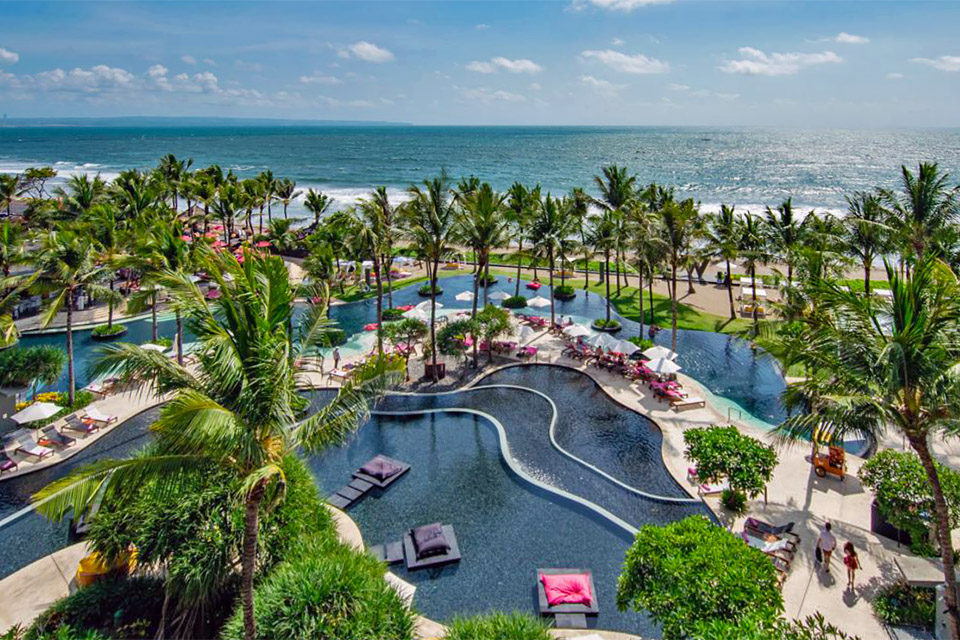
Seminyak and Canggu on the southwest coast suit families who travel for atmosphere as much as comfort. The streets here are real streets, the surf is real surf, and the energy belongs to the destination rather than the resort bubble. Children old enough to surf — roughly seven and upward, depending on ability — will find Canggu’s beach breaks genuinely transformative. The villa culture here is strong: private garden pools, outdoor living spaces, and a staff-to-guest ratio that suits families more than the corridor-and-lobby model.
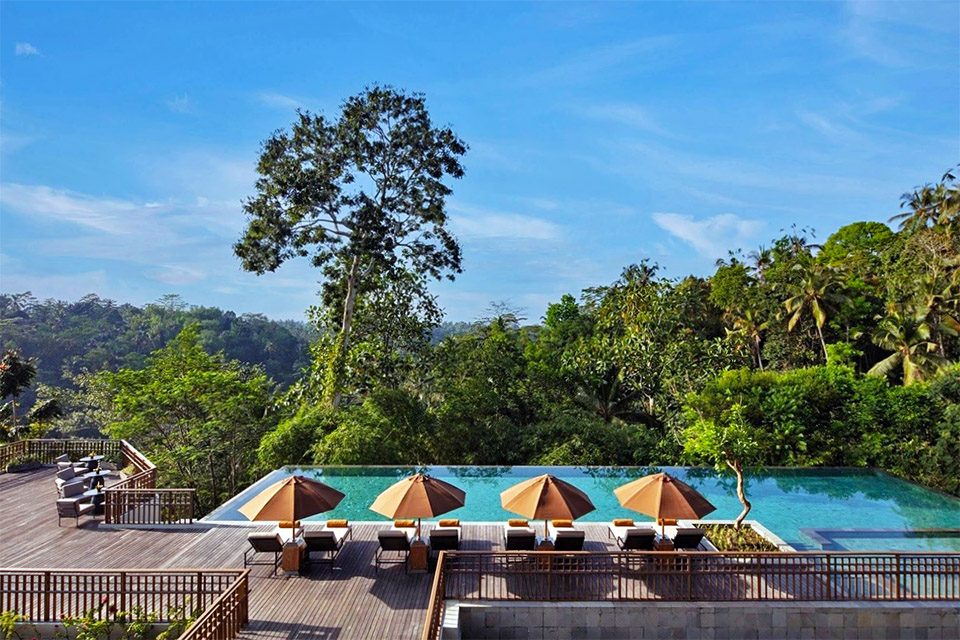
Ubud rewards the family that wants its children to come home changed rather than merely rested. The morning market at 5:30am is chaos and colour and smell in equal measure. The Sacred Monkey Forest gives a six-year-old stories that last a decade. The river gorge resorts, tiered down through jungle toward the Ayung River, offer a sense of immersion in landscape that no beach property can replicate. The practical consideration: Ubud gets real rain, the gorge properties involve serious staircases, and there is no beach. Know what you are choosing.
Jimbaran and Uluwatu on the Bukit limestone peninsula give families the most architecturally dramatic setting on the island — cliff-top pools over the Indian Ocean, sunset views that stop conversation. The beaches require either a funicular descent or a long staircase, which limits accessibility with very young children but rewards those who can manage it with some of Bali’s most spectacular coastal swimming.
 Insider's Insight — Matching Region to Your Children's Ages
 Insider's Insight — Matching Region to Your Children's Ages
- Under 4: Nusa Dua — flat beach, calm water, wide resort paths, zero traffic anxiety.
- 4–8: Nusa Dua or Canggu — pool infrastructure for younger ones, surf lessons for the bolder.
- 8–13: Ubud plus coast split — culture first, then beach; the contrast is what they’ll remember.
- Teenagers: Canggu or Uluwatu — real surf, real food scene, architecture they’ll actually photograph.
- Mixed ages: Base in Canggu, day-trip to Ubud — thirty-five minutes each way, manageable with a good driver.
Nusa Dua: The Benchmark for Family Resort Infrastructure
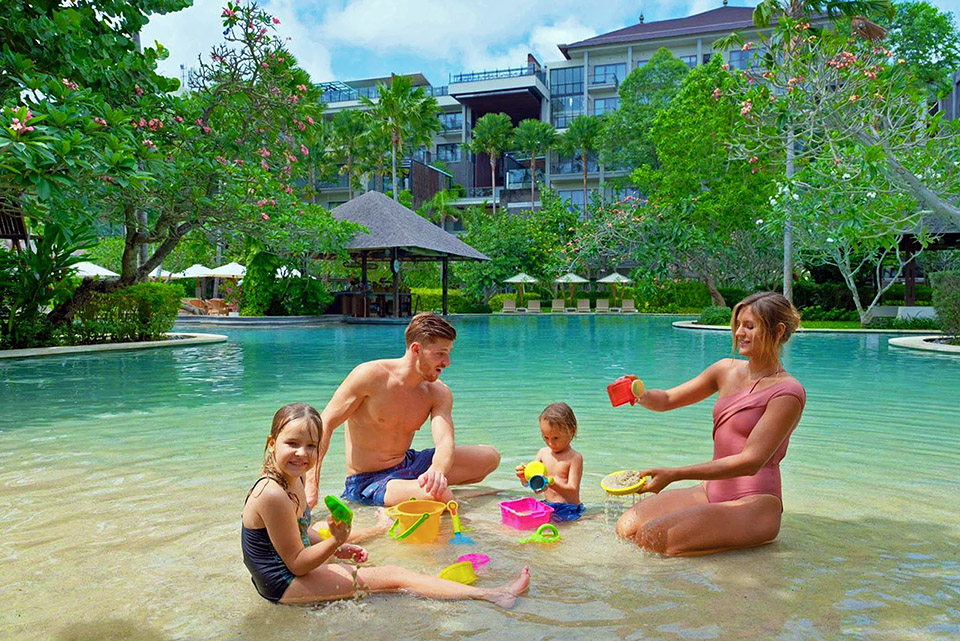
There is a specific moment that parents of toddlers understand: you are sitting on a beach, watching the water, and you are not anxious. Not watchful in that low-grade, won’t-quite-relax way that most tropical beaches produce when your child is three and gravitating toward the surf. At Nusa Dua, the reef changes the equation. The bay sits behind a coral shelf that absorbs the Indian Ocean swell, leaving the shore with the kind of gentle shore-wash that a toddler wades through without drama. That alone is worth knowing before you decide where to base a family holiday.
The resort infrastructure here is the densest on the island. Several of Asia’s largest international hotel groups have built their flagship Bali properties inside the ITDC zone — a planned resort enclave with manicured paths between properties, a beachfront boardwalk, and roads wide enough to feel genuinely safe for small cyclists. It is not Bali at its most raw or atmospheric. What it is, is reliable.
Grand Hyatt Bali
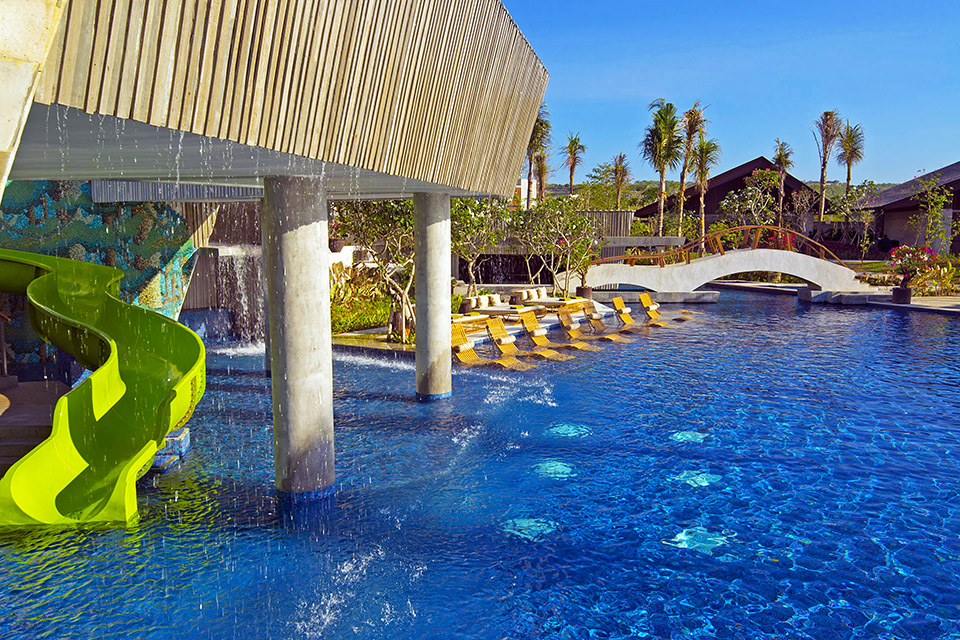
The Grand Hyatt is the reference point against which every other family resort in Nusa Dua is measured, and it holds that position for good reason. The pool complex — five interconnected lagoon-style pools including a dedicated kids’ pool, a water slide circuit, and a jet-stream channel — sits within a twenty-five-hectare property and rarely feels over-capacity. Camp Hyatt accepts children from three to twelve years old across half-day and full-day programmes, with a ratio of roughly one carer to four children in the younger age groups. The beach access from the resort is via a gentle paved slope — wide enough for a pram, shaded at intervals, with a beach service team that sets up umbrellas before you arrive.
The Grand Hyatt’s dining spans six venues, at least three of which function well for family meals at family hours. The buffet breakfast runs until 10:30am — a genuine relief when jet lag has your toddler down at 7pm and up at 4:30am, meaning everyone is starving by 9:45.
Sofitel Bali Nusa Dua Beach Resort
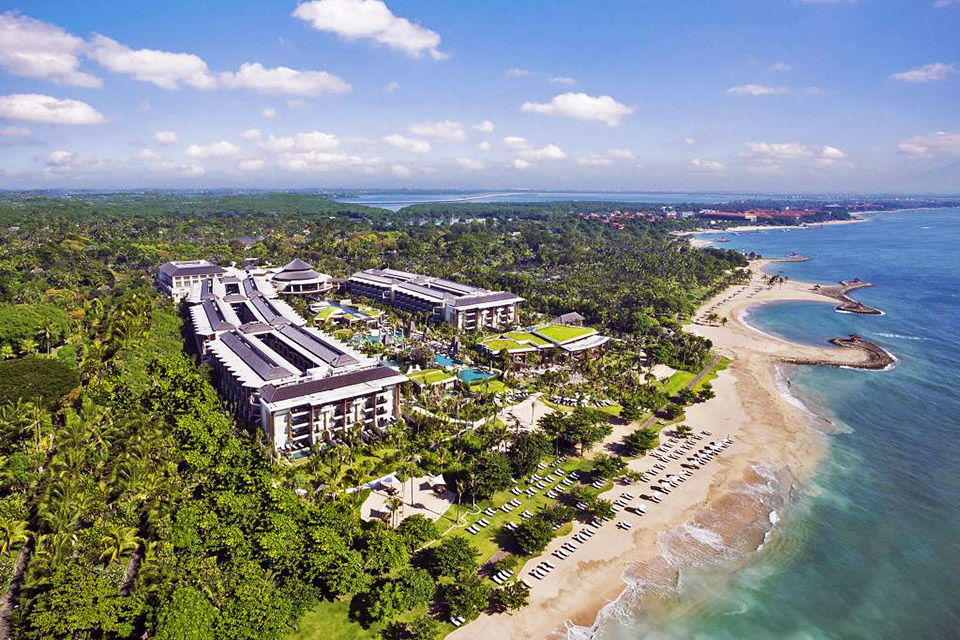
The Sofitel pitches itself at a slightly more refined register than its neighbour — fewer rooms, better food, a pool area that manages to feel spacious without becoming aquatic-park territory. The kids’ club here runs themed programming across the week: Balinese dance on Tuesday, market-vegetable cooking on Thursday, traditional crafts on Saturday. These are not activities invented to keep children occupied; they are activities designed to teach them something about where they are. The distinction matters, and children between six and twelve tend to engage with it genuinely.
The adult spa here — So SPA — is one of the better wellness facilities in the Nusa Dua zone, which matters when you’re travelling with another adult who can cover for ninety minutes while you disappear into a treatment room and remember what silence sounds like.
A reef-protected bay gives back something that most tropical beach holidays quietly remove from parents: the ability to sit with a coffee and watch, rather than watch and worry.
The St. Regis Bali Resort
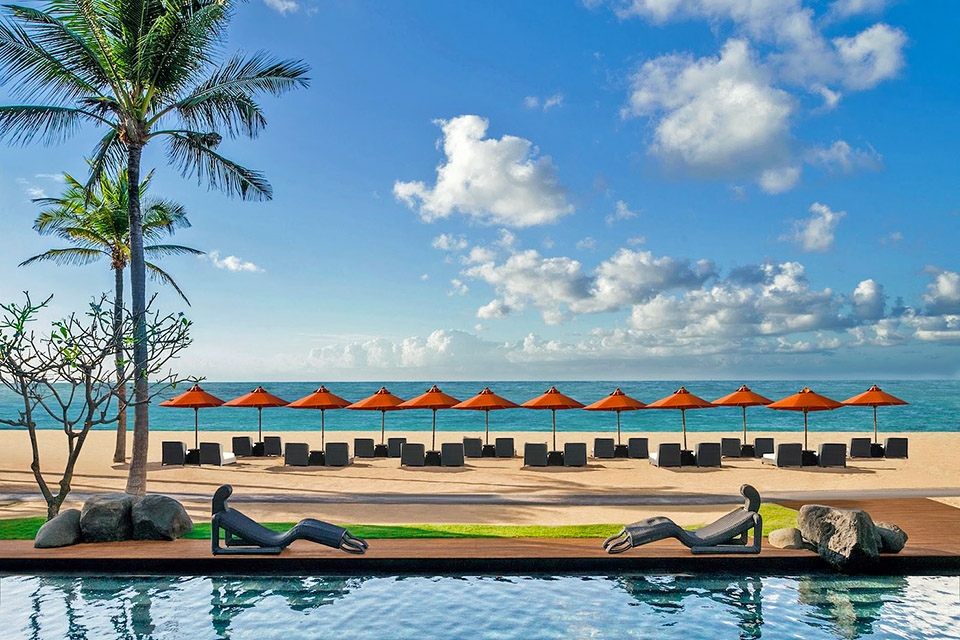
The St. Regis occupies the quieter, more private end of Nusa Dua and operates at a level of service that is less about facilities and more about anticipation. The butler assigned to each villa and suite is not a luxury flourish — it is a genuine operational asset when you have children. A butler who has memorised that your seven-year-old takes her eggs scrambled, not fried, and that your four-year-old needs the pool temperature checked before he’ll go in, removes the friction from twenty small moments per day.
Those moments accumulate.
The lagoon pools here are architectural rather than activity-driven — shaped and planted to feel like natural water features — which suits families with older children better than families with under-fives who want a slide.
Seminyak and Canggu: Atmosphere Over Infrastructure
The decision to base a family holiday in Seminyak or Canggu rather than Nusa Dua is a particular kind of travel philosophy made concrete. You are choosing texture over convenience, the scent of frangipani offerings on a morning walk over a resort-village path between breakfast and the pool. For the right family — children who are curious, old enough to appreciate stimulation rather than just require safety — this part of the island delivers experiences that the resort zone to the south structurally cannot.
The southwest coast faces the Indian Ocean directly, and the surf that arrives at Echo Beach, Batu Bolong, and Berawa has real power. It produces one of the world’s most accessible beginner surf breaks — the waves break predictably, the reef is sand, and the surf school infrastructure is excellent. It also produces rips and shore-break that demand adult awareness around non-swimmers. Know the difference between the right beach conditions and the wrong ones before you take children into the water.
The Layar Private Villas, Seminyak
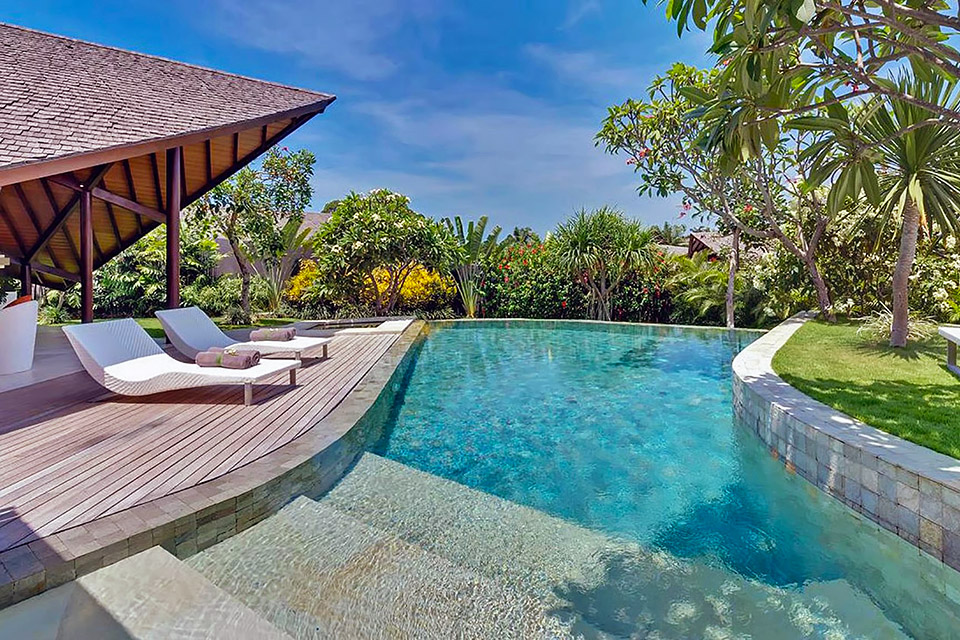
The Layar is not a hotel with family rooms — it is a collection of twenty-two individually staffed villas, each with its own private pool. For a family with children under eight, a private pool is not an indulgence: it is the single feature that eliminates more parenting anxiety than any other. No shared pool edges to monitor. No strangers’ children to negotiate with. No 6pm pool closure when the evening is just getting warm. Your pool, your hours, your rules.
The two-bedroom villas have a configuration that works intuitively for family travel: separate sleeping wings, a living room large enough for the aftermath of a beach day, a kitchen for the fruit and snacks and 5am cereal runs that a room minibar will never cover.
The Layar’s staff-to-guest ratio is unusually high. The villa butler who brings breakfast each morning is the same person you call when your child gets a sea-urchin spine in her foot at 4pm on a Thursday, and they know who to call and how quickly. That kind of on-the-ground competence is worth more than any number of resort facilities.
Insider's Pick — Canggu for Different Family Types
- Families with surfers (7+): Stay near Batu Bolong — five-minute walk to the reef-break surf school at dawn.
- Families with toddlers: Choose a villa in Berawa or Umalas — quieter lanes, bigger compound gardens, easier nap logistics.
- Teens who find resort hotels embarrassing: The Slow, Canggu — architecture and atmosphere they’ll actually want to photograph.
- Multi-generational groups: A staffed villa compound in Umalas — cook, driver, pool, and enough rooms for everyone to have space.
Katamama, Seminyak
Katamama has twenty-two suites and was built as a love letter to Balinese craft — hand-chiselled stone panels, hand-thrown terracotta, batik textiles sourced from specific weaving villages across the archipelago. The pool is a single, precisely proportioned rectangle of dark-bottomed water surrounded by carved stone.
There is nothing designed to entertain children, and the hotel makes no particular claim that it is a family property. What it is, is a place where the surroundings do the work — where a curious seven-year-old will spend twenty minutes examining a carved frieze and ask questions about what the figures are doing.
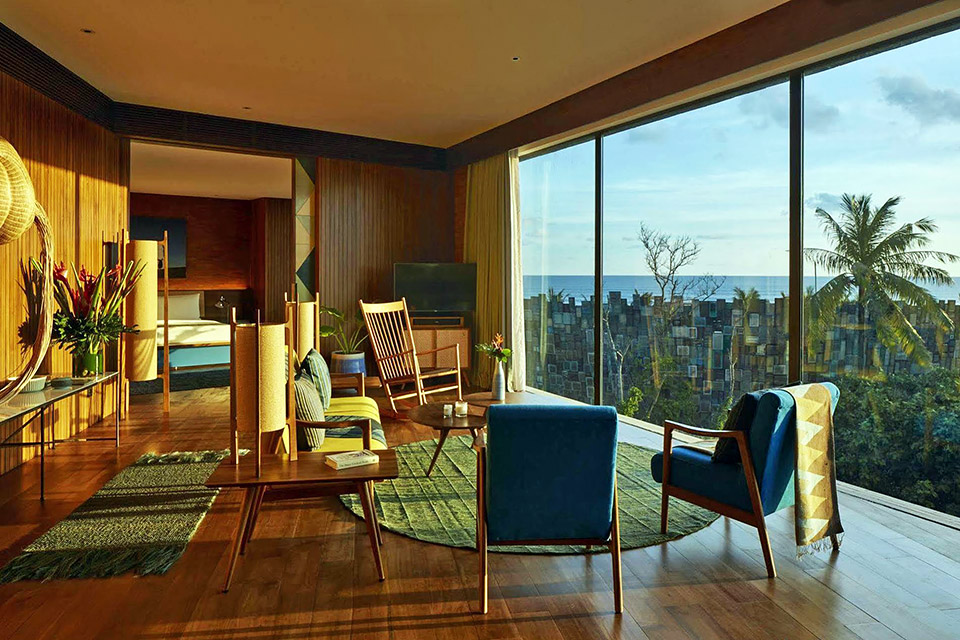
The staff answer those questions with the ease of people who have genuinely thought about the building they work in. That, for a certain kind of family, is more valuable than a water slide.
Ubud: For Families Who Want Their Children to Come Home Different
There is a morning, on most Ubud visits, when the family dynamic shifts. It happens sometime in the first forty-eight hours. A rooster somewhere below the gorge starts before dawn. The jungle sounds layer up — insects, then birds, then the low percussion of a distant temple ceremony — and your children lie in the dark listening instead of asking for their tablets. Something about the density of life in this landscape gets through to small people in a way that a beautiful beach, however beautiful, simply doesn’t.
The gorge properties are the defining accommodation category in Ubud: resorts terraced down limestone and volcanic-soil cliffs toward the Ayung River, with jungle canopy at eye level and rice paddies stitched across the hills in every direction. They are architecturally extraordinary. They require an honest conversation with yourself about your children’s mobility — most involve between forty and eighty steps between the road arrival point, the main building, and the accommodation units below. Some have lift systems; most do not.
With children under two or with prams, several of these properties become impractical despite being otherwise excellent. Ask the hotel specifically before you book.
Mandapa, A Ritz-Carlton Reserve
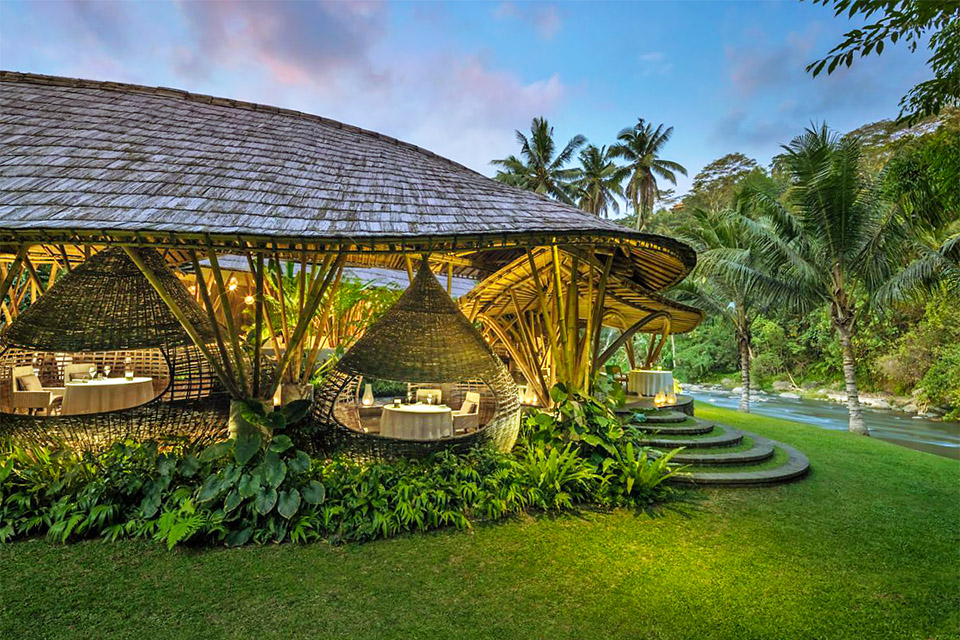
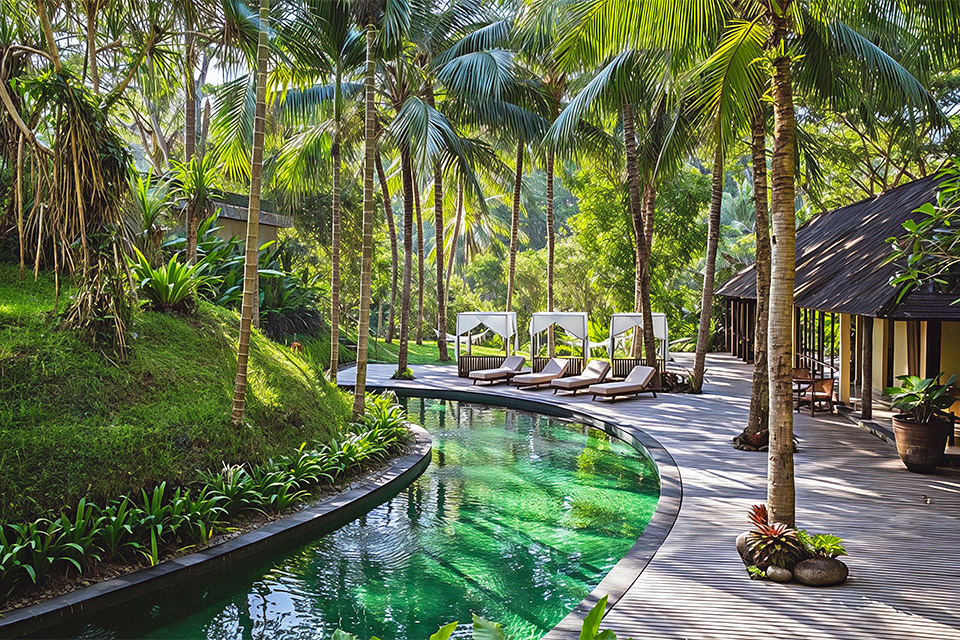
The Mandapa sits on a bend of the Ayung where the river slows and the paddy terraces rise in steps on both banks. The resort’s layout is more navigable than most Ubud gorge properties — the central resort level connects villas, the main pool, and the primary restaurant across a relatively gentle gradient, and the path down to the river is manageable with children who can walk independently.
The Mandapa Pengalaman kids’ programme is among the most genuinely designed on the island: age-calibrated activities from three upward, small group sizes, culturally rooted content — early morning rice harvesting with the gardening team, gamelan introductions with the resident musician, hand-pounded herb workshops at the kitchen garden. These are not activities invented to free parents; they are activities constructed around the question of what a child should understand about Bali.
Evening babysitting is arranged through the concierge with the option to request the same carer across multiple nights — meaning your child meets one trusted person on the first evening and is settled into a routine by the second. For parents who want their evenings back, that continuity is the detail that actually makes it work.
Ubud doesn’t perform for children — it simply is, and children respond to that authenticity in a way no amount of designed resort programming can replicate.
Four Seasons Resort Bali at Sayan
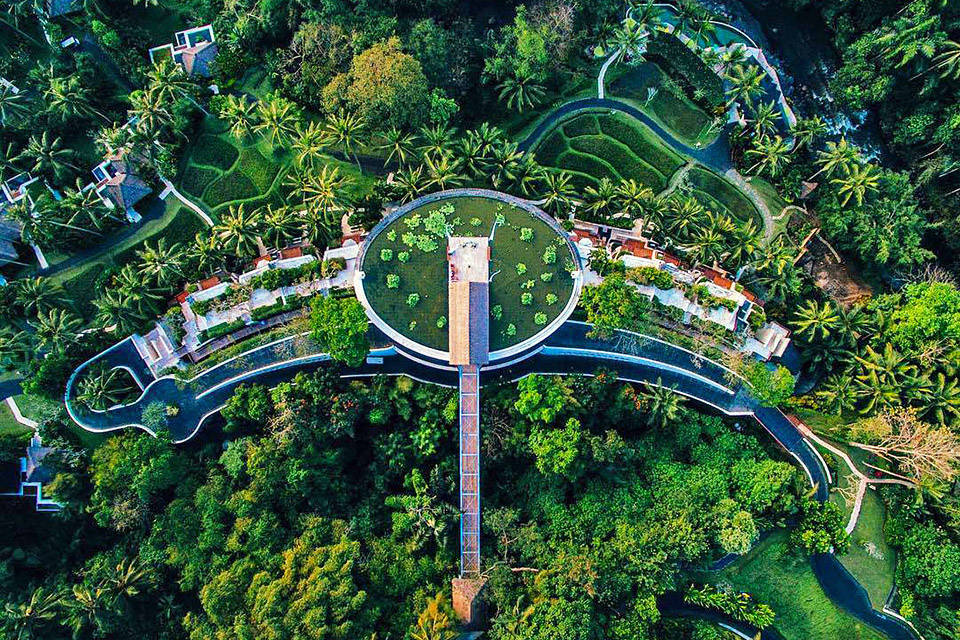
The Four Seasons Sayan is built on the premise that the landscape is the experience, and the property earns that positioning with architectural seriousness. The main building — an ellipse suspended above the Ayung gorge at canopy height — is genuinely unlike anything else on the island. Villas descend the gorge wall in sequence, each with its own plunge pool oriented toward the river below. Guests reach their villas by descending through jungle on tiered stone paths; the sound of the Ayung grows louder with each level until, at the river-level villas, it fills every room.
The family programming here operates on two tracks. The children’s track — guided nature walks, rice terrace cycling, morning yoga tailored for small bodies — is excellent for children from roughly seven upward. The family track includes guided white-water rafting on the Ayung, which runs directly below the resort and provides one of the more memorable morning activities available to families anywhere in Bali. The Four Seasons Sayan is not appropriate for families with toddlers or prams. For everyone else, the setting justifies the effort of getting there.
Komaneka at Bisma
Komaneka at Bisma is smaller and less structurally ambitious than the Mandapa or Four Seasons Sayan, but it occupies a valley view that has become genuinely iconic: an infinity pool apparently hovering above a slope of rice terraces and coconut palms that drops toward the Wos River far below.
The suites are generous — villa-sized by most city-hotel standards — and the property’s intimacy means the staff know your children’s names within twenty-four hours. The restaurant is the best food in the Komaneka portfolio, which is saying something.
Children who are old enough to appreciate extraordinary surroundings — roughly six and above — will find the setting quietly fascinating. For families with very young children, the stairwork and the absence of structured kids’ programming makes other Ubud properties a safer choice.
Insider's Tips — Ubud with Children
- Pack a lightweight rain layer for everyone — Ubud averages over 200cm of annual rainfall; showers are common even in dry season.
- Time the Monkey Forest at 8am — the monkeys are calmer before tour groups arrive and light through banyan canopy is extraordinary.
- Book a guided market visit — Ubud’s early-morning market is over by 7am. Most hotels can arrange a guided walk from 5:30am.
- Use the same driver for your Ubud stay — Ubud’s narrow lanes and limited signage reward someone who already knows the shortcuts.
 Confirm the staircase count before any gorge booking —
it is the question properties never volunteer an answer to.
Jimbaran and Uluwatu: Cliff-Top Drama for Families Who Can Handle It
The Bukit Peninsula at Bali’s southern tip is the island’s geological exclamation point — white limestone cliffs dropping sixty metres to the Indian Ocean, secret beaches accessible only by steep staircase, temples balanced on cliff edges above crashing surf. It is dramatically beautiful in a way that no amount of resort landscaping can manufacture. It is also, for families with very young children or anyone with prams, the most practically challenging region on this list. The families who choose it and come back for it are those who understood the terms going in.
Ayana Resort and Spa Bali / Rimba Jimbaran Bali by Ayana
The Ayana occupies ninety hectares of Jimbaran clifftop and encompasses two distinct properties that share the same facilities: the Ayana itself, which pitches toward couples and design-conscious adults, and the Rimba Jimbaran Bali by Ayana, which is purpose-built around families.
Booking into Rimba gives access to everything the Ayana offers — the cliff-top Rock Bar (a genuine Bali icon), the multiple pool zones, the ESPA spa, the ocean-front dining — while staying in accommodation that was actually designed with children rather than honeymooners in mind. Rimba’s room categories include bunk-bed configurations for families with two older children, and the kids’ club here runs a full-day programme from 9am to 9pm, which is one of the longer operating windows on the island.
The journey between the cliff-top resort and the private beach below is a funicular — a short, slow descent through cliff vegetation that every child under twelve will want to ride no fewer than four times per day. Factor this into your beach schedule accordingly.
Alila Villas Uluwatu
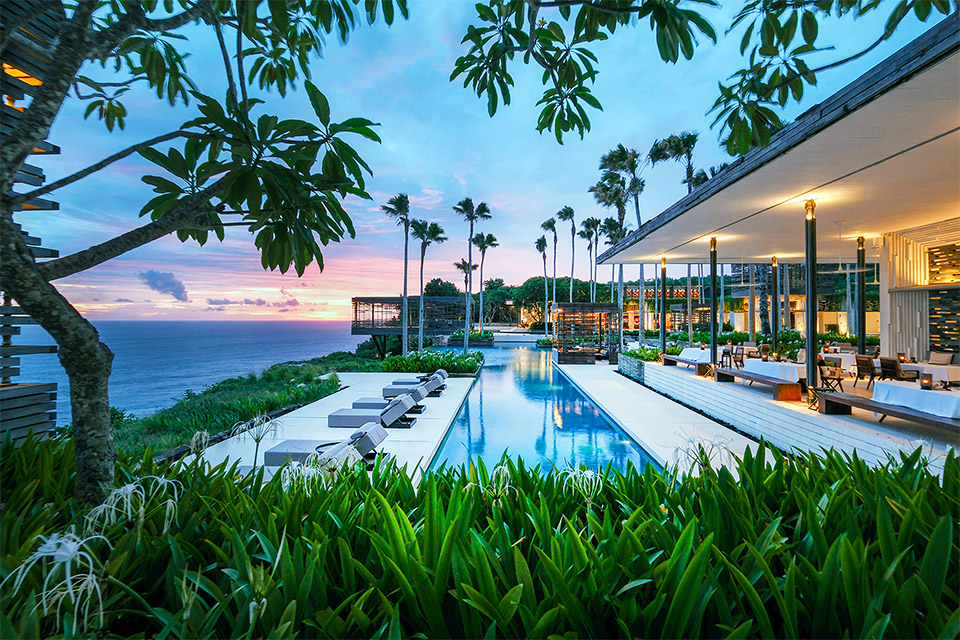
The Alila Villas Uluwatu is an adult resort that accepts children without performing the kind of quiet institutional resentment — pool areas before 3pm restricted, restaurant menus with nothing a six-year-old would eat — that some Uluwatu properties deploy. The villas are generously sized, each with a private pool and open-sided living space designed to make the constant presence of the Indian Ocean view feel like a natural feature rather than a backdrop.
What makes it worth considering for families with older children is its proximity to Pura Luhur Uluwatu, one of Bali’s six directional sea temples, where the Kecak fire dance is performed on the clifftop amphitheatre at sunset most evenings. One hundred voices building a human percussion engine against a darkening sky and an ocean horizon, with no instruments, no electronics, no amplification. It is the kind of thing that lodges permanently in a child who is old enough to sit still for it — roughly six upward, honestly, with some eight-year-olds getting more from it than some adults.
The Alila Villas Uluwatu is not the right choice for families with children under five. The pools are adult-proportioned, the distances within the property require walking, and the cliff-top setting adds an environmental complexity that demands consistent supervision. Come back when they are older. It will be worth the wait.
What the Resort Websites Don't Tell You: The Features That Actually Matter
Every property in the four- and five-star category will describe itself as family-friendly. Very few will give you the specific operational detail that allows you to evaluate whether their definition of family-friendly matches your family’s actual requirements. These are the questions to ask and the factors to interrogate before you commit to a booking.
Pool Depth and Design
The photograph on the website shows a beautiful infinity pool against a rice-terrace or ocean backdrop. It tells you almost nothing about whether a three-year-old can use it. What matters: the minimum depth of the shallowest section (thirty to forty centimetres is genuinely usable for toddlers; sixty centimetres requires your undivided attention), whether there is a dedicated children’s water area separate from the adult pool, the presence and quality of shade structures over the pool deck, and whether the pool is gated or open-access from the room terrace.
Ask these questions directly. A property that cannot answer them specifically has not thought carefully about the experience it is providing.
Kids’ Club Operating Hours
Morning kids’ club sessions are common. Evening sessions — the ones that actually allow parents to eat dinner with both hands free — are rare and worth specifically seeking out. The Mandapa and Grand Hyatt both offer evening programmes. Most boutique properties offer morning only.
If your family’s priority is adult evenings, build this into your decision-making before you arrive and discover the club closes at 5pm.
Food Service Hours and Flexibility
Jet lag turns children’s eating schedules into something that no restaurant opening time can predict. A resort that opens breakfast at 7:30am is useless when your toddler has been awake since 5am and hungry since 5:15. Ask: what is the earliest room service available, and does the room have a kettle and minibar stocked for early morning? The better properties anticipate this. Some will stock the minibar with breakfast items on request the night before. That detail is worth more than any amount of dining venue architecture.
Transfer and Getting Around
Bali’s transport infrastructure does not accommodate families with young children intuitively. Ride-hailing apps — operate island-wide — are convenient but arrive in vehicles that rarely carry internationally-compliant child seats, and booking surge pricing during school-run hours in Seminyak can be significant. The families who have the most fluid experience in Bali are those who arrange a dedicated driver for the duration of the stay — a single person who knows the itinerary, knows the property, and does not need GPS to find the beach.
Most resorts can recommend trusted driver-guides. Budget USD 55–75 for a full eight-hour day, which is reasonable value for what it removes from your daily logistics.
Comparison: Best Bali Family Resorts at a Glance
RESORT |
REGION |
IDEAL AGES |
KID'S CLUB |
POOL TYPE |
RATE RANGE (USD/NIGHT) |
|---|---|---|---|---|---|
Grand Hyatt Bali
|
Nusa Dua
|
All ages, especially under 10
|
Full-day, 3–12 yrs
|
Multi-pool lagoon + slide
|
280–430
|
Sofitel Nusa Dua
|
Nusa Dua
|
4–14, culturally curious
|
Themed half/full-day
|
Lagoon-style, adult + kids
|
240–390
|
The St. Regis Bali
|
Nusa Dua
|
6+, families valuing service
|
Butler-supported
|
Architectural lagoon
|
500–950
|
The Layar
|
Seminyak
|
All ages, self-directed
|
On request
|
Private villa pool per unit
|
600–1,200
|
Katamama
|
Seminyak
|
7+, design-aware families
|
None
|
Single architectural pool
|
350–650
|
Mandapa, Ritz-Carlton Reserve
|
Ubud
|
3+, cultural programming
|
Full-day, age-calibrated
|
River-view infinity
|
800–1,700
|
Four Seasons Sayan
|
Ubud
|
7+, gorge setting
|
Yes, cultural focus
|
Canopy infinity + plunge
|
700–1,500
|
Komaneka at Bisma
|
Ubud
|
6+, valley views
|
Limited
|
Rice-terrace infinity
|
400–720
|
Rimba Jimbaran by Ayana
|
Jimbaran
|
All ages, beach access
|
Full-day + evening
|
Multi-zone cliff-top pools
|
300–560
|
Alila Villas Uluwatu
|
Uluwatu
|
8+, cliff setting
|
Minimal
|
Private cliff-top villa pool
|
600–1,100
|
Rates are indicative peak-season rack rates (July–August, December). Shoulder months — May, September, early October — typically run 20–35% lower. Always confirm directly with the property; direct bookings frequently include kids’ club credits, complimentary cot installation, and early check-in that online travel agencies do not.
When to Visit Bali with Children
Bali’s dry season runs April through October, and the families who arrive in July and August get the best-weather odds, the most consistent beach days, and the longest waits at popular temples. Book four to six months ahead for peak school-holiday travel — the better properties fill their family room categories first, and waiting until three months out for the Grand Hyatt or the Mandapa in July is an optimistic strategy that rarely ends well.
The genuine sweet spot, if your family’s school calendar allows it, is May or the last two weeks of September. Weather is reliably dry. Resorts are at sixty to seventy percent capacity. Prices drop meaningfully — typically fifteen to thirty percent below peak at the same properties. The Sacred Monkey Forest and the Kecak fire dance have audiences rather than crowds. The beaches have space.
Wet season — November through March — is worth a more considered look than its reputation suggests. Bali’s rainfall in the wet season comes in short, heavy bursts rather than sustained days of grey. A morning at the beach or pool is almost always possible; a dramatic afternoon downpour clears in forty minutes and leaves the paddy fields an extraordinary electric green.
Resort rates in wet season can be forty to fifty percent below peak, which is a significant amount of money that either stays in your pocket or funds experiences.
The surf on the south-facing coast intensifies between December and February; Nusa Dua’s reef-protected bay is the safest beach option during these months for families with non-swimmers.
Plan Your Bali Trip Now
The families who return to Bali with their children — and they do return, sometimes for a decade of the same week in the same region until the children become teenagers who are harder to coordinate — are not returning for the pool or the kids’ club or even the sunsets, though all of those are real.
They are returning because Bali does something to children that cannot be manufactured in a resort context. It asks them to pay attention. The smell of incense from a morning offering. The sound of frogs after rain. The fact that the woman who made their nasi goreng smiled at them without any agenda. These are small accumulations, and they add up to something that a child carries without quite knowing they are carrying it.
Choose the right region for your family’s current chapter. Be honest about what your children need from a pool and what you need from an evening. Ask the specific questions that the booking websites won’t answer automatically. And leave some space in the itinerary that is not accounted for — because the best Bali moment your family has will almost certainly be the one that wasn’t planned.
The island has been surprising families for a long time. It knows what it is doing.
💡Related reads:
FAQ
What is the best area in Bali for families with young children?
For children under five, Nusa Dua is consistently the most practical base. The reef-protected bay gives calm, shallow water safe for toddlers. The resort-zone roads are flat and wide. The big hotel properties here have the deepest kids’ club infrastructure and the most generous pool configurations. For children six and above, the choice opens up considerably — Ubud’s cultural density, Canggu’s surf culture, and the cliff-top drama of Jimbaran all become genuinely accessible options depending on your family’s temperament.
Do Bali resorts have good kids' clubs?
The best ones are genuinely good — culturally rooted, age-calibrated, staffed by people who have chosen to work with children rather than been assigned to the role. The Mandapa’s Pengalaman programme, Camp Hyatt at the Grand Hyatt Bali, and the Sofitel Nusa Dua’s themed day curriculum are the most consistently praised among families who have used them. The worst are rooms with tables and colouring books given an evocative name. The way to tell the difference: ask the hotel about the staff-to-child ratio in the youngest age group and what the programming was on the previous Tuesday. Specific answers indicate a real operation; vague answers indicate the alternative.
Is Bali safe for children?
By the broad standards of international travel, yes. The main practical considerations: ocean swimming on the open-coast west-facing beaches carries rip and shore-break risk and requires adult supervision and knowledge of conditions; traffic in Seminyak and Canggu is dense and does not observe pedestrian right-of-way in the way that European or Australian roads do; food from established restaurant and resort kitchens is safe, with the standard cautions around raw salads and pre-cut fruit from street stalls; sun intensity in the tropics exceeds what most families from temperate climates are accustomed to, and fifty-plus SPF applied before 9am and again at midday is not overcautious. None of these are Bali-specific concerns — they apply equally to Phuket, Lombok, or any tropical destination. Bali’s particular advantage is the warmth and attentiveness with which Balinese adults treat visiting children, which creates a low-level ambient safety that is genuinely distinctive.
Which Bali resort has the best pool for kids?
The Grand Hyatt Bali’s multi-pool lagoon complex is the most comprehensively designed for children across all age groups — the dedicated toddler pool, the water-slide circuit, and the jet-stream channel collectively mean there is something for a two-year-old and something different for a twelve-year-old. The Rimba Jimbaran by Ayana is the closest second, with multiple pool zones across the cliff-top property. For families where the priority is a private pool rather than a shared resort facility, the villa properties in Seminyak — The Layar particularly — offer children their own pool in the garden, which solves an entirely different set of parenting logistics.
What should I look for in a Bali family resort?
Five things, in roughly this order of importance: pool design appropriate for your children’s ages; food service hours that accommodate early risers and jet-lagged schedules; babysitting availability with carer continuity across multiple nights; access to the beach or surrounding landscape that matches your children’s mobility; and a kids’ club with evening as well as morning programming if adult dinners are a priority. The marketing language — “family-friendly”, “kid-approved”, “perfect for little ones” — tells you nothing about any of these. Ask specific operational questions and judge by the specificity of the answers.
How much does a family-friendly resort in Bali cost?
A solid four-star property with a proper pool setup and basic kids’ facilities starts at around USD 180–240 per night in shoulder season — the Sofitel Nusa Dua is in this range off-peak, as are several villa properties in Canggu. The reserve-tier Ubud properties and the larger Nusa Dua flagships in peak season range from USD 400 to USD 1,700 per night. Private villa compounds — often the best solution for families with multiple children or mixed-generation groups — range from USD 300 for a modest two-bedroom with cook and driver to USD 2,000-plus for a staffed luxury compound in Seminyak. The consistent finding among experienced Bali family travellers: spending more on accommodation and less on external activities produces a more relaxed holiday, particularly for children under seven whose most important variable is the quality of the pool ten metres from the bedroom door.
Do Bali resorts provide babysitting?
Yes — babysitting is available across almost all four- and five-star properties, arranged through the concierge with twenty-four to forty-eight hours’ notice in most cases. Hourly rates range from approximately USD 10 to USD 20. The quality varies; the best practical approach is to request the same carer for consecutive evenings, building a relationship rather than introducing a new face each night, and to ask whether the sitter is a resort employee or an external referral — the former comes with more institutional accountability. Some properties — the Mandapa and Rimba Jimbaran among them — offer structured evening kids’ club programming as an alternative to in-room babysitting, which many children prefer.
Can I combine Ubud and the beach in a family trip?
Not only can you — you probably should. The transfer between Ubud and any of the coastal resort zones takes sixty to ninety minutes depending on traffic and origin. Most families find a three-to-four night Ubud stay followed by four-to-five nights on the coast produces something with real shape: the cultural density of the highlands, the morning markets and river walks and temple visits, followed by the release of the beach. Children experience the contrast viscerally. Use a dedicated driver for the inter-region transfer rather than a booking app; luggage, children, and the inevitable mid-journey snack situation are better managed by someone who knows the road and has been briefed in advance.
Is Bali good for multi-generational family holidays?
Bali may be the single best destination in Asia for a multi-generational group. The private villa model handles the generational logistics that a hotel corridor cannot: multiple bedrooms, a shared pool, a communal kitchen and living space, and household staff — cook, housekeeper, driver — means that grandparents have company and their own room, grandchildren have a pool and adults available, and the middle generation has an infrastructure that actually supports rather than merely tolerates the complexity of three generations sharing a holiday. Villa compounds in Umalas, Pererenan, and Canggu accommodate eight to fourteen guests comfortably. Staff costs in Bali are reasonable; a full-time cook for a week will not break the budget of a multi-family group sharing the accommodation cost.
Last updated June 2026. Resort rates, programme details, and operating hours are subject to change — always confirm directly with the property before finalising a booking. HalloBALI Travel DMC can arrange private family itineraries, villa sourcing, guided cultural experiences, and in-destination support across Bali and eastern Indonesia. Contact us at hallobalitraveldmc.com.