Routes, operators, prices, and everything you need before you twist the throttle.
Bali ATV Quad Bike Tours – The rice terrace opens in front of you with no warning — one moment you’re deep in a tunnel of bamboo, the next you’ve burst into open air, the entire Tegallalang valley falling away in green steps below. Your hands are still gripping the handlebars. Mud has claimed your forearms. You are, objectively, having the best morning of your holiday.
Bali ATV quad bike tours have been running for over two decades, and the experience has refined itself into something genuinely worth doing. This isn’t the clunky tourist activity it once was — the routes are longer, the machines are better, the landscapes more varied than many visitors expect. What started as a novelty for Kuta guesthouses has evolved into one of the island’s most versatile outdoor activities, pulling in everyone from families with teenagers to groups of friends who want something with a little more adrenaline than another sunrise hike.
This guide covers everything: how to choose the right operator, which routes justify the price, what the experience actually feels like at each location, and the practical details that most tour comparison sites don’t bother telling you. Whether you’re booking weeks in advance or looking for something to fill a free morning, here’s what you need to know.


💡Related reads:
What Is a Bali ATV Tour, and Why Is It Worth Doing?
An ATV — all-terrain vehicle, referred to locally as a quad bike — is a four-wheeled motorised vehicle designed for off-road terrain. In the Bali context, most are 250cc automatic or semi-automatic machines, built wide enough for stability on uneven ground and slow enough that first-time riders can manage them within minutes of the safety briefing. You don’t need a motorcycle licence or any prior riding experience. The machine steers like a car but handles like a tractor — deliberate, grippy, and surprisingly forgiving.
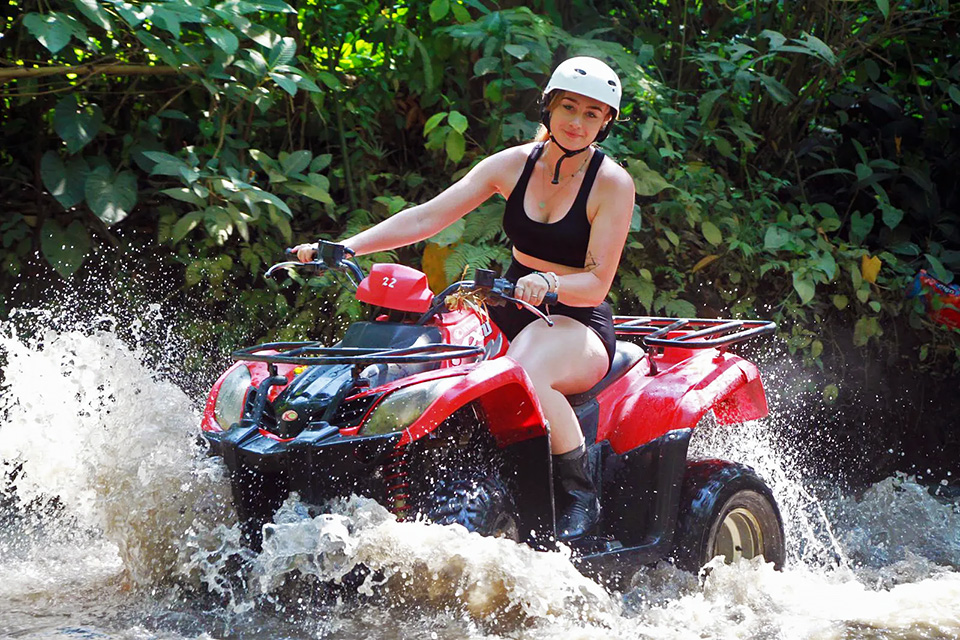
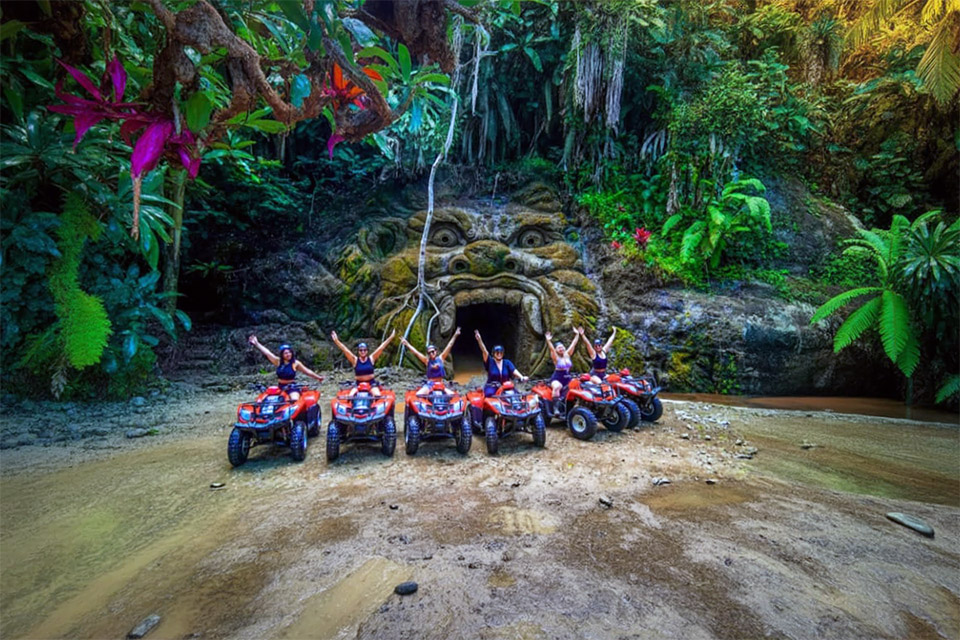
What makes Bali’s ATV tours distinctive is the terrain they move through. Unlike quad biking in desert settings or purpose-built tracks, Bali’s routes cut through genuinely functional countryside: working rice paddies, active plantations, traditional villages, and river gorges that no tarmac road reaches. You move through landscapes that most visitors only photograph from viewpoint platforms — except here you’re in them, at ground level, at the pace of the land itself.
The activity sits in a sweet spot between thrill and scenery. It demands just enough concentration to keep your full attention, but leaves enough mental bandwidth to appreciate the jungle closing in on both sides, the smell of wet earth after morning rain, the sound of the river long before you see it.
 Insider's Insight — Who This Activity Actually Suits
 Insider's Insight — Who This Activity Actually Suits
- First-timers: the 250cc automatic machines are genuinely beginner-friendly — most people are confident within 10 minutes.
- Families: children from around 7 years old can ride as passengers; some operators allow children 12+ to ride solo on smaller machines.
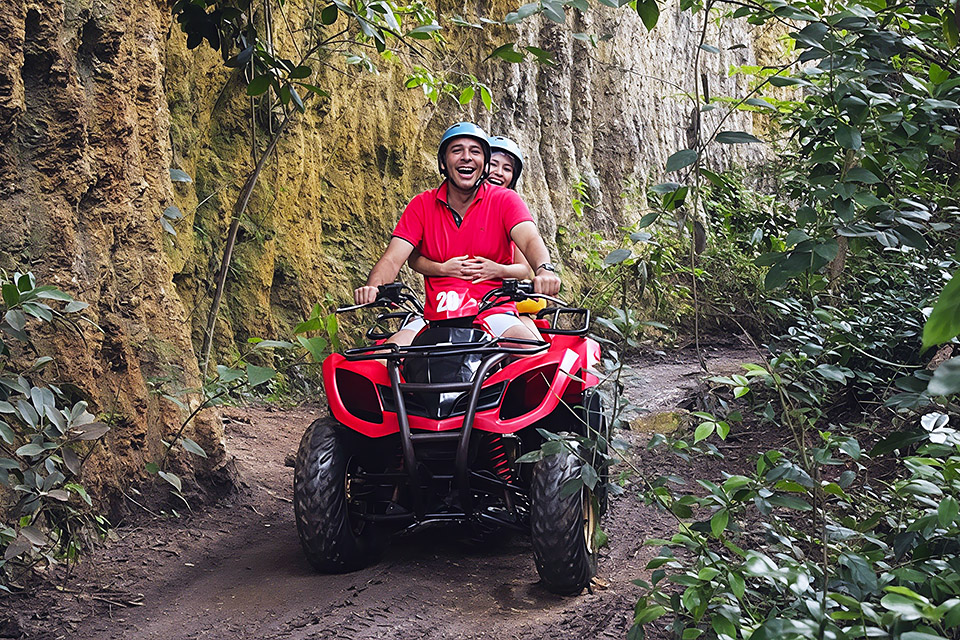
- Couples: double-seater (tandem) ATVs are standard — one person rides, the other holds on from behind.
- Groups: ATV tours accommodate groups of 2 to 30+ riders; most operators stagger starts to avoid convoy traffic on narrow trails.
 Not ideal for: anyone with significant back, neck, or knee problems — the vibration on rocky terrain is real, and a 2-hour ride will feel it.
The Main ATV Regions in Bali
Bali’s ATV operators are not evenly distributed. Three areas account for the majority of tours, each with a distinct character, and the choice between them changes the experience considerably.
Ubud — The Benchmark
Ubud is where the ATV scene grew up, and for good reason. The terrain around Tegallalang, Payangan, and Taro combines everything the activity promises: sculpted rice terraces, jungle paths narrow enough to brush your shoulders, river valley descents, and traditional village lanes where children wave from doorways. Most Ubud-area routes run 1.5 to 2 hours, cover 12 to 22 kilometres of actual trail, and include a river crossing or two. The mud here is the real thing — volcanic, dark red-brown, and more than willing to coat you comprehensively.
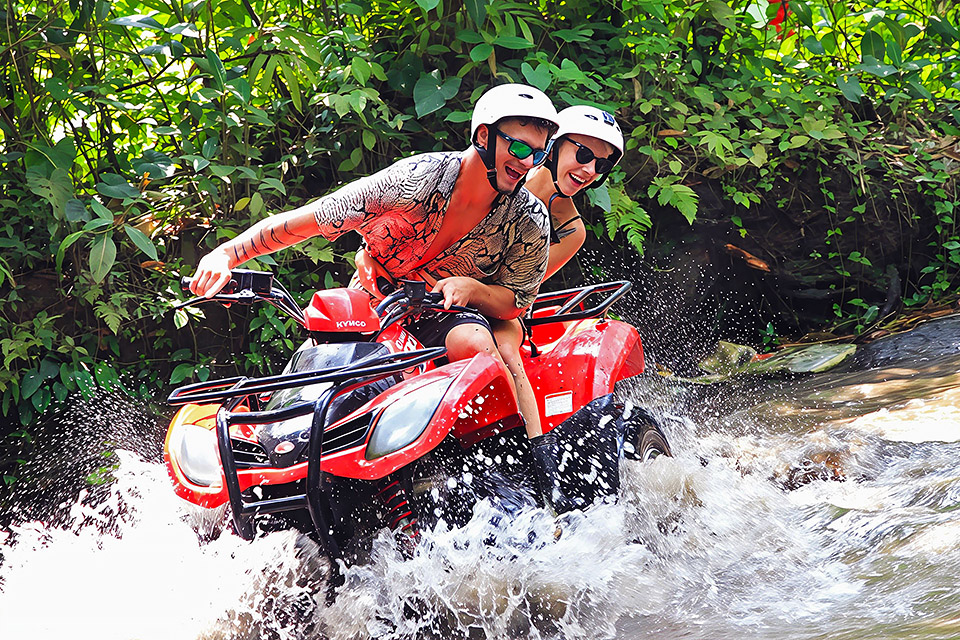
The concentration of operators around Ubud is also highest, which means prices are competitive and the infrastructure is mature. Most packages include hotel pickup from Ubud or Seminyak, a safety briefing, full protective gear, a shower and change of clothes at the basecamp, and lunch or a snack. You’ll finish with more mud than you started with and a clearer sense of why this particular valley draws people back year after year.
Bedugul and the Central Highlands
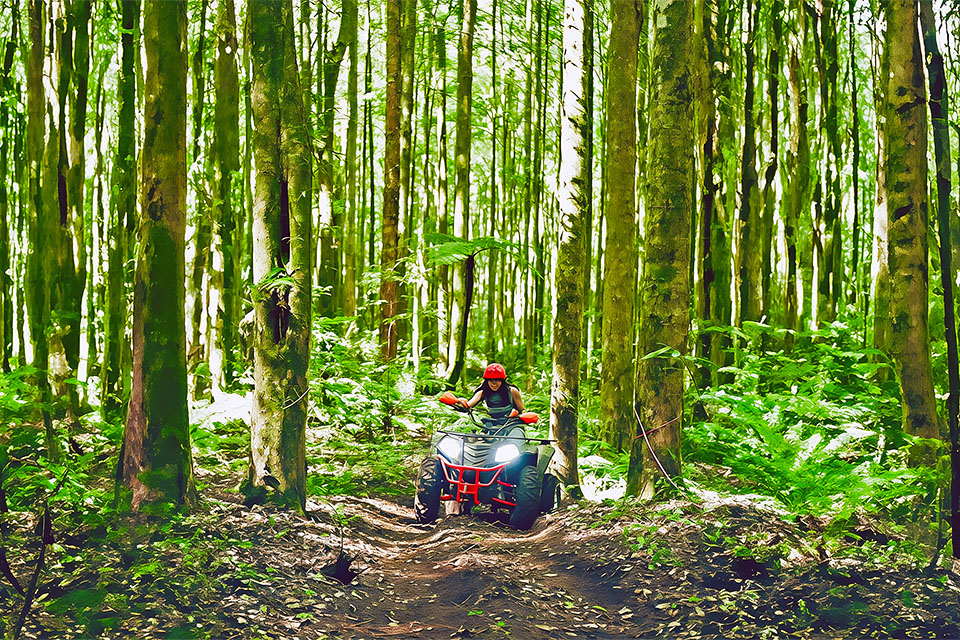
Less marketed but increasingly popular with repeat Bali visitors, the highland routes around Bedugul and Baturiti run through cooler, denser vegetation at elevations between 800 and 1,200 metres. The air is noticeably different — crisp and clean in a way that feels almost alpine after days on the southern coast. Routes here move through strawberry and vegetable farms, pine forests, and cloud-forest edges where visibility drops to 30 metres in morning mist.
The tradeoff is access — Bedugul is 1.5 to 2 hours from Seminyak and Kuta, making it a half-day commitment before you’ve even started the ATV. But if you’re already travelling to Ulun Danu Beratan temple or Lake Tamblingan, a Bedugul ATV session makes an excellent combination. Temperatures here can drop to 18°C in the early morning; bring a layer.
Kuta and the Southern Coast
A handful of operators run shorter ATV experiences from bases near Kuta, Legian, and Canggu, targeting visitors who don’t have a full day to give or who are basing themselves on the coast without transport to Ubud. These routes tend to be flatter, shorter (45 minutes to 1 hour), and more track-like than trail-like. They’re a reasonable introduction to the machines, but the scenery doesn’t compare to the central and highland areas. Worth considering only if Ubud genuinely isn’t possible during your stay.
The mud around Ubud is volcanic, dark red-brown, and more than willing to coat you comprehensively. This is not a polite activity. It’s a good one.
Choosing an ATV Operator: What Actually Matters
There are more than 40 registered ATV operators in the Ubud area alone, and the quality gap between them is meaningful. Price is a signal, but not always the one you think — the cheapest operators sometimes run excellent trails with older machines; some mid-range operators run excellent machines on mediocre trails. Here’s how to read the difference.
The Machine Fleet
Ask specifically about the CC rating and machine brand. Most operators use 250cc ATVs — adequate and appropriate for the terrain. A small number of premium operators now run 350cc or 500cc machines, which offer more power for steeper inclines and a more responsive ride. Yamaha Grizzly and Honda TRX series machines are the most common and well-maintained; avoid operators running unbranded Chinese-manufactured machines, which have a higher breakdown rate on longer trails.
Ask how frequently machines are serviced. A reputable operator will answer this specifically (“every 100 hours of use” or “weekly”). A vague answer is a yellow flag.
The Route
Ask for a map or a description of the route in kilometres and terrain type. Any operator worth booking with can describe their trail in detail: how far, what surfaces, whether there’s a river crossing, how long the jungle section runs. Generic answers like “beautiful rice fields and jungle” with no specifics mean the route may be short, sanitised, or both.
The best routes in the Ubud area cover at least 15 kilometres and include at least three distinct terrain types — typically rice terrace edges, jungle canopy trail, and river valley or plantation. A good operator will be proud of their route and specific about it.
Safety Infrastructure
Helmets, goggles, and gloves should be included as standard — not optional upgrades. Check that the helmets offered are full-face, not open-face motorcycle helmets. A competent guide should lead the group throughout the trail, not follow at the back. The group-to-guide ratio matters: one guide per six to eight riders is appropriate; anything above ten riders per guide is a quality signal worth noting.
Ask whether there is a support vehicle or mechanic vehicle following the trail. On longer routes, breakdowns happen. A good operator has a plan for them.
Insider's Tips — Getting to the Trailhead
- Ask the route length in km — anything under 10km is a short circuit, not a real trail experience.
- Request the machine brand — Yamaha or Honda fleets signal better maintenance habits.
- Check inclusion of hotel transfers — adds significant value if you’re staying in Seminyak or Kuta.
- Read recent reviews for mud-day feedback — rainy season reviews reveal how trails hold up after rainfall.
- Avoid operators without a physical basecamp address — pop-up booking desks often use sub-contracted trails with minimal safety infrastructure and quality assurance.
Price Guide: What a Bali ATV Tour Actually Costs
Prices have stabilised over the last few years as the market matured. Here is what to expect across operator tiers, inclusive of standard inclusions (gear, guide, lunch or light meal).
OPERATOR TIER |
SOLO RIDER |
TANDEM (2 PEOPLE, 1 ATV) |
TYPICAL ROUTE LENGTH |
|---|---|---|---|
Budget / guesthouse-arranged
|
IDR 350,000–450,000
|
IDR 550,000–650,000
|
8–12 km, 1 hour
|
Mid-range / independent
|
IDR 500,000–700,000
|
IDR 750,000–950,000
|
14–18 km, 1.5–2 hours
|
Premium / DMC-arranged
|
IDR 750,000–1,100,000
|
IDR 1,000,000–1,400,000
|
18–25 km, 2–3 hours
|
Note that prices quoted on booking platforms often include a commission layer — direct booking with an operator’s own website or a trusted DMC typically saves 10 to 15 percent. Hotel-arranged tours carry the highest markup of all; they’re convenient but rarely the best value.
Most operators include hotel transfers from Ubud as standard. Transfers from Seminyak, Kuta, or Canggu attract an additional IDR 50,000 to 150,000 per person. Always confirm transfer inclusion before booking.
What to Expect: The Experience Step by Step
Knowing what the day looks like from start to finish removes the friction that first-timers often feel before any unfamiliar outdoor activity. Here is the typical flow for a full Ubud-area ATV tour.
Pickup and Transfer
Most tours begin with a hotel pickup between 7:30am and 9:00am, depending on the transfer distance. The drive from Seminyak to a Tegallalang-area basecamp takes approximately 1 hour 20 minutes in typical morning traffic; from Ubud town, 30 to 45 minutes. The transfer is usually in a small van or private car with your guide or driver.
Arrival and Briefing
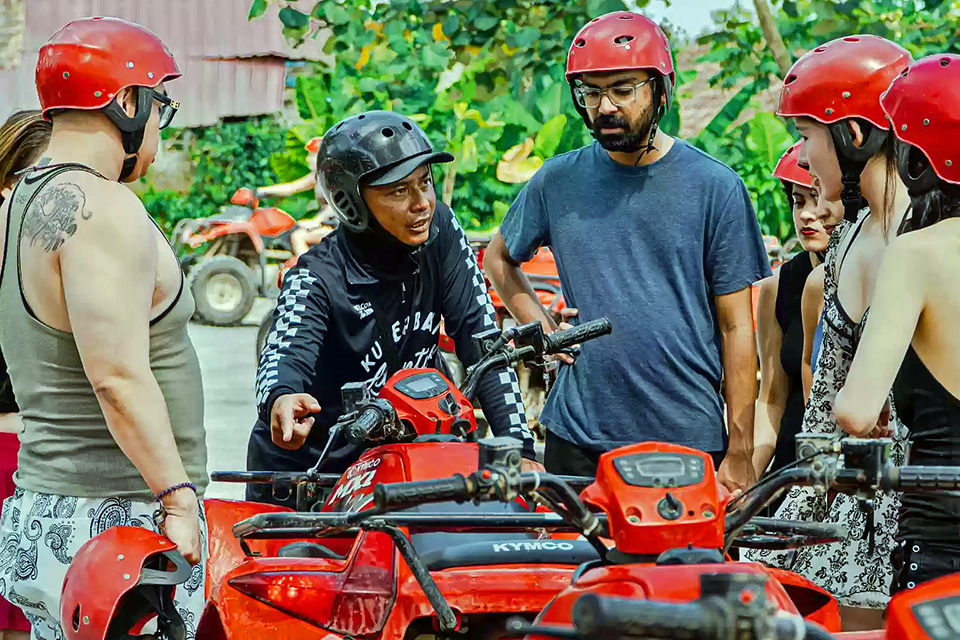
At the basecamp, you’ll be fitted with a helmet, goggles, gloves, and a protective jacket or vest. Shoe covers are often provided to keep your footwear clean, though experience suggests that no footwear survives a full muddy trail entirely intact — closed shoes are strongly recommended over sandals regardless of covers. The safety briefing runs 15 to 20 minutes and covers machine controls, hand signals, trail rules, and what to do if your ATV stalls or gets stuck. Pay attention: the information is directly useful.
The Practice Loop
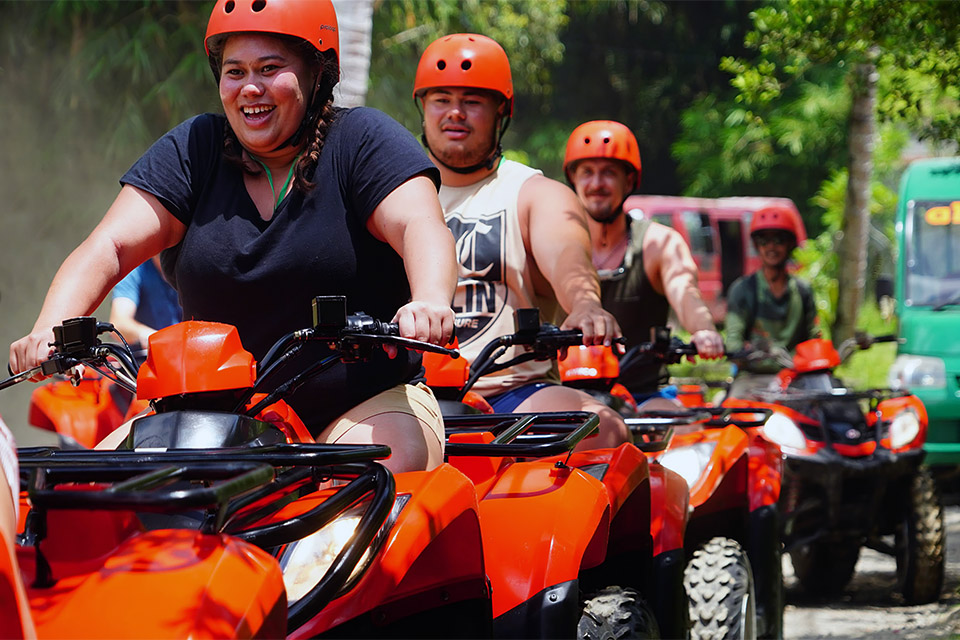
Nearly every reputable operator runs a short practice circuit within the basecamp perimeter before heading to the main trail — typically a flat 200-metre loop that lets you feel the throttle, test the brakes, and practise turning. First-time riders almost universally report that the machine felt more manageable than expected within the first two minutes.
On the Trail
The main trail is where the experience earns its price. A well-designed Ubud route moves through at least four or five distinct environments in the first 30 minutes alone — a plantation access road giving way to a jungle canopy track, opening briefly to a terrace edge view, then dropping into a creek crossing before rising again into village lane. The guide leads at a pace that keeps the group together but doesn’t feel forced. You’ll stop at two or three points for photos and water breaks; guides tend to know exactly where the light is good and where the view justifies a pause.
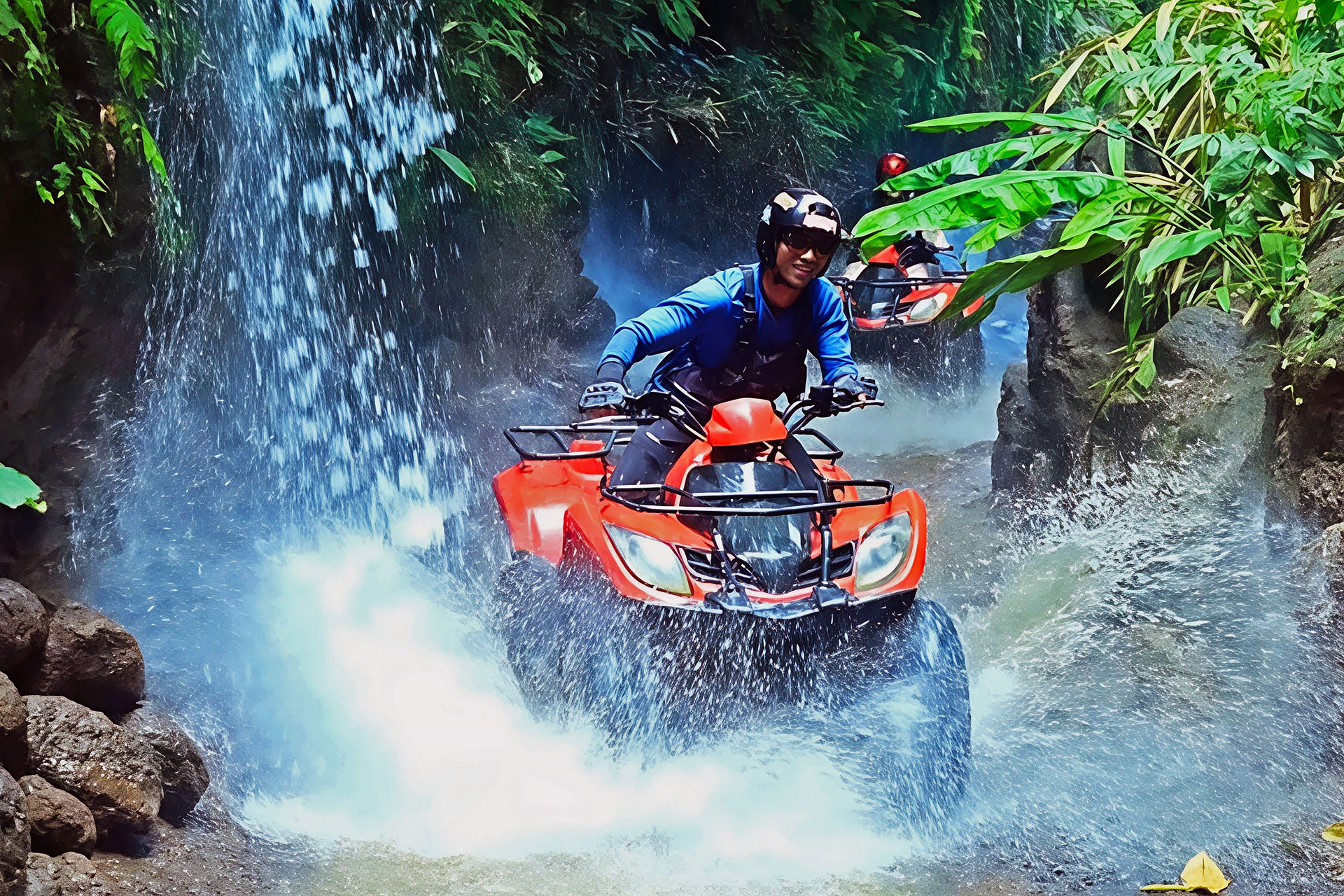
The river crossing, where present, is the moment that most riders remember. The water typically runs between 30 and 60 centimetres deep depending on the season, and the riverbed is usually smooth volcanic stone. The machine pulls through it without drama if you maintain steady throttle — the instinct to slow down is the wrong instinct. Go steadily, don’t brake in the water, and trust the machine’s weight. Your guide will demonstrate first.
The instinct at the river crossing is to slow down. It’s the wrong instinct. Steady throttle, trust the machine’s weight, and don’t brake in the water.
Post-Ride
Back at the basecamp, outdoor showers and changing rooms are standard. Soap, shampoo, and towels are usually provided. The mud comes off more easily than it looks, though red volcanic earth has a particular relationship with white clothing that no shower entirely resolves — pack a change of clothes and don’t wear anything you’d miss. Lunch or a light Balinese meal is served at most mid-range and premium operators, typically nasi goreng, mie goreng, fresh fruit, and coffee or tea. The food is usually simple and genuinely welcome after two hours of riding.
Seasonal Considerations: Wet Season vs Dry Season
Bali has two clearly defined seasons, and both are fine for ATV tours — with adjustments in expectation.
The dry season runs from May through October. Trails are firm, dust is occasional, visibility is excellent, and the rice terraces are often at their most photogenic in July and August when lower fields are freshly planted and the upper fields are golden-green. Mornings are clear, and the temperature on the trails sits between 26 and 31°C at Ubud-area elevations. This is the most comfortable period to ride.
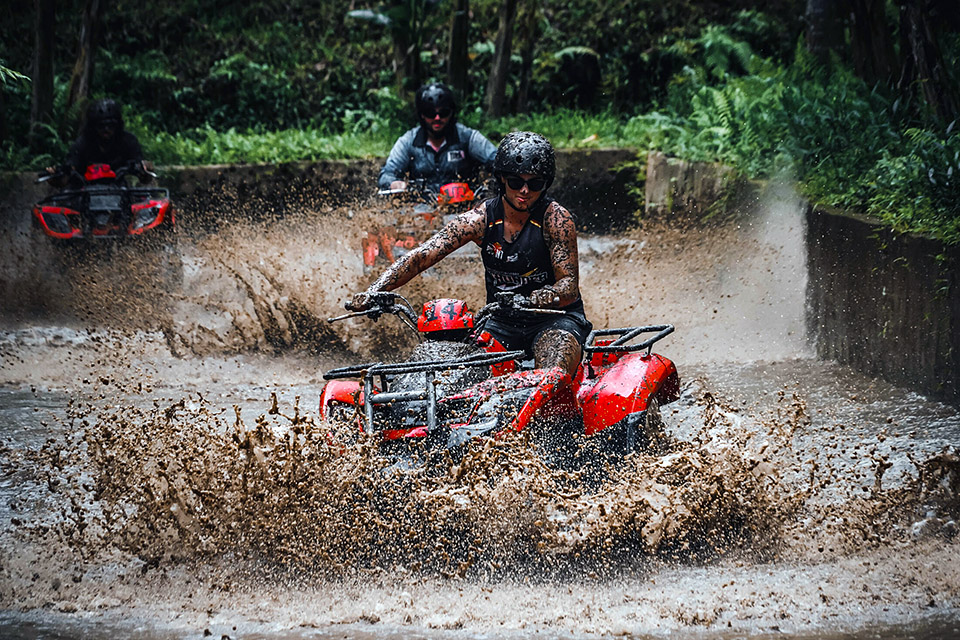
The wet season, November through April, brings daily rainfall — usually in the afternoon, sometimes in the morning. The trails become dramatically muddier, the jungle turns an almost unrealistic shade of green, and the rivers run faster and fuller. This is, in the view of riders who have done both, often the more memorable experience. The mud is not a problem to be tolerated; it’s part of the experience.
Operators continue running tours through the wet season; routes may be slightly shortened on heavy-rain days, and river crossings are skipped if water levels are unsafe. Trust the operator’s judgment on this — they know their trail conditions better than any weather app.
SEASON |
TRAIL CONDITIONS |
SCENERY |
TEMPERATURE |
BOOKING DEMAND |
|---|---|---|---|---|
Dry (May–Oct)
|
Firm, dusty sections
|
Clear views, vivid green
|
26–31°C
|
High — book ahead
|
Wet (Nov–Apr)
|
Deep mud, river higher
|
Intense green, mist possible
|
24–28°C
|
Lower — flexible walk-in
|
What to Wear and Bring
The packing list for a Bali ATV tour is short.
Most of what you need is either provided or obvious.
What trips people up is the clothing question.
Wear clothes you don’t mind getting muddy — specifically, clothes that you’re comfortable being mud-stained. Long sleeves are a reasonable choice on the trail for sun protection and minor scratch prevention from overhanging branches; short sleeves are equally fine if you’re comfortable. Shorts work. Jeans don’t — they become heavy, chafe when wet, and take 48 hours to dry.
Footwear is important: closed-toe shoes or trainers, not sandals or flip-flops. The foot pegs are grippy but require a sole, and getting a flip-flop caught in terrain mid-ride is a real inconvenience. Don’t borrow someone’s old trainers for this — wear something that fits properly.
- Change of clothes and underwear.
- A small dry bag or ziplock for your phone if you want to photograph from the trail.
- A hair tie if you have long hair.
- Sunscreen applied before departure — the gear covers your face but not your neck and forearms.
- Any prescription medication if the activity duration extends to 3+ hours.
Leave watches, rings, and any jewellery at the hotel. The mud is genuinely thorough, and small items disappear into it with no fuss and no recovery.
Insider's Tips — What to Wear and Pack
- Old dark clothes only — volcanic mud stains are permanent on light fabrics.
- Closed shoes, not sandals — foot pegs require sole contact; flip-flops are a hazard.
- Dry bag for your phone — a ziplock bag inside a pocket works fine; waterproof cases are better.
- Leave jewellery behind — rings and watches disappear in mud and don’t come back.
- Apply sunscreen before departure — you won’t reapply on the trail, and exposed neck/forearms burn quickly.
ATV Tours Combined with Other Activities
The most efficient way to use an ATV tour is as a morning activity, leaving the afternoon free for something slower. The typical ATV day runs 7:30am to 1:00pm including transfers and lunch — which leaves a clean half-day for a waterfall, a temple, a cooking class, or simply the hotel pool.
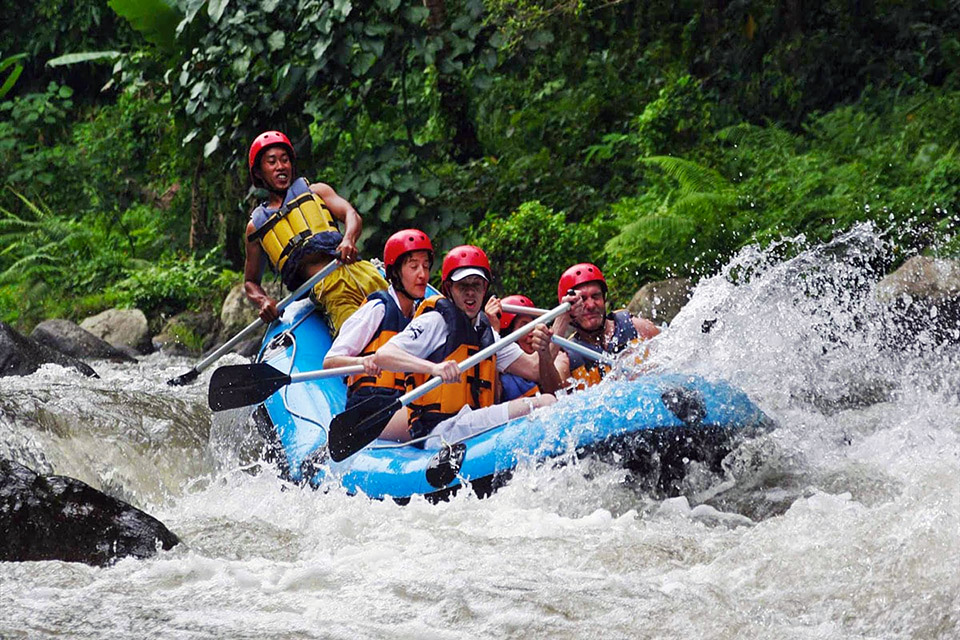
Several operators now offer combination packages that pair ATV with rafting on the Ayung or Telaga Waja rivers. These are long days — usually 7am to 4pm — but they cover the two best active outdoor experiences in central Bali in a single outing. The combination makes particular sense for visitors who have limited time in Ubud, or who want to pack a high-activity day between quieter beach or temple days.
A less-marketed but very worthwhile combination pairs ATV riding in the Bedugul highlands with a visit to Ulun Danu Beratan temple on the same day. The logistics require a private driver, but the contrast between fast, muddy trail and serene lakeside temple is more interesting than it sounds. Leave the highlands by 11am, lunch near the lake, visit the temple in the afternoon light. You’ll have mud under your fingernails while sitting at one of Bali’s most peaceful religious sites, which is its own kind of interesting.
ATV Tours in Bali vs Other Bali Adventures: An Honest Comparison
Where does ATV quad biking sit in the landscape of Bali’s outdoor activities? It’s a genuine question for visitors trying to allocate limited days.
ACTIVITY |
DURATION (FULL DAY INCL. TRANSFER) |
FITNESS REQUIRED |
PRICE RANGE (PER PERSON) |
BEST FOR |
|---|---|---|---|---|
ATV Quad Bike (Ubud)
|
Half-day (5–6 hrs)
|
Low
|
IDR 500k–1.1M
|
Adrenaline + scenery, all abilities
|
White Water Rafting (Ayung)
|
Half-day (5–6 hrs)
|
Low–moderate
|
IDR 400k–850k
|
Groups, adrenaline, gorge scenery
|
Rice Terrace Cycling (Ubud)
|
Half-day (4–5 hrs)
|
Low (mostly downhill)
|
IDR 350k–700k
|
Scenic, slower pace, cultural
|
Full day (7–8 hrs)
|
Moderate–high
|
IDR 350k–600k
|
Views, achievement, early risers
| |
Bali Swing
|
2–3 hrs
|
None
|
IDR 250k–500k
|
Photography, short activity
|
The ATV’s particular advantage is its low barrier to entry combined with a high reward-to-effort ratio. You get two hours of genuine off-road terrain without requiring fitness, experience, or an early alarm clock. For visitors who want something more active than a temple visit but less demanding than a pre-dawn volcano hike, it occupies an uncrowded and genuinely satisfying middle ground.
Safety, Responsible Riding, and Environmental Notes
ATV tour safety in Bali has improved considerably over the past decade as the industry professionalised. The incidents that do occur almost always trace back to the same few causes: riders ignoring guide instructions, attempting speeds above trail conditions, or going out with an operator who skimped on the briefing.
Follow the guide. This sounds like obvious advice, but it carries specific meaning on an ATV trail: maintain the gap between riders that the guide sets, do not overtake, and do not adjust your speed upward simply because the machine feels capable of more. The machine can go faster than the trail safely allows. The guide knows this. Trust that knowledge.
On the environmental side, responsible operators keep their trails within established land agreements with local farmers and village heads. The rice paddies you ride beside — not through — are active agricultural land. Reputable operators are strict about staying on the marked trail, and guests should resist any temptation to cut corners through field margins. The relationships between ATV operators and local communities depend on the activity remaining minimally disruptive to agricultural cycles.
Choose operators who participate in trail maintenance and who employ local guides. The economic benefit of ATV tourism to highland villages around Tegallalang and Payangan is real and direct — guides, mechanics, cooks, and drivers in these communities earn livelihoods that depend on the activity being done well.
The machine can go faster than the trail safely allows. The guide has ridden this trail five hundred times and knows where that limit is. Trust that knowledge.
Booking: When and How
In the dry season peak (July and August), popular Ubud-area operators fill their morning slots three to five days in advance. Book at least three days ahead, preferably a week, if you have a specific date in mind. Shoulder season (May, June, September, October) allows for two to three days’ notice comfortably. Wet season visitors can often book the day before with no difficulty.
Booking directly with the operator — via their website, WhatsApp, or through a trusted Bali DMC — is almost always preferable to third-party platforms, which add 15 to 25 percent commission to the listed price and provide limited support if something needs to change on the day. A simple WhatsApp message with your hotel, party size, and preferred date is the standard booking method for most mid-range operators and takes about 10 minutes to confirm.
If you’re staying in a villa with a butler or in a hotel with a concierge, ask them for a recommended operator — the good ones have relationships with specific trail operators and can often negotiate a better rate than you’d get independently. This is one of the few cases where using an intermediary genuinely adds value.
Plan Your Bali Trip Now
There is a particular kind of satisfaction that comes from a physical activity set inside a beautiful place — where the landscape is not just a backdrop but the actual point of being there. Bali’s ATV quad bike tours land in that category when they’re done well. The rice terraces are more affecting at wheel height than from a viewing platform. The jungle is more present when it’s brushing your elbows. The river is more alive when you’re crossing it rather than photographing it from above.
The activity has matured in the two decades since the first operators opened in the Tegallalang valley. The machines are better, the routes are longer, the safety infrastructure is genuine. What hasn’t changed is the terrain itself — the red-brown volcanic mud, the bamboo tunnels, the sudden views across valleys that still take your breath away even when you’re gripping a handlebar and covered in the Balinese countryside.
Book the longer route. Go in the morning. Wear clothes you don’t mind losing.
💡Related reads:
FAQ
Do I need a licence or prior experience to ride an ATV in Bali?
No. Bali ATV tours do not require a motorcycle or vehicle licence. The machines are automatic or semi-automatic and are introduced via a safety briefing and practice loop at the basecamp. The vast majority of riders have no prior experience and manage the trail without difficulty.
What is the minimum age for Bali ATV tours?
Most operators set a minimum age of 7 to 10 years for children riding as passengers on a tandem ATV. Children aged 12 and above can typically ride solo on smaller 125cc or 150cc machines at operators that offer them. Always confirm the specific age policy when booking — it varies between operators.
Is there a weight limit?
Most Bali ATV operators apply a maximum weight limit of 120 to 150 kilograms per rider for solo ATVs, and a combined limit of around 150 to 180 kilograms for tandem machines. If you’re close to these limits, confirm directly with the operator before booking — this is a safety parameter, not a policy they apply inconsistently.
Can I go ATV riding during the rainy season?
Yes. ATV tours run year-round in Bali, including during the wet season (November to April). Trail conditions are muddier and river crossings may be modified or skipped on heavy-rain days, but the experience remains fully operational. The wet season brings its own aesthetic to the jungle and rice terrace landscape that many riders prefer.
How muddy does it actually get?
Very. On a wet-season trail or on any trail in the days after rain, expect to be substantially mud-covered by the end of the ride. Helmets and goggles protect the face, but arms, legs, and clothing take the full effect. Showers and changing facilities at the basecamp are standard — bring a change of clothes and wear nothing you’d be upset about losing to a permanent mud stain.
Is the ATV experience different for solo riders versus tandem riders?
Meaningfully, yes. Solo riders control the machine, set their own pace within the guide’s rhythm, and have a more physically engaged experience. Tandem riders — the passenger on a two-person ATV — have a more passenger-like experience that is still immersive and scenic but involves no driving. For children and nervous first-timers, tandem is often the smarter entry point; it can be followed by a solo session on the practice loop at the end of the trail if interest develops.
What's the difference between a 1-hour and a 2-hour ATV tour?
Beyond the obvious duration difference, the route depth changes substantially. One-hour tours typically cover 8 to 12 kilometres and may include only one or two terrain types. Two-hour tours cover 15 to 22 kilometres and usually include the full range — rice terraces, jungle canopy, plantation, river valley, and village. The river crossing is usually only present in 2-hour+ routes. If the experience is the point, not just the checkbox, choose the longer option.
Should I book online in advance or book locally in Bali?
Both work, but the approach differs. Online booking through an operator’s own website or a trusted DMC is recommended for peak season (July–August) when slots fill quickly. Outside peak season, booking 2 to 3 days ahead via WhatsApp with the operator directly is usually faster, cheaper, and more flexible than pre-trip online booking.
Are there any health conditions that would prevent someone from doing this?
Significant back, neck, or knee problems warrant caution — the vibration from two hours of off-road terrain is substantial and can aggravate existing conditions. Pregnancy is a contraindication that all reputable operators will apply without exception. Heart conditions that restrict physical exertion should be discussed with a physician before booking. Beyond these, the activity is broadly accessible to most healthy adults.
What should I do with my valuables during the tour?
Leave them in the transfer vehicle or in a secure locker at the basecamp. Do not bring anything into the trail that isn’t in a dry bag or ziplock inside a secured pocket. Phones are the one common exception — a waterproof case and a secure trouser pocket are standard practice. Wallets, passports, and unprotected electronics have no place on a muddy trail.