Ubud Monkey Forest Tickets – Nestled in the heart of Ubud, the Sacred Monkey Forest Sanctuary is more than just a tourist attraction — it’s a living, breathing symbol of Bali’s deep connection to nature, spirituality, and culture. Travelers from around the world are drawn here not only to see the lively troops of long-tailed macaques but also to wander through ancient temples, mossy stone carvings, and lush jungle pathways that feel like stepping into another world.
But many first-time visitors ask the same question: Are Ubud Monkey Forest tickets really worth the price? This article will help you uncover the answer by exploring every angle — from ticket costs and what’s included, to the unique blend of culture, wildlife, and sacred tradition you’ll encounter inside. Along the way, we’ll highlight how the Monkey Forest embodies the Balinese philosophy of harmony with nature, compare its value to other attractions in Bali, and share practical tips to make the most of your visit.
By the end, you’ll know exactly why this sanctuary remains one of the best attractions in Ubud — and whether it deserves a spot on your Bali itinerary.
Why Talk About Ubud Monkey Forest Tickets?
Few places in Bali spark as much curiosity as the Sacred Monkey Forest Sanctuary in Ubud. As one of the island’s most visited attractions, it invites travelers into a lush green world where culture, spirituality, and nature intertwine. Yet for many planning their Bali trip, a lingering question often arises: Are Ubud Monkey Forest tickets really worth the price?
At first glance, some might see it as just another tourist stop where visitors pay an entrance fee to watch playful macaques. But the truth runs much deeper. The Monkey Forest is not only home to hundreds of long-tailed macaques but also a sacred sanctuary dotted with ancient temples, mystical statues, and centuries-old trees that embody the spirit of Ubud. In this article, we’ll take an honest look at what the ticket truly offers and why it has earned its place as a must-experience Ubud attraction.
How Much Do Ubud Monkey Forest Tickets Cost?
Hovering between IDR 80,000 and 120,000, Ubud Monkey Forest ticket prices shift gently with the rhythm of the week—weekdays tend to whisper a softer rate, while weekends ask a bit more. For international adults, expect to pay around IDR 100,000 on weekdays and IDR 120,000 on weekends, while children aged 3–12 are admitted for about IDR 80,000 (weekdays) and IDR 100,000 (weekends). These rates mirror the domestic tiers, sometimes slightly lower, depending on the day.
To put it in perspective, nearby attractions range from the gentle forms of Balinese dance at Ubud Palace (approx. IDR 20,000) to the more vivid natural spectacle of Bali Bird Park (approx. IDR 385,000). So, the entrance fee itself strikes a humble chord—neither extravagant nor trivial.
But the cost is not mere currency exchanged at a gate—it sustains the forest’s heartbeat. Every ticket nurtures conservation efforts, temple upkeep, and the sacred balance of culture and nature. This fee is a respectful offering that keeps the moss-draped temples, ancestral trees, and mischievous macaques thriving in their timeless dance under Bali’s ancient canopy.
More Than Just Monkeys
At first glance, many visitors imagine that Ubud Monkey Forest tickets include little more than a chance to watch macaques scamper through the trees. Yet stepping beyond the gate reveals an experience far richer—a blend of living jungle, sacred temples, and the rhythms of Balinese culture.
The moment you enter, the forest embraces you. Shafts of sunlight filter through towering banyan and nutmeg trees, the air alive with the chatter of monkeys and the rustle of leaves overhead. Smooth stone pathways wind safely through the sanctuary, leading you deeper into its heart. Along the way, local guides share quiet insights, helping you see the forest not as a tourist stop, but as a sanctuary where nature and spirit walk hand in hand.
Perhaps the most enchanting surprise is discovering what you get with the ticket beyond the wildlife. Hidden among the trees are three ancient temples—each alive with incense, moss, and whispered prayers. At Pura Dalem Agung, guardian statues stand watch, while the Holy Spring Temple radiates an aura of cleansing and renewal. Near the Prajapati Temple, life and death intertwine, echoing the Balinese belief in harmony and balance.
In this way, the forest becomes an Ubud cultural experience unlike any other. With a single ticket, you gain access not just to nature, but to centuries of devotion, artistry, and the sacred bond between humans and the divine.
The Monkeys: A Fascinating Look Into Nature
The main reason many travelers come is to see monkeys in Ubud, yet the encounter is far more captivating than most expect. Inside the sanctuary, hundreds of long-tailed macaques in Bali thrive in their own world—playful, curious, and deeply bound to the forest around them.
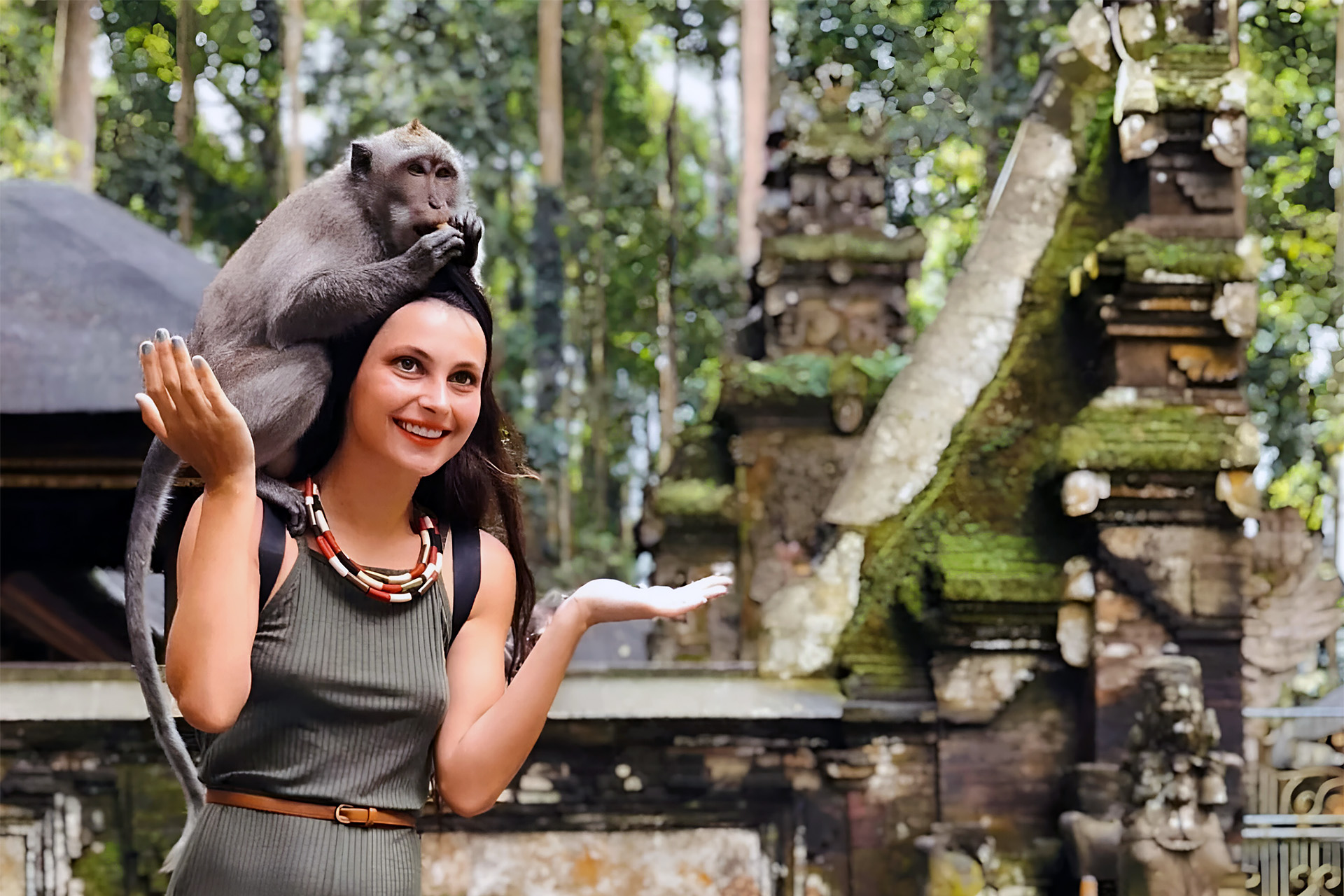
As you walk the shaded trails, you’ll notice tender scenes that feel almost human: a mother gently grooming her infant, or young monkeys tumbling together in a blur of energy. At times, one might hop onto a railing beside you, tilting its head as if to study you with equal curiosity. Unlike their mischievous cousins in Uluwatu, the macaques here are generally more gentle, often content simply to watch or approach calmly when they sense trust.
The beauty lies in observing them in their true natural habitat. Each moment reveals the complex rhythms of their society—hierarchies, bonds, and unspoken rules of coexistence. And your entrance fee plays a vital role in keeping this harmony intact. Every ticket contributes to food programs, health checks, and conservation, ensuring that future generations of visitors can witness these lively interactions under the ancient canopy of Ubud.
The Spiritual Side: Ancient Temples Inside the Forest
Beyond the chatter of monkeys and the rustle of banyan leaves, the forest shifts into silence, guiding you toward its sacred heart. Here lie the ancient temples in Ubud Monkey Forest, sanctuaries where moss-covered stones breathe history and devotion lingers in the air. These temples are not museum relics but living spaces of worship, deeply bound to the pulse of Balinese culture.
The largest, Pura Dalem Agung, rises with weathered guardian statues draped in black-and-white cloth. The air carries the fragrance of burning incense, sweet and earthy, while the faint sound of gamelan from a nearby village sometimes drifts through the trees. At the Holy Spring Temple, water trickles steadily from dragon-headed fountains, its sound mingling with the quiet chants of locals seeking purification. Then there is the Prajapati Temple, near the village cemetery, where the stillness is heavier, echoing the Balinese philosophy of life, death, and eternal renewal.
To stand in these spaces is to feel a spiritual experience unlike any other—a harmony of nature, prayer, and tradition. In this light, your ticket becomes more than just entry to a wildlife sanctuary; it is a humble offering that preserves rituals, sustains community, and allows travelers a rare glimpse into Bali’s soul.
Human–Nature Relationship in Balinese Culture
Walking through the Monkey Forest, it soon becomes clear that this is more than a place to observe wildlife—it is a living embodiment of Balinese culture and nature intertwined. Every pathway, every tree, every temple reflects the island’s guiding philosophy of Tri Hita Karana Ubud: the harmony between humans, the natural world, and the divine.
You feel this balance in subtle ways. The monkeys move freely, never caged, yet their presence is gently guided by the guardians of the forest. Ancient trees rise like silent witnesses, their roots coiling around stone shrines as if binding nature and spirit together. Visitors pause, lowering their voices, sensing an unspoken respect that permeates the sanctuary. Even the fragrance of flowers offered at temple altars mingles with the earthy scent of damp soil, reminding you that rituals here are inseparable from the land itself.
By paying the ticket fee, you become part of this harmony. Each contribution supports conservation, temple upkeep, and community efforts that ensure the forest remains whole. The experience is not just about watching macaques or exploring ruins—it is about joining in a centuries-old covenant of harmony with nature, where your presence and respect help sustain Bali’s most cherished values.
Comparing to Other Attractions
When travelers consider the best attractions in Ubud, the list often includes the emerald rice terraces of Tegallalang, the thundering cascades of Tegenungan, and the tranquil beauty of Tirta Empul’s holy springs. Each of these places offers something extraordinary—whether it’s the artistry of agriculture, the raw force of nature, or the serenity of ritual. Yet, the Ubud Monkey Forest stands apart.
Here, for a modest fee, you are invited into a world where wildlife, culture, and spirituality converge. Few destinations allow you to lock eyes with a mischievous macaque, step beneath banyan roots draping over mossy stone gates, and witness daily offerings laid at temple shrines—all within the same journey. The atmosphere feels alive, layered with stories and sensations that shift with every turn of the path.
From a practical perspective, the ticket is worth the price when compared not only to other local sites but also to global attractions. While famous zoos or cultural parks elsewhere can cost several times more, the Monkey Forest delivers both intimacy and authenticity at a fraction of the cost. For travelers seeking value for money in Bali, few experiences offer such a rare blend of natural wonder, cultural depth, and spiritual presence.
Practical Tips to Maximize Your Visit
To truly get the most out of your ticket, a few simple Ubud Monkey Forest tips can transform your experience from ordinary to unforgettable. The best time to visit Monkey Forest is early morning, just after the gates open. At this hour, the pathways are quieter, the light filters beautifully through the banyan canopy, and the monkeys are more playful than aggressive.
When it comes to safety with monkeys in Ubud, remember one rule above all: never feed them. Carrying visible snacks, dangling sunglasses, or loose bags can quickly invite cheeky mischief. Keep your belongings zipped, avoid direct eye contact if a monkey climbs onto you, and move calmly—staff are always nearby to help if needed.
Since the forest is also a sacred temple complex, modest attire is encouraged. Shoulders and knees covered show respect, particularly if you step near shrines where daily offerings are placed. If you’d like deeper insight, consider joining a local guide—many share fascinating stories about the forest’s spiritual role and the monkey clans’ behavior patterns.
With these tips, your visit flows with ease, balancing both adventure and respect, ensuring your time in the Monkey Forest becomes a highlight of your Bali journey.
Final Verdict
Yes, Ubud Monkey Forest Tickets Are Worth It.
When weighing the experience, it’s clear that Ubud Monkey Forest tickets are worth it for far more than simply watching monkeys. A visit combines playful encounters with these curious creatures, a serene walk through ancient banyan trees, and a deep sense of cultural immersion among centuries-old temples. Beyond the beauty, your entry fee also contributes to vital conservation and community efforts, ensuring this sacred site thrives for generations to come.
If you’re asking yourself why visit Ubud Monkey Forest, the answer is simple: it’s one of the rare places in Bali where nature, spirituality, and cultural heritage blend seamlessly into a single experience. Whether it’s your first trip to the island or a return journey, make sure to add Ubud Monkey Forest to your Bali itinerary—it’s a highlight that captures the true soul of the island.
FAQ about Ubud Monkey Forest Tickets
1. How much is the ticket for Ubud Monkey Forest?
As of 2025, Ubud Monkey Forest tickets are IDR 80,000 for adults and IDR 60,000 for children. Prices may change slightly during peak seasons.
2. Where can I buy Ubud Monkey Forest tickets?
Tickets can be purchased directly at the entrance or online through the official Monkey Forest Ubud website for added convenience.
3. What are the opening hours of Ubud Monkey Forest?
The forest is open daily from 9:00 AM to 6:00 PM, with last entry allowed at 5:00 PM. Morning visits are generally quieter.
4. How much time do I need to explore Monkey Forest Ubud?
Most visitors spend around 1.5 to 2 hours exploring the forest, temples, and walking paths at a comfortable pace.
5. What is the best time to visit Monkey Forest in Ubud?
The best time to visit is early morning (9:00–10:00 AM) when the forest is peaceful, cooler, and less crowded.
6. Is Ubud Monkey Forest safe for children?
Yes, children are welcome, but parents should supervise them closely around monkeys and temple areas for safety.
7. What should I wear when visiting Monkey Forest Ubud?
Wear comfortable clothing and walking shoes. If you plan to enter temple areas, modest attire covering shoulders and knees is required.
8. Can I bring food or drinks into Ubud Monkey Forest?
It’s best not to carry food or drinks inside, as monkeys may try to grab them. Water bottles are fine if kept inside a bag.
9. Are there guided tours available in Ubud Monkey Forest?
Yes, guided tours are available and highly recommended to learn about Balinese culture, temple history, and monkey behavior.
10. Why visit Ubud Monkey Forest instead of other Bali attractions?
Ubud Monkey Forest is unique because it blends wildlife, ancient temples, and Balinese spirituality — offering far more than just a nature walk.