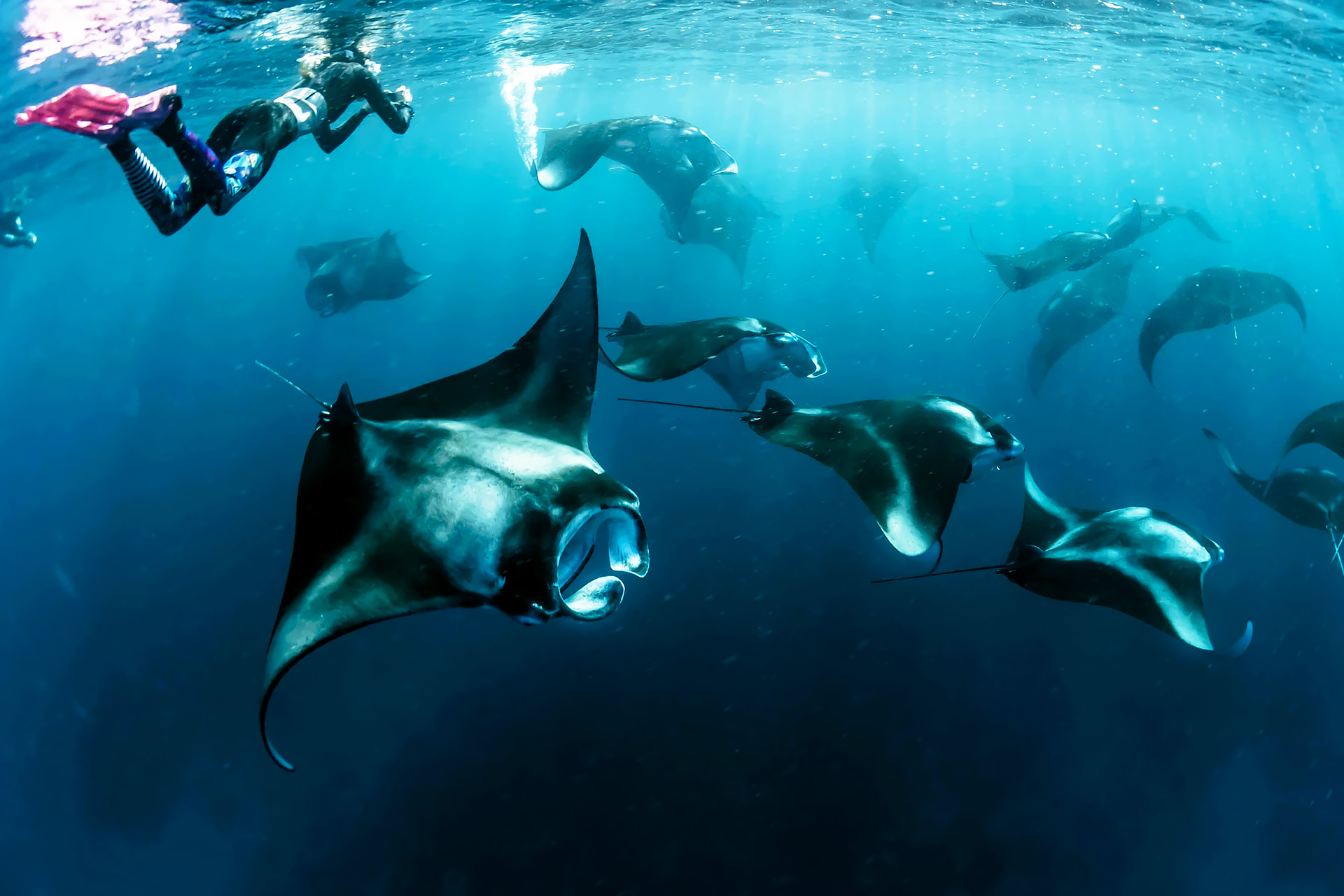
Snorkeling with Manta Rays in Nusa Penida – The boat rocks gently as it slows, turquoise water sparkling like glass around you. You slip over the side, the first rush of cool ocean washing over your skin. For a moment, all you see are bubbles and shifting light beams, the sea holding its breath. Then—out of the blue—a shadow forms below. It grows larger, wider, wings unfurling in slow motion. A manta ray.
It glides toward you with the grace of something timeless, sweeping its fins like a bird soaring underwater. Your heartbeat races, but the creature is calm, almost curious. In silence, you share the same current, its wingspan dwarfing your body, its movements hypnotic. You forget the world above the surface. In that instant, you’re not just snorkeling—you’re stepping into a memory that will stay with you forever.
To swim with manta rays in Nusa Penida is to meet the ocean at its most graceful.
This is why travelers come from across the globe to experience snorkeling with manta rays in Nusa Penida. Not just to check another adventure off a list, but to feel what it means to be small in the presence of something so effortlessly majestic. It is not a thrill; it is a communion.
The Manta’s Haven
If Bali is known for its temples and rice terraces, then Nusa Penida has carved its name on the map for one extraordinary reason: its manta rays. These giants of the sea are unlike anything else you’ll encounter while snorkeling in Bali. With wingspans stretching up to 7 meters, they move with a grace that feels more like dancing than swimming, soaring through the ocean’s currents as if the water were air.

And yet, despite their size, mantas are gentle beings. They have no stingers, no teeth meant to bite. Instead, they glide peacefully, feeding on clouds of plankton carried by the tides. Watch long enough, and you’ll see them loop and circle, scooping invisible feasts into their wide, open mouths—a performance of both elegance and survival.
What makes Nusa Penida manta ray snorkeling so special is reliability. While encounters with wild creatures are never guaranteed, here the odds are in your favor.
Manta Bay offers shallow waters where snorkelers often meet these giants close to the surface, while Manta Point—a deeper site favored by divers—serves as a year-round cleaning station where mantas gather to be tended by tiny reef fish.
This is what sets Nusa Penida apart. In other corners of Bali, you’ll find colorful coral gardens, teeming schools of fish, and perhaps even sea turtles. But here, just a short boat ride from the mainland, you have the rare chance to swim with manta rays in Bali—an encounter so moving that it makes even the most vibrant coral pale in comparison.
To be in Nusa Penida is to be in one of the few places in the world where meeting the ocean’s most graceful giants is not a dream, but a likely reality.
Manta Bay vs. Manta Point
Every manta ray encounter in Nusa Penida feels like a gift from the ocean, but not all sites offer the same kind of experience. Two locations in particular—Manta Bay and Manta Point—are the heart of this magic, each with its own personality and rhythm.
Manta Bay is where many first-timers find themselves. Just a short boat ride from Toya Pakeh harbor, its shallower waters and relative proximity make it more accessible, especially for those new to snorkeling.
The visibility at Manta Bay often allows snorkelers to see mantas gliding just beneath the surface, their vast wings silhouetted against the turquoise light. When they circle up close, it feels as if the sea itself has opened a door and invited you inside.
Further out, in deeper, wilder seas, lies Manta Point. This site is less forgiving—currents can be strong, the surface choppier, and the journey longer. But for those who venture here, the reward is profound. This is a natural cleaning station, where manta rays gather in larger numbers, hovering almost still while tiny reef fish tend to them. It is an underwater ballet, a ritual as ancient as the ocean itself. Divers in particular prize this spot, though snorkelers can sometimes share the stage if conditions allow.
For those wishing to round out their day, nearby Crystal Bay and Gamat Bay add another layer of wonder. Their coral gardens shimmer with life—parrotfish, angelfish, and sometimes even a sea turtle drifting lazily by. After the majesty of mantas, these sites remind you that the ocean’s beauty lies both in its giants and its small, jeweled details.
Insider’s Tips: Best Time to Spot Manta Rays
- When to go: Calm mornings are ideal, when the seas are gentler and visibility clearer.
- Season: Manta sightings happen year-round, but the dry season (April–October) offers calmer seas and higher chances.
- Avoid: Windy afternoons, when currents grow stronger and boats may struggle to maintain position.
What the Experience Feels Like
The moment you slip into the water, the world shifts. The chatter from the boat fades, replaced by the steady rhythm of your breath through the snorkel. Sunlight filters down in golden streaks, dancing across the surface as you kick gently toward the shadows below. Your heart beats louder than the ocean at first—nerves mingling with anticipation.
Then, suddenly, the shadow moves. Out of the blue expanse, a shape unfolds—a manta ray. Its wings stretch wider than your outstretched arms, wider even than a small car. It glides with impossible grace, not hurried, not bothered, just alive in a rhythm the ocean has always known.
For a moment, you forget to breathe. The manta sweeps past you, a living silhouette framed by shafts of light. Its movements are not just graceful; they are mesmerizing, like a bird flying in slow motion beneath the waves. You float, almost weightless, caught between awe and stillness.
And then you notice something else: calm. Despite its size, the manta is gentle. It doesn’t threaten, doesn’t rush. If anything, it seems curious—turning in slow circles, wings lifting and falling like a heartbeat of the sea. Fear dissolves into exhilaration, then into something quieter, more profound. It’s humbling to realize how small you are in its world, and yet how welcome.
For many first-timers, this is the revelation: snorkeling with manta rays in Nusa Penida is not about adrenaline, but about connection.
These giants are living reminders that wildness can also be peaceful, that beauty can be immense without being intimidating. In the silence of the water, as the manta glides past, you feel not just exhilaration, but gratitude.
Insider’s Insight: Safety & Etiquette in the Water
- Keep distance: Maintain at least 3–4 meters from mantas; let them approach if they choose.
- Follow guides: Local boat crews know the currents and best practices; trust their instructions.
- No touching: Their skin is sensitive—contact can harm their protective coating.
- Stay calm: Sudden movements or chasing can scare them away.
- Eco-respect: Use reef-safe sunscreen and never stand on coral.
Practical Guide
Snorkeling with manta rays in Nusa Penida is unforgettable, but it’s not something to do on your own. The island’s currents are among the strongest in Bali, and knowing where—and when—to find mantas requires local knowledge. Thankfully, tours are plentiful, ranging from quick half-day trips to full-day adventures that combine snorkeling with a taste of Nusa Penida’s land highlights.
Tours: Half-Day vs. Full-Day
- Half-day snorkeling tours (usually 3–4 hours) focus on manta encounters at either Manta Bay or Manta Point, often with add-on stops at coral gardens like Crystal Bay or Gamat Bay. These are perfect if you’re short on time or staying in Bali and want a quick crossing.
- Full-day trips (6–8 hours) go further. You’ll spend the morning in the water, then switch gears to explore dramatic land spots like Kelingking Beach or Broken Beach. This option is popular for those combining marine and coastal beauty in one sweep.
Costs: Group vs. Private
- Group tours (shared boats, 8–12 people) usually range between IDR 400,000–700,000 (USD 25–45) per person, depending on inclusions.
- Private charters start at around IDR 2,500,000 (USD 160) for the boat, offering flexibility, quieter moments, and longer water time.
What’s Included
Most operators provide snorkel, fins, and a life jacket. Some also offer towels, snacks, and drinking water. For photographers, a GoPro rental may be available. Still, it’s wise to confirm before booking, as equipment quality varies.
Safety First
Currents around Nusa Penida can be unpredictable and strong. That’s why guided tours are essential—not just for finding mantas but for ensuring you snorkel safely. Guides monitor conditions and keep you within safe zones. For non-swimmers or nervous snorkelers, flotation devices and life jackets are always on hand.
Respect the Mantas
As tempting as it may be to swim closer, mantas deserve their space. Always keep a respectful distance (at least 3–4 meters), never attempt to touch, and avoid blocking their path. By following these guidelines, you protect both yourself and the gentle giants you’ve come to see.
Insider’s Box: What to Bring for Your Snorkel Trip
- Reef-safe sunscreen (protects both you and the ocean).
- Rash guard or swim shirt (for sun protection + comfort).
- Reusable water bottle (stay hydrated between swims).
- GoPro or waterproof camera (to capture those once-in-a-lifetime moments).
- Dry bag (to keep your phone, wallet, and clothes safe on the boat).
Beyond Manta Rays
Long after your heart slows from the first manta encounter, the ocean around Nusa Penida still has stories to tell. Drift over coral gardens at Crystal Bay, where schools of reef fish flash in every imaginable color—parrotfish nibbling, angelfish weaving between coral spires, and damselfish darting in quicksilver bursts.
Look a little closer and you might catch a hawksbill turtle gliding lazily past, rising now and then to breathe before returning to the quiet safety of the reef. On lucky days, you may spot an eagle ray streaking through the blue, its movements faster, sharper, like a brushstroke of speed against the manta’s graceful arcs.

For those arriving between July and October, the waters sometimes reveal their most elusive guest: the mola-mola, or ocean sunfish. With its giant, almost alien form, it emerges from the depths to bask in the shallows, a reminder of how rare and surprising the ocean can be.
Every snorkel site feels like its own chapter—Manta Point with its giants, Crystal Bay with its shimmering reefs, Gamat Bay with its currents and kaleidoscope of marine life. Together, they make snorkeling in Nusa Penida not just a place to swim with manta rays, but a window into one of Bali’s richest marine ecosystems.
Insider’s Tips: Spotting More Than Mantas
- Crystal Bay → calm waters, rich coral gardens, turtles.
- Gamat Bay → stronger currents, but excellent for colorful reef fish.
- Toyapakeh → clear water, walls of coral teeming with life.
- Mola-Mola Season → best chance between July–October, with early morning dives.
Memory to Last a Lifetime
There are moments in travel that slip past the usual definitions of adventure and become something deeper. Snorkeling with manta rays in Nusa Penida is one of them. Long after the saltwater dries on your skin and the boat carries you back across the Bali Strait, the memory stays—the soft rhythm of their wings, the way sunlight turned the ocean into liquid gold, the humbling realization that you were allowed, for a brief moment, into their silent world.
The ocean gives many gifts, but swimming with manta rays in Nusa Penida feels like its most generous offering.
It’s not just the encounter that lingers, but how it changes you. To share space with a creature so immense, yet so gentle, is to feel both small and infinite at once. You’ll remember the hush when one swept past, close enough to trace its outline in your mind forever. You’ll remember climbing back onto the boat, lungs still catching up, heart still full, listening to the sea as though it carried a secret only you now knew.
Nusa Penida snorkeling tours offer many wonders—reefs alive with color, fish that shimmer like jewels—but the manta rays will remain the story you tell most often, the gift you never expected to be so profound. At HalloBALI, we believe these experiences deserve to be effortless and unforgettable. Our curated trips are designed to bring you face to face with these gentle giants while ensuring your safety and comfort.
Book your manta ray snorkeling journey with us, and carry home not just photographs, but a memory to last a lifetime.
FAQ
Still have questions? You’re not alone. These are the things most travelers wonder before snorkeling with manta rays in Nusa Penida — and the answers will help you step onto the boat with confidence.
Is it safe to snorkel with manta rays in Nusa Penida?
Yes. Manta rays are gentle filter-feeders with no stingers or teeth. The main safety concern is the sea itself — currents can be strong, so always go with a licensed guide.
Do I need to be a strong swimmer?
Not necessarily. Most tours provide life jackets and flotation devices, and guides stay nearby. Being comfortable in the water helps, but beginners are welcome.
When is the best time to see manta rays?
Manta rays are spotted year-round, but calm mornings in the dry season (April–October) offer the best visibility and conditions.
Can I guarantee manta ray sightings?
No wildlife encounter is ever guaranteed, but Nusa Penida is one of the most reliable places in the world to see mantas. Even if they don’t appear, you’ll enjoy vibrant coral gardens and tropical fish.
How long is a typical snorkeling trip?
Half-day trips last around 4–5 hours, while full-day tours can combine multiple snorkeling sites and even short land stops.
What should I bring with me?
Essentials include reef-safe sunscreen, a rash guard, towel, water bottle, and an underwater camera (like a GoPro) if you want to capture the experience.
Can I dive instead of snorkel?
Yes. Certified divers can join specialized trips to Manta Point for deeper encounters. If you’re not certified, snorkeling still brings you face-to-face with these giants in shallower waters.
Ready to turn these answers into memories?
HalloBALI curates safe, eco-friendly snorkeling tours that bring you closer to Nusa Penida’s gentle giants — without the stress of planning BOOK NOW.